
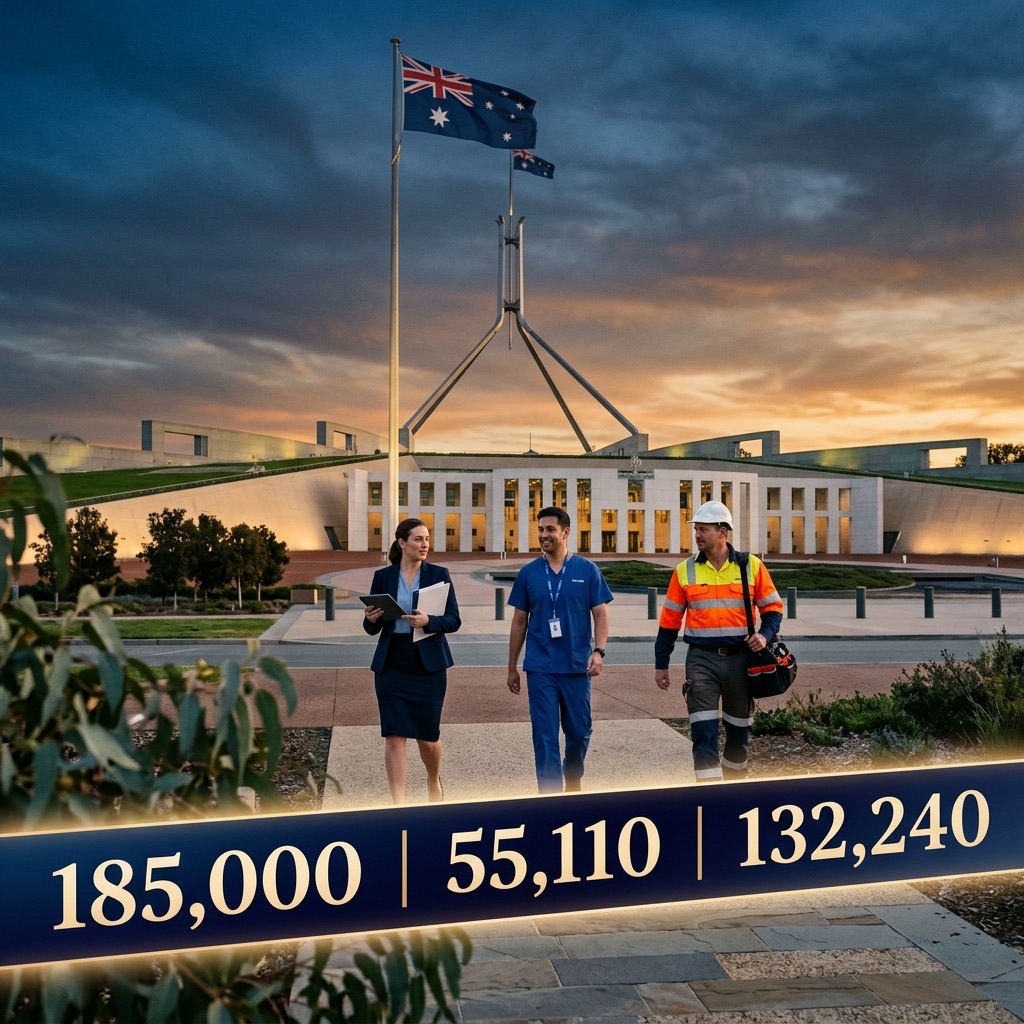
On 12 May 2026, Treasurer Jim Chalmers handed down the 2026-27 Federal Budget - and for Australian migration, it is the most significant single-night recalibration in years. The permanent Migration Program planning level is held at 185,000 places, unchanged from 2025-26. But the composition has shifted decisively: only 55,110 places are reserved for offshore applicants - the smallest offshore allocation in a decade - with the remaining ~129,890 places earmarked for people already onshore on temporary visas. The Skill stream is set at 132,240 places (just over 70% of the total), and the Government has formally committed to a points-test "optimisation" with a consultation paper in June 2026 and a draft legislative instrument by December 2026. This is the strategic read of what changed, who is most affected, and what you should do in the six weeks before the new programme year begins on 1 July 2026.
The Headline Numbers
The 2026-27 Migration Program holds steady on volume - but that headline disguises a meaningful redistribution. The 185,000-place ceiling is unchanged from the 2025-26 planning level, the same figure that has applied since 2023-24 under successive Budgets. What is new is where those places go. The 132,240 Skill stream allocation represents the largest skilled share in recent programme history; the offshore-only ceiling at 55,110 is the lowest single-year offshore figure since well before the COVID-19 reset. The Humanitarian Program is held at 20,000 places, the level set in 2023-24, despite a long-standing Labor Party platform commitment to progressively increase that ceiling to 27,000.
| Programme Element | 2025-26 Setting | 2026-27 Setting | Direction |
|---|---|---|---|
| Total Migration Program | 185,000 | 185,000 | Held |
| Skill Stream | ~137,100 (74%) | 132,240 (~71.5%) | Slightly down |
| Family Stream | ~52,500 | ~52,760 (residual) | Steady |
| Offshore Allocation | Higher | 55,110 | Sharp cut |
| Humanitarian Program | 20,000 | 20,000 | Held |
| Refugee + Settlement spend | - | $910.9 million | Stable |
Beyond the headline numbers, the Budget allocates $85.2 million to accelerate Trades Recognition Australia (TRA) skills assessments and occupational licensing reform, with a stated target of facilitating up to 4,000 additional skilled trades workers per year, primarily in construction and electrical occupations. A further $19.8 million over four years funds enhanced integrity scrutiny of both onshore and offshore student visa applications, layering on top of the existing Ministerial Direction 115 traffic-light processing model. The Treasurer's speech also flagged a forthcoming Ministerial Direction prioritising "highly skilled trades in construction and renewables" - the precise text is not yet public, but the policy direction is now on the record.
The onshore pivot is the dominant theme. With ~70% of 2026-27 places effectively reserved for applicants already in Australia on temporary visas - 485 graduates, 482 sponsored workers, 500 students transitioning out, 491/494 regional holders - the practical reality is that the fastest route to permanent residency under the new programme is via an onshore stepping-stone visa, not via offshore SkillSelect.
The Budget also re-confirmed the previously announced CSIT and SSIT threshold increases taking effect on 1 July 2026 under the standard Average Weekly Ordinary Time Earnings (AWOTE) indexation cycle. These thresholds drive employer-sponsored eligibility under the Skills in Demand (SID) framework. For more detail on how the points test side of the equation may shift, see our companion analysis: Points Test Overhaul Coming? What We Know About the 2026-27 Skilled Migration Reform.
Who Is Affected?
The 2026-27 settings hit different applicant cohorts very differently. The clearest winners are temporary visa holders already in Australia who are eligible for onshore transition. The clearest losers are offshore-only applicants without an Australian study or employment foothold. Here is the breakdown by audience segment.
Offshore Skilled Independent (Subclass 189) candidates are the most pressured cohort. The 189 visa has already endured a six-month invitation drought - no SkillSelect 189 round has been confirmed since 13 November 2025. The 55,110-place offshore ceiling now provides the structural reason: if the broader 2026-27 architecture prioritises onshore applicants by a 70/30 split, a purely offshore points-tested pathway is a smaller slice of a smaller pie. Candidates relying solely on a 189 EOI need to seriously reassess. Use our GSM Points Calculator to check whether your current score is competitive against the likely 2026-27 cut-offs, and read our companion piece on the 189 visa May 2026 drought update and action plan for the recalibrated diversification strategy.
Onshore Subclass 485 graduates are arguably the biggest beneficiaries of the new architecture. With 70%+ of places reserved for onshore applicants and a $85.2M trades acceleration package targeting construction and electrical trades, a 485 holder in an eligible trades occupation, allied health discipline, or in-demand ICT role is now in the strongest position the post-COVID migration system has produced. The realistic skilled migration pathway for many 485 holders is a sequence of: TRA or VETASSESS assessment (fast-tracked from 1 July 2026), state nomination 190/491 while onshore, or employer-sponsored 482 → 186 within the same financial year.
Subclass 482 (Skills in Demand) holders face two compounding pressures and one significant opportunity. The pressures are the 1 July 2026 increase in the Core Skills Income Threshold (CSIT) from $76,515 to $79,499 and the Specialist Skills Income Threshold (SSIT) from $141,210 to $146,717 - meaning any pending nomination lodged after 1 July will need to satisfy the higher salary floor. The opportunity is that the onshore-priority architecture makes the 482-to-186 (Employer Nomination Scheme) transition the single highest-volume PR conversion route in the 2026-27 programme year. Employers should lodge pending nominations before 1 July to lock in current thresholds; employees should review whether their sponsorship arrangements meet the upcoming higher floors.
International students on Subclass 500 visas face mixed news. The $19.8M integrity package signals more rigorous document verification and tighter financial-capacity checks, particularly for Evidence Level 3 nationalities (which have included India, Nepal, Bhutan and Bangladesh since January 2026). But the broader onshore-priority logic means that a student who completes their qualification in Australia, transitions to a 485 visa, and then meets the criteria for a skilled or employer-sponsored pathway is now operating inside the favoured cohort under the 2026-27 settings. Decision-ready Genuine Student (GS) evidence at application is critical - there is no longer any tolerance for shortcuts at the front end.
Family stream applicants - partner, parent, child - are largely insulated from the offshore-cap and Skill-stream changes, because the Family stream operates on a separate planning track. However, the partner visa "one-request" policy introduced in April 2026 (only one Request for Further Information will be issued before the Department may decide on a file) continues to apply, and parent visa applications under subclasses 103, 143, 804 and 864 must now be lodged online via ImmiAccount under the Migration (Arrangements for Parent Visa Applications) Instrument 2026 (LIN 26/005), effective from 22 April 2026. Contributory parent temporary visas remain paper-only.
Tradespeople - particularly carpenters, electricians, plumbers, structural-steel workers, solar/wind/battery installers, and other construction and renewables specialists - should be paying the closest attention. The $85.2M TRA acceleration is the largest single skills-assessment investment in recent memory, and the forthcoming Ministerial Direction is expected to formally prioritise this cohort in the SkillSelect processing queue. Confirm your occupation eligibility using the ANZSCO Occupation Search tool before booking any TRA assessment.
What You Should Do Now
The six weeks between 16 May 2026 and the 1 July 2026 programme reset are decision-relevant time. Here is the recalibrated five-step action plan.
1. Reassess your onshore vs offshore positioning before 30 June. If you are currently onshore on a 485, 482, 500, or working holiday visa, the 2026-27 architecture is built around your cohort - do not let that visa lapse without a documented next-step pathway. If you are offshore and have been waiting for a 189 invitation, recalibrate towards 190/491 state nomination, employer sponsorship by an Australian sponsor (with possible onshore transition once you arrive on a sponsored visa), or the skilled visa routes that retain genuine offshore volume.
2. Lock in current CSIT/SSIT thresholds where possible. If you are an employer sponsoring on the Core Skills or Specialist Skills stream of the Skills in Demand framework, the salary thresholds rise on 1 July 2026 to $79,499 (CSIT/TSMIT) and $146,717 (SSIT). Lodge nominations that are ready to go before 1 July to lock in the current $76,515 / $141,210 floors. This is a strict cut-off - there is no grandfathering of pre-1-July rates for post-1-July nominations.
3. Refresh your EOI and update points as actual changes occur. SkillSelect points are calculated on the date of invitation, not the date of EOI lodgement. If you have completed a new English test, hit a new work experience milestone, or had a birthday that changes your age-band points, update SkillSelect this week. Recalculate your competitive standing under the current settings - particularly if you also intend to be in the pool when the points test consultation begins in June.
4. Plan around the points test consultation paper expected in June 2026. The Government has committed to releasing a consultation paper in June 2026, with a draft legislative instrument by December 2026 and transitional protection for invitations already issued under the current points test. The practical implication: invitations earned in May or June 2026 are governed by the current rules; invitations issued after the new instrument takes effect will be governed by the revised rules. If you are close to a competitive score under the current settings, the most strategic action is to maximise your chance of an invitation before the rules change - not to wait and see what the consultation produces.
5. Reassess if you are betting solely on Subclass 189. With NSW 190 exhausted, Victoria closed for 2025-26, and Northern Territory shut, the remaining 2025-26 state nomination windows in Queensland, Western Australia, South Australia and the ACT will close in June with the new programme year resetting on 1 July 2026. The 491 visa carries an additional 15 points (versus 5 points for 190) and offers a regional pathway to permanent residency via Subclass 191 after three years. For many candidates whose 189 score is no longer competitive in a 55,110-offshore environment, 491 is the more realistic 2026-27 route.
Common mistake under the new settings: Assuming the onshore-priority tilt is informal or temporary. It is the formal Budget architecture for the 2026-27 programme year. Treat it as the new baseline, not as a short-term anomaly. State nomination requirements and occupation lists are subject to change - please confirm current availability before applying.
The application fees for the major skilled subclasses remain at AUD $4,910 for 189/190/491/186 primary applicants and AUD $3,210 for the 482 primary applicant (current as of May 2026, subject to indexation on 1 July 2026). Plan for these alongside skills-assessment, English-test, and medical/police-check costs that typically push the total professional engagement above AUD $8,000-10,000 per applicant before grant.
Additional Context: What the Budget Did Not Say
Three notable omissions are worth flagging. First, the Budget did not publish subclass-level allocations within the 132,240 Skill-stream envelope. Industry expects the Department of Home Affairs to release these details with the Migration Program Report towards the end of June 2026 - until then, planning for specific 189 vs 190 vs 491 vs 186 vs 482 splits is informed estimation rather than confirmed allocation. Second, the Budget made no commitment to a final 189 invitation round before 30 June 2026 - the six-month drought may simply continue into the new programme year. Third, the points test consultation paper is the only formal commitment on the points-test rewrite - there is no indication that interim concessions (for example, an Australian-study bonus protection clause, or a regional-experience grandfathering provision) will accompany the consultation. Anyone telling you definitively otherwise is speculating beyond the public record.
For tradespeople in particular, the $85.2M TRA acceleration is significant precisely because it addresses the historic chokepoint in the trades pathway - the 12-month+ Job Ready Program (JRP) requirement that has discouraged many otherwise qualified overseas tradespeople from pursuing Australian migration. Faster TRA assessment does not, in itself, eliminate the JRP - but it shortens the assessment phase that precedes any onshore Job Ready arrangements. Trade occupations remain a deeper pathway than "study and get PR" suggests; the structural assessment requirements still apply.
This assessment is based on Australian migration law and policy as at 16 May 2026. Migration law can change without notice. This is not legal advice.
How First Migration Can Help
Navigating the 2026-27 settings can be complex, but you don't have to do it alone. At First Migration Service Centre, our registered migration agents are tracking the Budget detail, the points-test consultation, the forthcoming Ministerial Direction on trades priority, and the underlying legislation in real time - so that you don't have to guess what the new architecture means for your specific occupation, points score, current visa status, and onshore-versus-offshore position.
Ready to take the next step? We invite you to submit a free visa assessment so we can understand your situation and recalibrate your pathway before the 1 July 2026 programme reset.
RMA R. Weng
MARA 1569835Registered Migration Agent | Master of Laws (ANU) | Bachelor of Laws (Deakin)
Certified by the Migration Agents Registration Authority (MARA). Specializing in skilled migration, employer-sponsored visas, and partner visas. Admitted to practice law in Victoria.
Related Articles

Disclaimer: This information is general in nature and does not constitute formal migration advice. Immigration laws and policies change frequently. Always consult a MARA-registered migration agent for advice specific to your circumstances. First Migration Service Centre (MARA 1569835) provides this content for informational purposes only.
MARA Registered Agent
Registration No. 1569835
Certified by the Migration Agents Registration Authority. Your trusted partner for Australian visa applications.

South Australia DAMA Expires 30 September 2026: What the Deadline Means and Whether You Should Lodge Before It
What the 67-Day 189 Blackout Actually Means (And What It Does Not)
South Australia Skilled Migration Reopens 26 August 2026: What 190/491 Applicants Should Check Before Lodging
Onshore vs Offshore in 2026: How Location Sets Your Queue Position

Adding a Dependent Child Over 18 to Your Australian Visa (2026)
Office Hours
Mon-Fri: 9AM-5PM Sat: 10AM-2PM