
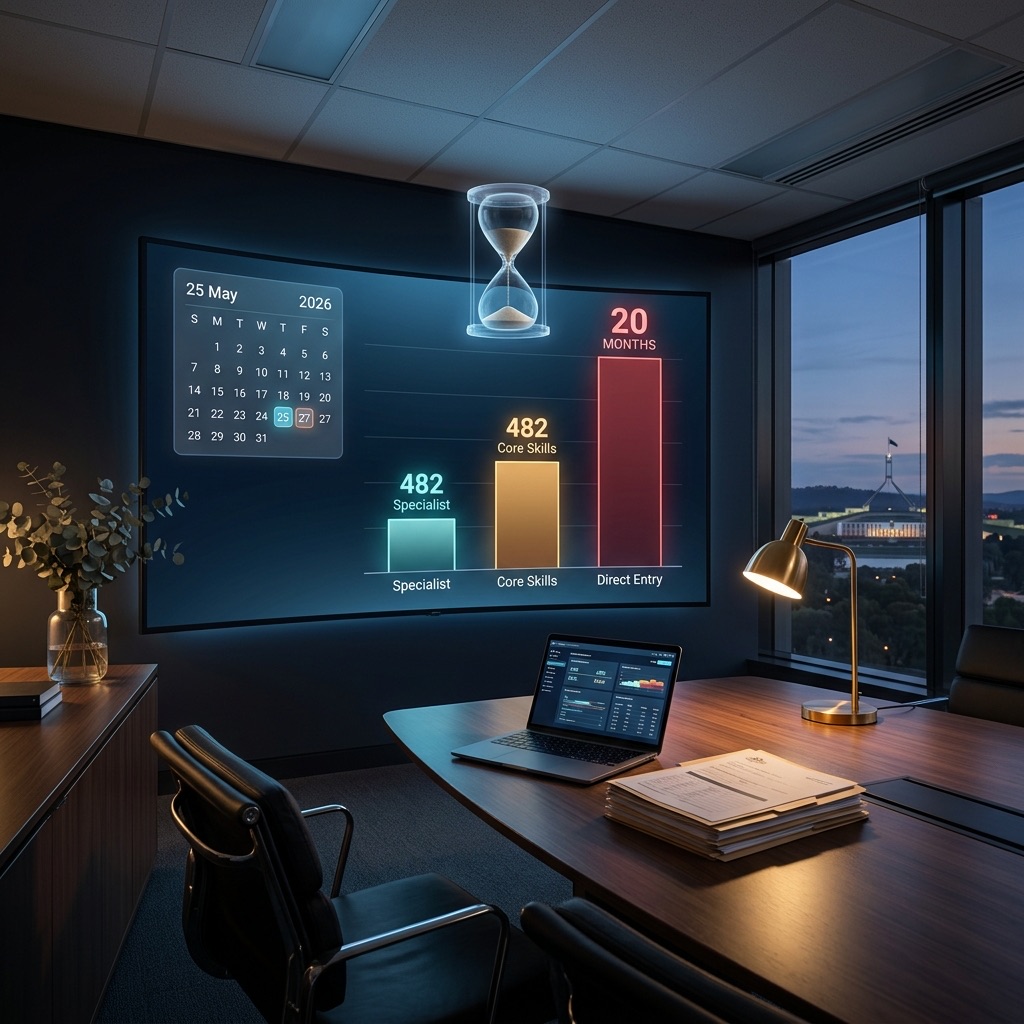
The Department of Home Affairs refreshed its visa-processing-times dashboard on 27 May 2026 with data dated 25 May 2026, and the snapshot rewrites several practical planning assumptions for employers, sponsors, skilled workers, and short-stay business travellers. The headline is the 186 Direct Entry permanent residence pathway sitting at approximately 20 months for the 90th percentile of applications, while the two streams of Subclass 482 have separated dramatically: Specialist Skills median around two weeks, against Core Skills median 63 days with 90% reaching up to nine months. Subclass 600 Business Visitor and Subclass 400 Short-term Work continue to clear in 6-23 and 7-23 days respectively. If you are preparing a 2025-26 lodgement before the 1 July 2026 threshold reset, or planning 2026-27 hires, these are the numbers that should be driving your timeline.
What the 25 May 2026 Dashboard Actually Shows
The Home Affairs visa-processing-times dashboard reports two percentiles for each subclass: the 50th percentile (median) - half of all decisions issued within that timeframe - and the 90th percentile - the time within which 90% of decisions are issued. The 90th-percentile figure is the more honest planning number for any complex lodgement; the median understates risk because it is dragged down by the simplest cases. The 25 May 2026 data set covers grants issued in the preceding rolling window and is the freshest snapshot Home Affairs has published in 2026 to date.
| Subclass | Stream / Pathway | 50% Within | 90% Within |
|---|---|---|---|
| 482 | Specialist Skills | ~2 weeks | - |
| 482 | Core Skills | 63 days (~2 months) | up to 9 months |
| 186 | Direct Entry (PR) | - | ~20 months |
| 600 | Business Visitor | 6-23 days average | - |
| 400 | Short-term Work | 7-23 days | - |
Two structural pressures sit underneath those numbers. First, TSS (482) lodgements are up approximately 34.5% year-on-year for 2025-26 according to industry analysis published alongside the dashboard release. That is a substantial volume increase against a Departmental case-officer base that has not grown proportionately. Second, the 1 July 2026 Core Skills Income Threshold (CSIT) lift to $79,499 and Specialist Skills Income Threshold (SSIT) lift to $146,717 is concentrating lodgement activity into the final weeks of June 2026 as employers race to lodge nominations under the existing thresholds. The 482 Core Skills queue is consequently expected to lengthen further before it shortens.
The figures should be read as planning baselines, not promises. Home Affairs explicitly notes that processing times can shift week-to-week based on case complexity, completeness of documentation, character or security flags, and policy direction. The 90th-percentile number is the figure to build a recruitment or relocation plan around; the median is the figure to use only when assessing the simplest, fully decision-ready files for low-risk nationalities.
Median ≠ your case. A 482 Core Skills median of 63 days does not mean your nomination will be decided in two months. The 90th-percentile figure of up to nine months is the prudent planning baseline for any nomination with documentation gaps, evidence requests, or higher-risk nationality profile. Use the median only as a best-case scenario.
The 482 Specialist vs Core Skills Gap - Why One Is 4× Faster
The single most important read from the May 2026 dashboard is the four-times processing-speed gap between 482 Specialist Skills and Core Skills. Specialist Skills clears at around two weeks at the median, while Core Skills sits at 63 days at the median - and stretches to nine months at the 90th percentile for the slower files. For an employer with an urgent commercial need, that gap can be the difference between filling a role this quarter and missing the entire financial year's hiring window.
The differential exists because the Specialist Skills stream is reserved for nominated occupations attracting a guaranteed annual market salary rate at or above the Specialist Skills Income Threshold. With the SSIT lifting from $141,210 to $146,717 on 1 July 2026, the eligibility band for Specialist Skills is narrowing in real terms - but the processing benefit remains substantial. Any role you can legitimately structure to satisfy the SSIT (and the genuine market-salary test, and the standard Labour Market Testing exemption framework) is a role where, on the current median Specialist Skills turnaround, a visa-holder may be able to commence work within four to six weeks of nomination lodgement - subject to character and security checks, complete documentation, and standard relocation timelines. The same role in the Core Skills stream is currently tracking at four to nine months on the same percentile bands.
For employers operating close to the SSIT threshold, the strategic calculation between 1 June and 30 June 2026 is sharp. A nomination lodged before 1 July at $141,210+ qualifies for Specialist Skills under existing settings; the same role lodged on 1 July at $141,210 falls into Core Skills (because the new SSIT of $146,717 takes effect that day), losing the processing advantage. If the role is genuinely paid in the $141,210-$146,716 band, lodging before 30 June 2026 is materially more valuable than waiting - not because the visa fee will be cheaper, but because the file will clear two months faster on the median and potentially eight months faster at the 90th percentile. Use our Visa Condition Lookup to confirm post-grant conditions for either stream before structuring the offer.
The Specialist Skills median of ~2 weeks is a Departmental commitment to fast-tracking high-income nominations, not a guaranteed turnaround. Cases with complex character or security checks will still take materially longer regardless of stream. The headline figure applies to clean files from low-risk nationalities with complete documentation.
186 Direct Entry at 20 Months - What That Means for PR Planning
The 90th-percentile figure of approximately 20 months for 186 Direct Entry is the single most consequential figure on the dashboard for permanent residence planning. Direct Entry is the 186 pathway for candidates who have not held a 482 (or its predecessor TSS) for the qualifying period - typically applicants with a positive skills assessment and three years of full-time post-skills-assessment work in the nominated occupation (which may be accrued onshore or overseas), or onshore applicants who have not completed the qualifying 482 service required for the Temporary Residence Transition (TRT) stream.
A 20-month planning baseline reshapes how employer-sponsored PR pipelines need to be sequenced. An employer who nominates a senior overseas hire today (30 May 2026) under 186 Direct Entry should plan for that grant landing as late as the first quarter of 2028. That is incompatible with most commercial relocation timetables and incompatible with most candidate expectations. The practical implication is that 186 Direct Entry has effectively become a fallback PR pathway rather than a first-choice strategy. Where the candidate has any plausible 482 service or any feasible TRT runway, the 482 → 186 TRT route is now the structurally faster permanent-residence path despite the requirement to first complete at least two years of qualifying full-time employment with the nominating employer in the nominated occupation while holding a 482 (or eligible bridging visa).
The 20-month figure is also a function of the 34.5% year-on-year lift in TSS lodgements flowing through to 186 nominations as cohorts mature. The system is processing more files than at any time since the 482 framework was introduced, and the 2026-27 Employer Sponsored allocation of 58,040 places (combined 186 + 494 + 482 PR pathway, up 32% on 2025-26) signals that the volume pressure on case officers will continue. For occupation-eligibility confirmation under the employer sponsored visa framework, use our ANZSCO Occupation Search tool to verify the relevant skill list and assessing authority for your nominated role before lodgement.
600 & 400 - The Short-Stay Fast Lane Still Works
The dashboard confirms two reassurances at the short-stay end. Subclass 600 Business Visitor continues to be granted within 6-23 days on average, depending on application stream and nationality. Subclass 400 Short-term Work is granted within 7-23 days and remains the fastest sponsored pathway for genuinely short-term commercial work where a 482 is not yet practical or where the role is genuinely under six months. Both pathways are largely unaffected by the broader processing slowdown because they sit in separate workflow queues.
For employers managing urgent commercial travel - board meetings, conference attendance, equipment installation, short-term consulting engagements - the 400 visa remains the operational tool of choice. The 400 covers up to six months of work for highly specialised, non-ongoing activities and is the cleanest substitute for 482 when the role does not justify the longer-term sponsorship overhead. For mixed business-and-leisure travel to attend trade shows, customer meetings, or familiarisation visits, the 600 Business Stream is the standard choice.
A practical note on Iranian-passport applicants: the existing travel-ban arrangements affecting 600 visitor grants for Iranian nationals remain in force and are expected to expire only in late September 2026. Iranian applicants for short-stay visas should not rely on the dashboard median figures, which reflect outcomes for unaffected nationalities; their planning baseline should assume substantially longer processing and a non-trivial refusal risk under existing Ministerial direction settings.
How the Numbers Affect Six Migration Cohorts
The 25 May 2026 dashboard produces different planning outcomes for different applicant cohorts. The headline numbers obscure those differences; the table below makes them explicit.
| Cohort | Most Relevant Subclass | Realistic 2026 Planning Timeline | Strategic Implication |
|---|---|---|---|
| Senior overseas hires (offshore) | 186 Direct Entry | 12-20 months | Default to 482 → 186 TRT instead, if any 482 runway exists |
| 482 holders with 2+ years' service | 186 TRT | Typically 6-12 months | Lodge now while CSIT/SSIT settings are favourable |
| New offshore Specialist Skills hires | 482 Specialist | ~2 weeks median | Lock in before SSIT lifts 1 July 2026 |
| Core Skills 482 hires | 482 Core | 63 days median / up to 9 months | Build a six-month buffer into the relocation plan |
| Urgent commercial travel | 600 Business / 400 Short-term Work | 1-4 weeks | Use 400 for billable work; 600 for meetings only |
| GSM 189/190/491 candidates | Skilled Independent / Nominated | Not on this dashboard (round-driven) | See our GSM Points Calculator for current scoring |
Each row implies a different lodgement strategy. The 186 Direct Entry cohort should reconsider whether a TRT runway is achievable; the Specialist Skills cohort should accelerate to beat the 1 July SSIT lift; the Core Skills cohort needs honest expectations management with the commercial sponsor about the six-month outer bound. The GSM cohorts are not visible on the processing-times dashboard because skilled migration grants are gated by SkillSelect invitation rounds rather than continuous processing; the binding constraint there is invitation supply rather than decision-time.
Five Planning Moves Before 1 July 2026
The 32 days between today and 1 July 2026 are the operational window for any 482/186 lodgement that locks in current settings. Here is the recalibrated action plan.
1. Audit every 482 nomination in draft against the Specialist Skills threshold. Any nomination currently drafted in the $141,210-$146,716 salary band qualifies for Specialist Skills under existing settings but will fall into Core Skills if lodged on or after 1 July 2026. The processing-time difference between the two streams is substantial - two weeks median versus 63 days median, and the gap widens at the 90th percentile. Lodging before 30 June 2026 in the Specialist Skills band is one of the highest-leverage tactical moves available this month.
2. Accelerate 482 → 186 TRT applications for eligible cohorts. 482 holders with two or more years of qualifying service should not delay a 186 TRT lodgement on the assumption that "next year will be better." The 58,040-place 2026-27 Employer Sponsored allocation is the largest in years, but volume pressure on case officers will likely keep processing-times stretched through Q1 2026-27 at minimum. Lodge now while documentation is current.
3. Defer 186 Direct Entry lodgements where any 482 runway is plausible. For a candidate who is offshore today but could plausibly come onshore on a 482 first, the combined 482 (~2 weeks Specialist / 63 days Core) plus two years of qualifying service plus 186 TRT (typically 6-12 months) is the structurally faster permanent-residence path than 186 Direct Entry's 20-month 90th-percentile baseline. Defaulting to Direct Entry purely because the candidate is "PR-ready" on paper is now the wrong default.
4. Build a six-month operational buffer into every 482 Core Skills relocation plan. Recruitment teams should communicate to hiring managers and to the candidate that 482 Core Skills processing can stretch to nine months at the 90th percentile. Plan onboarding, relocation logistics, school enrolments, and lease commitments against the six-to-nine-month bracket, not the two-month median. Setting the median as the plan creates avoidable commercial and personal stress when the file falls into the 90th-percentile slow tail.
5. Use 400 Short-term Work to bridge urgent commercial gaps. Where a role cannot wait for 482 Core Skills processing - but the work is genuinely non-ongoing and under six months - the 400 visa is the operational bridge. A 400 grant in 7-23 days lets the worker be in seat while the parallel 482 nomination is being assessed. This is a standard combined-pathway strategy for highly specialised contractors and project-based engagements.
Common 186 Direct Entry mistake: Lodging a Direct Entry application "to start the clock" when the candidate could plausibly transition via 482 first. The Direct Entry 20-month 90th-percentile timeline is now longer than the typical combined 482 (~2 weeks to ~63 days) plus 186 TRT (6-12 months) pathway for cohorts who can establish 482 service. Direct Entry is now best reserved for cases with no plausible 482 runway.
Limitations & Context
The dashboard numbers are subject to three important caveats. First, the figures are rolling-window historical averages, not forward-looking guarantees. A nomination lodged today will be decided based on the case-officer load, policy direction, and complexity profile that exist at the moment the file reaches the front of the queue - not the conditions that prevailed when the data was captured on 25 May 2026. Second, the headline percentile figures apply to low-risk nationalities with complete documentation. Files from higher-risk nationality profiles, files with character or security concerns, and files with incomplete documentation will consistently fall into the slow tail beyond the 90th percentile. Third, the dashboard does not publish times for skilled migration (189/190/491) grants because those subclasses are invitation-gated through SkillSelect rather than processed on a continuous queue basis - see our companion analysis on the 2026-27 subclass-level allocations for the GSM context.
The 1 July 2026 reset is the most consequential single date in the May 2026 dashboard's planning horizon. The CSIT lift to $79,499, the SSIT lift to $146,717, the 2026-27 Migration Program allocation reset to 132,240 Skill stream places, and the expected annual visa-fee indexation all take effect on the same day. For the strategic implications across the broader Skill stream, see our Federal Budget 2026-27 Migration Program coverage and the Budget 2026-27 for Employer Sponsors piece for the threshold timing detail.
This assessment is based on the Home Affairs visa-processing-times dashboard published 27 May 2026 (data dated 25 May 2026) and industry commentary published in the same week. Australian migration law and policy can change without notice. This is not legal advice; individual cases should be assessed by a registered migration agent against the latest legislative instruments and Ministerial directions.
How First Migration Can Help
Translating a Home Affairs dashboard into a workable lodgement plan is exactly the kind of strategic call where a registered migration agent earns their fee. At First Migration Service Centre, our team is tracking the published 25 May 2026 dashboard figures, the 1 July 2026 CSIT/SSIT lift, the 2026-27 Employer Sponsored allocation expansion, and the broader skilled migration and employer sponsored frameworks in real time - so that you do not have to guess what the published medians and 90th-percentile figures actually mean for your specific occupation, salary band, candidate nationality, and onshore-versus-offshore position.
Ready to take the next step? We invite you to submit a free visa assessment so we can map a lodgement plan against the May 2026 processing benchmarks before the 1 July 2026 reset.
RMA R. Weng
MARA 1569835Registered Migration Agent | Master of Laws (ANU) | Bachelor of Laws (Deakin)
Certified by the Migration Agents Registration Authority (MARA). Specializing in skilled migration, employer-sponsored visas, and partner visas. Admitted to practice law in Victoria.
Related Articles

Disclaimer: This information is general in nature and does not constitute formal migration advice. Immigration laws and policies change frequently. Always consult a MARA-registered migration agent for advice specific to your circumstances. First Migration Service Centre (MARA 1569835) provides this content for informational purposes only.
MARA Registered Agent
Registration No. 1569835
Certified by the Migration Agents Registration Authority. Your trusted partner for Australian visa applications.

South Australia DAMA Expires 30 September 2026: What the Deadline Means and Whether You Should Lodge Before It
What the 67-Day 189 Blackout Actually Means (And What It Does Not)
South Australia Skilled Migration Reopens 26 August 2026: What 190/491 Applicants Should Check Before Lodging
Onshore vs Offshore in 2026: How Location Sets Your Queue Position

Adding a Dependent Child Over 18 to Your Australian Visa (2026)
Office Hours
Mon-Fri: 9AM-5PM Sat: 10AM-2PM