
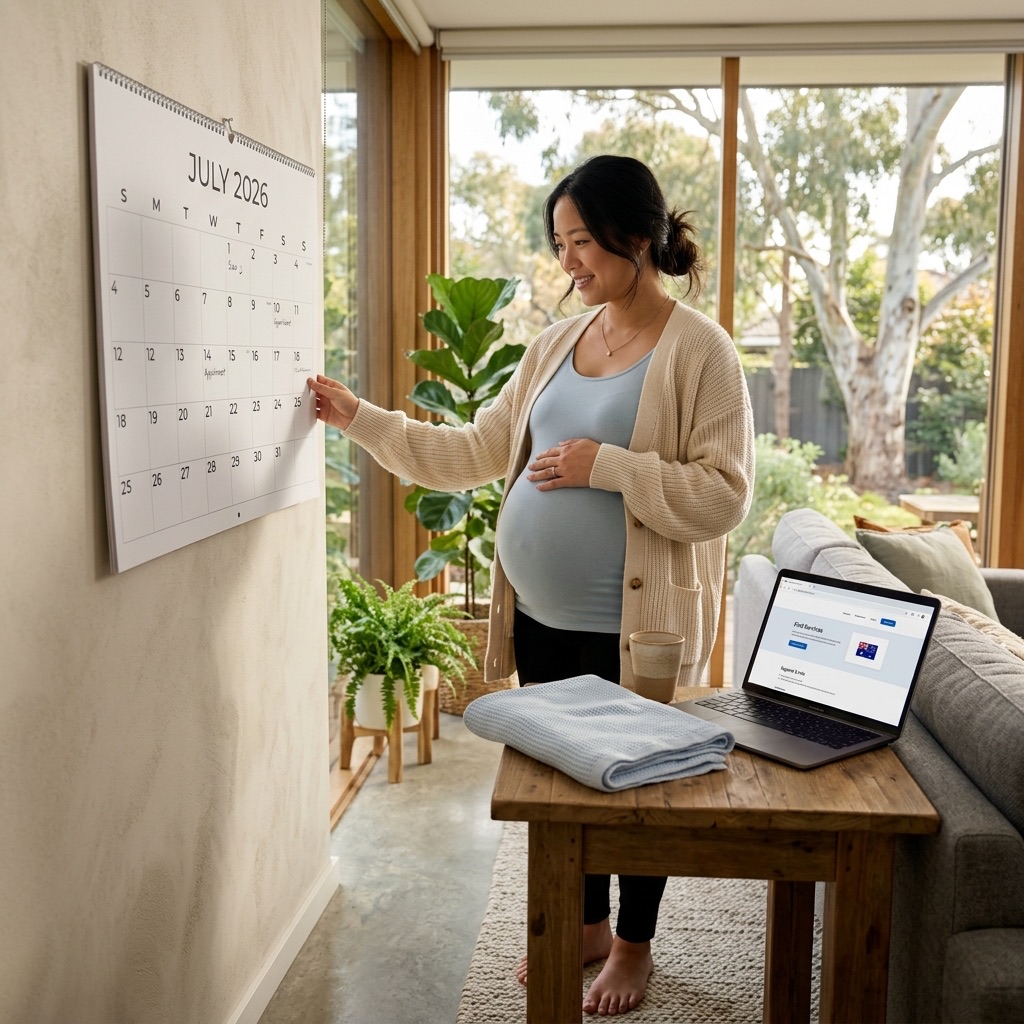
From 1 July 2026, Australia's Paid Parental Leave (PPL) scheme lifts to 26 weeks (130 working days) and continues paying 12% Superannuation Guarantee on top. It is one of the biggest family-support resets in a generation - but the part mainstream finance commentary keeps missing is that PPL has an "Australian resident" test under the Paid Parental Leave Act 2010 §§45-46 that quietly excludes most temporary visa holders. If your baby is due in the second half of 2026 and you are still mid-partner-visa or on a bridging visa, the difference between a granted PR and a BVA on the birth date can be the difference between a five-figure family payment and nothing at all.
The 1 July 2026 Reset: What Actually Changes
The 26-week / 12% super package is the culmination of the Albanese Government's three-stage PPL expansion. Children born or adopted on or after 1 July 2026 trigger the new entitlements; children born up to 30 June 2026 stay on the 22-week framework that has applied since July 2025. There is no retrospective top-up - the birth/adoption date is the hard cut-off.
The 12% superannuation contribution on PPL is not new on 1 July 2026 - it has applied since 1 July 2025. What is new in July 2026 is that the first wave of super payments will land in nominated funds, because PPL super is paid as a lump sum after the end of the financial year in which PPL was received. Eligible parents of children born from 1 July 2025 onwards should start seeing these contributions flow through from July 2026.
The headline numbers also matter for budgeting because, as of May 2026, the per-day rate, income cap and work test have not moved with the duration extension. The payment is still indexed to the National Minimum Wage, taxable, and paid by your employer (or Services Australia direct).
| PPL Setting | Before 1 July 2026 | From 1 July 2026 | Change Driver |
|---|---|---|---|
| Total weeks | 22 weeks (110 days) | 26 weeks (130 days) | Paid Parental Leave Amendment (More Support for Working Families) Act 2023 |
| "Use it or lose it" per parent | 4 weeks | 4 weeks | Unchanged |
| Super contribution on PPL | 12% (since 1 July 2025) | 12% (continues) | Government super on PPL scheme |
| Weekly payment rate | ~$948.10 before tax | Indexed to National Minimum Wage | Annual indexation 1 July |
| Individual income test | Below ~$180,007 | Same cap, indexed | Subject to indexation |
| Family income test | Subject to indexation (verify current cap with Services Australia) | Same cap, indexed | Subject to indexation |
| Work test | 330 hours in 10 of 13 months pre-birth | Unchanged | Paid Parental Leave Act 2010 §§31-37 |
The Hidden Catch: The PPL Act §§45-46 Residency Test
This is the part of PPL that mainstream finance reporting either skims or skips. To be paid PPL, a parent must be an "Australian resident" as defined under the Paid Parental Leave Act 2010 and must satisfy that test on the day of birth or adoption and on every day of the PPL period. The legislation does not just look at where you live - it looks at the type of visa you hold.
The Act treats the following as Australian residents for PPL purposes:
- Australian citizens
- Permanent visa holders - once the PR grant has been issued
- Special Category Visa (Subclass 444) holders - New Zealand citizens lawfully in Australia
- Holders of certain prescribed temporary visa subclasses - a narrow, defined list set by the Paid Parental Leave Rules
If you do not fit one of these categories on the birth date, you are not eligible - and there is no late-filing rescue. PPL is not a back-paid entitlement: missing the residency test on the birth/adoption day forecloses the claim entirely. This is materially different from Medicare or Centrelink-linked payments where some retrospective access is possible.
There is also a second tripwire that catches new PRs. Newly arrived resident's waiting period (NARWP) rules apply across many Centrelink-linked family payments and operate in parallel to the §§45-46 residency test. Waiting-period length, exemptions, and the trigger date that applies to your specific PR grant vary by payment, and certain visa categories (humanitarian, family-violence exemptions) are treated differently. Confirm your exact PPL NARWP position with Services Australia in writing before assuming PR alone is enough - the rule that applies to your case is not always the rule a headline article quotes.
The residency test applies to the parent claiming PPL, not to the child. An Australian citizen baby does not give the parent PPL eligibility if the parent fails the §§45-46 test on the birth date.
Visa-by-Visa: Who Actually Qualifies
The cleanest way to read your position is to start from your current visa class. The table below assumes the residency test is the only blocker - work test, income test and primary-carer rules apply on top, and 491/494 holders should note the visa-class restriction described below the table.
A few categories deserve special attention because they catch the most families off-guard. Permanent partner visa holders (Subclass 801 / 100) sit on the right side of the line, but the gap between provisional grant (820/309) and permanent grant (801/100) is often where the baby actually arrives. Subclass 491 and 494 holders consistently expect PPL eligibility because of how long they have been in Australia on a regional pathway - but the legislation is clear that the test runs on visa class, not duration of stay. Bridging visa holders are the highest-volume "fail" category at intake: a BVA is not a substantive visa, and unless the substantive underneath is on the prescribed temporary-visa list (which most partner-visa BVAs are not), the residency test fails.
If you are unsure where your case sits, our partner visa service team reviews PPL position alongside the substantive visa pathway as part of standard pre-application consultations - it is one of the most common questions onshore couples raise once pregnancy is on the horizon.
| Visa Class | PPL Residency Test (§§45-46) | Notes |
|---|---|---|
| Australian citizen | ✅ Qualifies | Subject to work test + income test only |
| Subclass 189 / 190 / 186 / 858 (PR) | ✅ Qualifies | Check the 104-week NARWP-equivalent if PR granted after 1 Jan 2019 |
| Subclass 191 (regional PR after 3 yrs on 491) | ✅ Qualifies | Same 104-week NARWP check |
| Subclass 491 / 494 (provisional, before 191) | ❌ Generally not eligible | Provisional visa class; transition to 191 PR first |
| Subclass 820 / 309 (provisional partner) | ❌ Generally not eligible | Not on the prescribed temporary-visa list |
| Subclass 801 / 100 (permanent partner) | ✅ Qualifies | Treated as PR; check NARWP-equivalent |
| Special Category Visa 444 (NZ citizens) | ✅ Qualifies | Express SCV inclusion in the Act |
| Subclass 482 / Skills in Demand | ❌ Generally not eligible | TR; not on the PPL-prescribed list |
| Subclass 485 (Temporary Graduate) | ❌ Not eligible | TR with no §§45-46 pathway |
| Subclass 500 (Student) | ❌ Not eligible | TR with no §§45-46 pathway |
| Subclass 600 / 601 / 651 (Visitor / eVisitor) | ❌ Not eligible | Short-stay; no PPL access |
| Bridging Visa A / B / C | ❌ Generally not eligible | Substantive visa underneath is usually a TR; very narrow exceptions only |
If you are on a Subclass 491 or 494 provisional visa, you are NOT eligible for PPL even though you hold a long-term skilled visa. You become eligible after the Subclass 191 PR grant. This catches many regional skilled-visa families by surprise - plan your pregnancy timing accordingly.
The Clinical Decision Point: Pregnancy Timing on a Bridging Visa
For onshore partner-visa applicants, the most expensive mistake is assuming the bridging visa will be enough. It rarely is. If your child is born while you are on a Subclass 820 BVA, the residency test on the birth date will almost always fail - and the PPL claim is foreclosed regardless of how quickly 820 is granted afterwards. There is no mechanism in the Act to back-date eligibility to the day the substantive 820 is granted.
That makes the 820 processing window - currently running well over a year on standard cases, with the published median moving regularly - a high-stakes period for couples planning a baby. Verify the current Home Affairs published median for your case profile at the time of planning. Three practical strategies typically come up at our intake:
- Plan around the grant timing. Where biology and clinical advice allow, aligning conception so the birth falls after the substantive 820 grant is the cleanest path. We routinely review case timelines so couples can make an informed decision with their GP/obstetrician - but, candidly, processing-time slippage means this is not always achievable.
- Confirm the working partner's eligibility. PPL is a per-parent entitlement with a 4-week "use it or lose it" allocation. If one partner is an Australian citizen or PR and meets the work test, that parent can still claim their portion of PPL even where the BVA-holder partner cannot. Couples often miss this.
- Quantify the gap, then plan. Twenty-six weeks at the current rate is a meaningful family payment, and the lost super contribution compounds over a working life. Knowing the dollar value of what is at stake helps the family decide how aggressively to push 820 evidence preparation. Our Partner Visa Readiness Assessment is the fastest way to see whether your 820 file is closer to grant than you think.
For offshore Subclass 309 applicants, the same logic applies - the 309 is a temporary visa and the residency test fails until Subclass 100 is granted. Many couples in this position settle in Australia first and then have children after the 100 grant, which we generally support unless there are over-riding family or medical reasons.
What You Should Do Now: A 5-Step Action Plan
- Confirm your residency-test position on paper, not on guesswork. Pull your visa grant notice, check the subclass, and map it against the table above. If you are on a bridging visa, identify the substantive visa underneath - that is what Services Australia will assess.
- Run an 820 / 309 readiness check. If your child is due within the next 12-18 months, a focused review of relationship evidence can compress the path to grant. We provide a free first-pass review through our partner visa service - and the partner visa readiness tool linked above lets you self-assess your evidence strength in minutes.
- Check your work test 13 months out. The PPL work test is 330 hours across 10 of the 13 months before birth/adoption. If you are about to drop hours, pause unpaid leave, or move to casual, lock in the calculation now - and keep payslip evidence.
- Cross-check the NARWP rules in writing. Ask Services Australia in writing whether a newly-arrived resident's waiting period applies to your specific PPL claim. The length, exemptions and trigger date depend on your visa class and grant date, and exemptions are narrow but real.
- Map the parallel 1 July 2026 settings. PPL is one of six federal levers that reset on 1 July 2026 - the Child Care Subsidy hourly cap, CSIT/SSIT for employer-sponsored streams, and visa fee indexation also move on the same day. Couples planning a baby alongside a PR pathway should map the whole package, not just PPL. Our Child Care Subsidy calculator covers the CCS side.
For an evergreen breakdown of PPL eligibility, payment rates and the application steps themselves (without the 1 July 2026 reset framing), see our Paid Parental Leave for Migrants guide. For the broader partner visa picture, our 2026 partner visa processing times analysis is the companion piece.
Additional Context: PPL and the Citizenship/PR Timeline
A subtle benefit of qualifying for PPL is that the 12% super contribution starts building retirement balance from the moment of the first claim - important for migrants who otherwise lose years of super accumulation during temporary-visa periods. Combined with the 4-year residence pathway to citizenship, families who qualify for the full 26 weeks of PPL plus super in 2026-27 are effectively front-loading both their settlement income and their long-term retirement position in the same financial year. Once PR is granted and the 4-year clock has run, our citizenship eligibility calculator is a useful next step.
The other often-missed point: PPL eligibility is not a one-shot test. Even if you fail the §§45-46 test on this birth date, your eligibility resets for any subsequent child once your visa status changes. Many families on long-running partner-visa pathways have a first child on a BVA without PPL and a second child after 801 grant with full PPL - that is normal, not a mistake on Services Australia's part.
For partner-visa families specifically, the strongest planning lever is usually compressing the 820 evidence and submission timeline, not chasing PPL exceptions that do not exist in the legislation. The Department of Home Affairs continues to publish processing times that reward decision-ready files; bringing forward the 820 grant by even a few months can be the difference between a baby born on a BVA (PPL foreclosed) and a baby born on a substantive 820 with the permanent 801 grant timed before the next planned pregnancy. We cover this trade-off in detail through our partner visa service, and we routinely sequence both the visa and PPL planning together at intake.
PPL rates, income tests, work-test parameters and waiting-period rules are indexed and subject to change. Figures in this article are current as of May 2026 and may move at the next 1 July indexation cycle or by legislative amendment. Always verify your specific entitlement position with Services Australia before relying on PPL in a family budget or visa-timing decision.
How First Migration Can Help
Navigating these changes can be complex, but you don't have to do it alone. At First Migration Service Centre, our registered migration agents work with families every week who are balancing pregnancy planning against partner-visa or skilled-visa timing. We can map your PPL eligibility position against your visa grant trajectory, help you build a decision-ready 820/309 file, and coordinate the timing decisions where they matter. We cannot guarantee a faster Home Affairs grant - processing times are set by the Department - but a tighter evidence file generally puts your case in the strongest position when it is reached.
Ready to take the next step? We invite you to submit a free visa assessment so we can understand your situation and provide tailored advice on PPL eligibility, visa timing and the broader 1 July 2026 reset.
RMA R. Weng
MARA 1569835Registered Migration Agent | Master of Laws (ANU) | Bachelor of Laws (Deakin)
Certified by the Migration Agents Registration Authority (MARA). Specializing in skilled migration, employer-sponsored visas, and partner visas. Admitted to practice law in Victoria.
Related Articles


Disclaimer: This information is general in nature and does not constitute formal migration advice. Immigration laws and policies change frequently. Always consult a MARA-registered migration agent for advice specific to your circumstances. First Migration Service Centre (MARA 1569835) provides this content for informational purposes only.
MARA Registered Agent
Registration No. 1569835
Certified by the Migration Agents Registration Authority. Your trusted partner for Australian visa applications.

South Australia DAMA Expires 30 September 2026: What the Deadline Means and Whether You Should Lodge Before It
What the 67-Day 189 Blackout Actually Means (And What It Does Not)
South Australia Skilled Migration Reopens 26 August 2026: What 190/491 Applicants Should Check Before Lodging
Onshore vs Offshore in 2026: How Location Sets Your Queue Position

Adding a Dependent Child Over 18 to Your Australian Visa (2026)
Office Hours
Mon-Fri: 9AM-5PM Sat: 10AM-2PM