
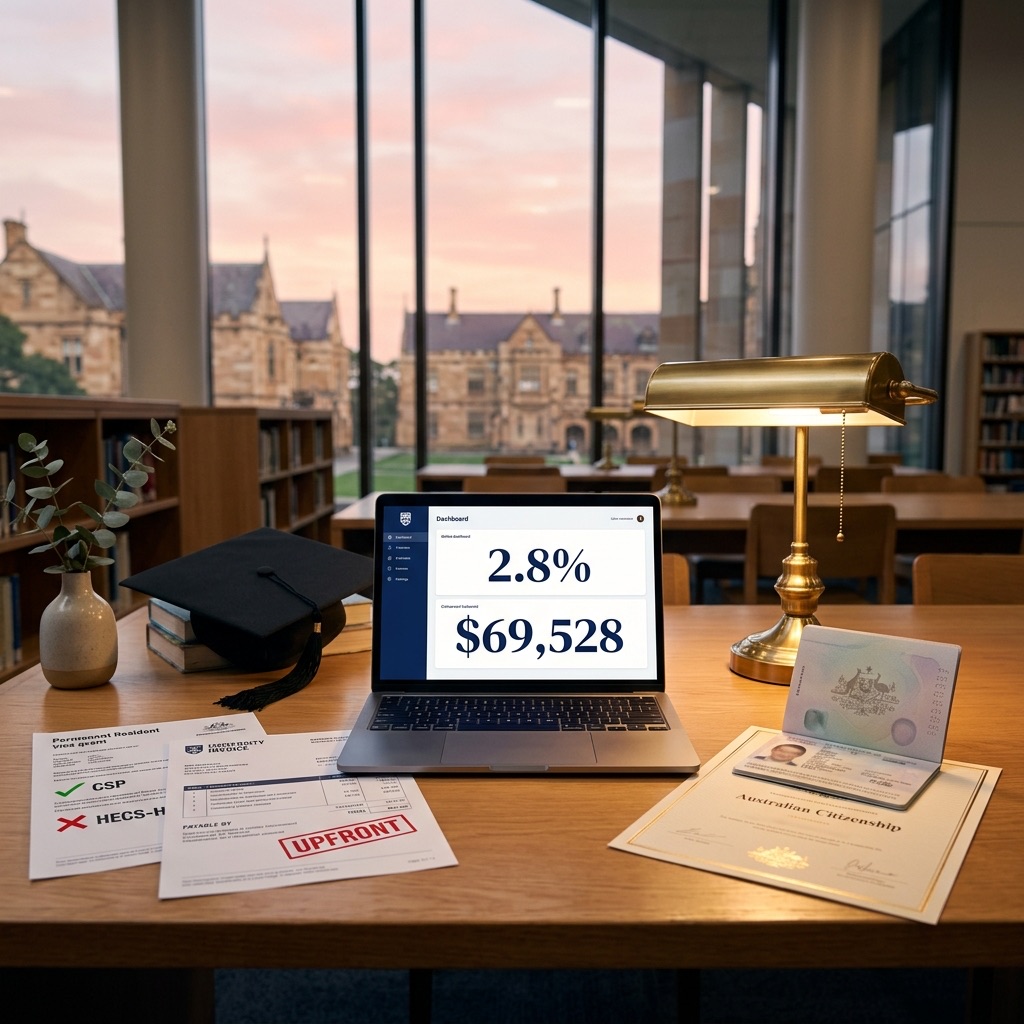
On 1 June 2026 the Australian Taxation Office will apply a 2.8% indexation to every outstanding HECS-HELP balance - the lowest annual figure since 2021 and the third consecutive year of softening under the Universities Accord (Student Support and Other Measures) Act 2024 lower-of-CPI/WPI rule. The compulsory repayment threshold for the 2026-27 income year also lifts to $69,528 (up from $67,000), and the new marginal repayment system means borrowers only repay on income above each threshold, not on the whole salary. None of this is controversial. What is widely misunderstood - including by hundreds of newly granted permanent residents we see at intake each year - is the rule sitting underneath all of it: permanent residency alone does not give you access to HECS-HELP. Under the Higher Education Support Act 2003 (HESA), only Australian citizens (and Permanent Humanitarian Visa holders under a narrow carve-out) can defer student contributions. Every other PR pays upfront. This article explains what changes on 1 June 2026, who is and is not eligible, and how to time further study around your visa-class transition.
What Just Changed on 1 June 2026
Three things take effect with the 2026 indexation event, and they are easy to confuse with each other. First, every HECS-HELP balance that was outstanding on 31 May 2026 is grown by 2.8% on 1 June 2026. Second, the voluntary repayment window that lets you reduce your balance before indexation closed on 26 May 2026 - for the 2026 cycle that opportunity has now passed. Third, and separately, the 2026-27 compulsory repayment threshold rises to $69,528, applying to your taxable income for the financial year starting 1 July 2026.
The 2.8% figure continues a clear three-year softening trend. Indexation peaked at 7.1% in June 2023 in the aftermath of the CPI shock, then dropped to 4.7% in 2024, 3.2% in 2025, and now 2.8% in 2026. This is the direct effect of the Universities Accord (Student Support and Other Measures) Act 2024, which changed the indexation formula to the lower of CPI or the Wage Price Index - preventing a repeat of the 2023 spike when CPI ran well ahead of wages.
The widely-publicised 20% one-off reduction on existing HECS-HELP balances applied to balances as at 1 June 2025, processed by the ATO across FY2025-26. There is no further 20% reduction at 1 June 2026 - only the 2.8% indexation applies.
| Year (1 June) | Indexation Rate | Notable Context |
|---|---|---|
| 2023 | 7.1% | Pre-reform peak (CPI-driven) |
| 2024 | 4.7% | First post-Universities Accord cycle |
| 2025 | 3.2% | Indexation softening trend continues; 20% one-off reduction applied |
| 2026 | 2.8% | Lowest since 2021; only indexation applies (no further 20% reduction) |
The repayment structure that sits behind the threshold lift is also worth understanding. From the 2026-27 income year onwards the ATO applies a marginal formula: $0.15 for every dollar of taxable income above the first threshold of $69,528, plus an additional $0.17 for every dollar above the next-tier threshold of $129,717 - or 10% of total repayment income, whichever amount is lower. For most borrowers between the two thresholds the marginal calculation produces the lower (and therefore applied) figure. This replaces the historical whole-salary approach where crossing a single threshold could trigger a large step-up in repayments. We unpack what that means in practice in the marginal-repayment section further down.
The Citizen-Only Rule Under HESA 2003 - The Single Most Misunderstood Rule
Australia's higher-education funding model has two distinct layers, and PR holders sit in an awkward middle position between them. The first layer is the Commonwealth Supported Place (CSP) - the domestic-student fee level that is roughly one-third to one-half of the international-student fee for the same course. Permanent residents qualify for CSP enrolment at most universities. The second layer is the HECS-HELP loan facility itself - the income-contingent loan from the Commonwealth that lets eligible students defer their student contribution until they earn above the repayment threshold. Under Division 90 of the Higher Education Support Act 2003 (HESA) - in particular the entitlement and citizenship provisions in sections 90-1 and 90-5 - this loan facility is restricted to Australian citizens, Permanent Humanitarian Visa holders, Pacific Engagement Visa (Subclass 192) holders, and a narrow long-term-residence pathway for New Zealand citizens.
The practical effect is that a permanent resident who enrols in a Commonwealth Supported Place is liable to pay each semester's student contribution upfront, in cash, by the census date. There is no income-contingent deferral, no indexation-protected loan balance, and no waiting until you earn $69,528 before repayment begins. You are responsible for the full domestic fee on the day it falls due. For a typical postgraduate Masters degree at a Group of Eight university, that can mean $14,000-$18,000 per year payable in two instalments (indicative 2026 Group of Eight postgraduate CSP range; confirm with the specific institution) - a materially different cash-flow proposition from the "study now, pay later" assumption many new PRs bring with them from prior conversations with friends or recruiters.
The exceptions inside HESA 2003 are narrow and well-defined. Permanent Humanitarian Visa holders - most commonly Subclass 200 (Refugee), 201 (In-Country Special Humanitarian), 202 (Global Special Humanitarian), 203 (Emergency Rescue) and 204 (Woman at Risk) - can access HECS-HELP on the same terms as Australian citizens because Parliament wrote that carve-out into the eligibility provisions. The newer Pacific Engagement Visa (Subclass 192) - the permanent visa stream for eligible nationals of Pacific island countries and Timor-Leste - was also brought inside the HECS-HELP-eligible group, provided the holder is living in Australia for the duration of study. New Zealand citizens on the Special Category Visa (Subclass 444) are generally outside the HECS-HELP perimeter unless they meet narrow long-term-residence criteria - broadly, around 10 years of Australian residence (with physical presence for at least 8 of those years) plus 18 of the last 24 months at the time of loan application, or qualifying via the separate childhood-arrival pathway. NZ-citizen clients who think they may be close to these thresholds should confirm eligibility before enrolment. No other permanent visa class - not 189, not 190, not 491→191, not 186, not 820→801, not 309→100, not 858, not 132 - qualifies.
| Visa / Status | CSP (domestic fee level)? | HECS-HELP loan deferral? | What You Pay |
|---|---|---|---|
| Australian citizen | ✅ Yes | ✅ Yes | Deferred via HECS-HELP; compulsory repayment from $69,528 income (2026-27) |
| Permanent Humanitarian Visa (200, 201, 202, 203, 204) | ✅ Yes | ✅ Yes (HESA 2003 carve-out) | Deferred via HECS-HELP; same as citizens |
| Pacific Engagement Visa (Subclass 192) | ✅ Yes | ✅ Yes (must be living in Australia during study) | Deferred via HECS-HELP |
| NZ Special Category Visa (Subclass 444) | Limited | Only if narrow long-term-residence criteria met | Generally upfront unless long-term criteria satisfied |
| Other PRs (189, 190, 491→191, 186, 820→801, 309→100, 132, 858) | ✅ Yes | ❌ No | CSP fee payable upfront each semester |
| Temporary visa holders (500, 485, 482, 491 provisional) | ❌ No | ❌ No | International student fee, payable upfront |
What This Means for You - Five Common Scenarios
The HECS-HELP rule plays out very differently depending on where you sit in the visa lifecycle. Mapping yourself to the right scenario matters because the financial implications of getting it wrong run into tens of thousands of dollars.
If you are a 482 holder on the pathway to 186 and you are budgeting for a Masters degree to begin shortly after PR grant, do not assume PR will unlock HECS-HELP. It will not. You will pay the domestic CSP fee upfront. If the Masters is genuinely useful for your skilled employment, factor the upfront cash requirement into your savings plan now - typically $14,000-$18,000 per year for a one-and-a-half to two-year postgraduate course at a major university. If your employer is willing to fund or part-fund the course (and many sponsoring employers will, especially where it strengthens the case for ongoing 186 nomination), that is the cleanest solution. Use our employer-sponsored visa pathway overview to confirm the 482-to-186 transition timing that aligns with study planning.
If you are a 485 graduate weighing a second qualification, the calculation is more nuanced. While on the 485 you are a temporary resident and pay international student fees - typically two to three times the domestic rate. A common mistake is to enrol in further study on the 485 expecting PR to drop the cost mid-course. Even if PR is granted during the course, you switch to CSP (domestic fee) at the next census date - but you still cannot defer via HECS-HELP. Many graduates time the further study to begin only after PR grant, capturing the CSP saving but accepting the upfront cash position.
If you are a 189, 190 or 491→191 grantee planning further study, the strategic question becomes whether to enrol now (CSP, upfront) or wait until you are an Australian citizen (CSP + HECS-HELP deferral). Citizenship eligibility under the Australian Citizenship Act 2007 requires four years of lawful residence including at least 12 months as a permanent resident, with absences capped at 12 months across the four-year period and 90 days in the final 12 months before lodgement. For most 189/190 grantees, the timeline from PR to citizenship is around three years; for 491 holders, the clock generally starts only when the 191 is granted. Use our Australian Citizenship Calculator to model your earliest eligibility date and weigh that against the cost of paying upfront now.
If you hold a Permanent Humanitarian Visa, the rules are different in your favour. You qualify for both CSP and HECS-HELP on the same terms as Australian citizens. You may also be exempt from the four-year Newly Arrived Resident's Waiting Period (NARWP) for certain Centrelink payments, including Austudy and Youth Allowance for study. Confirm your specific entitlements with Services Australia before enrolling.
If you are an Australian citizen with an existing HELP debt, the 1 June 2026 indexation of 2.8% applies to your outstanding balance. The 2026-27 compulsory repayment threshold of $69,528 means anyone earning above that figure on their 2026-27 tax return will repay on the marginal-above-threshold formula. If you have spare cash and want to reduce your balance, the 2026 voluntary repayment window (which closes annually shortly before indexation) has now passed - your next pre-indexation opportunity is in May 2027.
The New Marginal Repayment System Explained
For the 2025-26 income year onwards, Australia uses a marginal repayment formula rather than the historical whole-salary approach. Under the old system, crossing a threshold meant your repayment percentage applied to your entire taxable income - a small pay rise could trigger a disproportionately large repayment liability. Under the new system, each repayment rate applies only to the slice of income above its respective threshold, exactly like the personal income tax brackets.
In practice this means a borrower earning $80,000 in 2026-27 only pays HECS on the $10,472 sitting above the $69,528 first threshold, not on the whole $80,000. The repayment liability is materially smaller than under the old system, particularly for borrowers sitting just above the first threshold.
Repayment percentages and threshold tiers are set by the ATO and are typically published in late June each year for the new income year. For 2026-27 the first threshold confirmed is $69,528. Higher-income thresholds and rates should be verified against ATO Study Assist at the time you lodge your return.
The combination of softer indexation (2.8%), a higher entry threshold ($69,528) and the marginal formula means the real repayment burden for most Australian-citizen graduates in 2026-27 is the smallest it has been in roughly five years. None of this benefit, however, flows to permanent residents who never had access to the loan facility in the first place.
Strategy - Timing Study Around Your Visa Transition
For migrants on a clear PR-pathway who genuinely need a postgraduate qualification, the timing decision is rarely between "study now or never" - it is between "study now and pay upfront" versus "wait until citizenship and defer via HECS-HELP". Three factors tip the balance one way or the other.
The first is time-to-citizenship. If you are within 12 months of citizenship eligibility, waiting is almost always cheaper. If you are three or four years out - typical for fresh 189/190 grantees, and longer for 491 → 191 holders - waiting may not be realistic, particularly if the qualification is occupation-critical. Model the earliest eligible date carefully before committing.
The second is employer funding. Where an employer is sponsoring or part-funding postgraduate study, the HECS-HELP question is largely moot - employer-paid study is not deferred via HECS-HELP regardless of citizenship status. This route is particularly common for 482-to-186 candidates, where the further qualification is part of the sponsor's case for ongoing nomination under the employer-sponsored visa programme.
The third is cash flow. Even where the discounted CSP fee is affordable on paper, paying $14,000-$18,000 per year upfront while also covering rent, family costs, and possible NARWP-period exclusions from CRA and most Centrelink payments may strain the household budget. Borrowers who would otherwise have relied on the income-contingent buffer of HECS-HELP need to model this carefully before enrolling.
If you are a Subclass 500 student visa holder weighing the affordability of an Australian course before PR, our Student Visa Funds Calculator will help you model the full international-student picture. And if you are still mapping out the broader PR-pathway - including how a future Masters qualification might affect your points score - our GSM Points Calculator gives an instant view of where you sit.
How First Migration Can Help
The HECS-HELP / citizenship rule is one of the most common - and most expensive - student-finance misconceptions we correct at intake each year. Our team can help you:
- Map your earliest citizenship date against a realistic study start date
- Model the upfront-CSP versus deferred-HECS difference for your specific course and timeline
- Identify whether your visa pathway (189, 190, 491→191, 186, 820→801, 309→100, 858) aligns with employer-funded study options
- Confirm whether you qualify for the narrow Permanent Humanitarian Visa carve-out under HESA 2003
- Coordinate with your sponsoring employer on 482-to-186 timing that fits postgraduate study planning
Book a free migration assessment - our MARA-registered agents will walk you through both the visa and the higher-education funding implications in plain English. Or explore our full migration tools suite to model your numbers before you book.
RMA R. Weng
MARA 1569835Registered Migration Agent | Master of Laws (ANU) | Bachelor of Laws (Deakin)
Certified by the Migration Agents Registration Authority (MARA). Specializing in skilled migration, employer-sponsored visas, and partner visas. Admitted to practice law in Victoria.
Related Articles

South Australia DAMA Expires 30 September 2026: What the Deadline Means and Whether You Should Lodge Before It
What the 67-Day 189 Blackout Actually Means (And What It Does Not)
South Australia Skilled Migration Reopens 26 August 2026: What 190/491 Applicants Should Check Before Lodging
Disclaimer: This information is general in nature and does not constitute formal migration advice. Immigration laws and policies change frequently. Always consult a MARA-registered migration agent for advice specific to your circumstances. First Migration Service Centre (MARA 1569835) provides this content for informational purposes only.
MARA Registered Agent
Registration No. 1569835
Certified by the Migration Agents Registration Authority. Your trusted partner for Australian visa applications.
South Australia DAMA Expires 30 September 2026: What the Deadline Means and Whether You Should Lodge Before It
What the 67-Day 189 Blackout Actually Means (And What It Does Not)
South Australia Skilled Migration Reopens 26 August 2026: What 190/491 Applicants Should Check Before Lodging
Onshore vs Offshore in 2026: How Location Sets Your Queue Position

Adding a Dependent Child Over 18 to Your Australian Visa (2026)
Office Hours
Mon-Fri: 9AM-5PM Sat: 10AM-2PM