
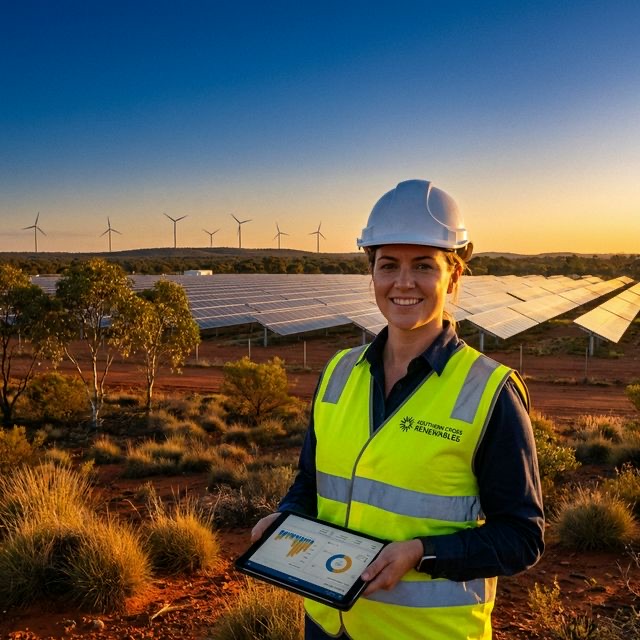
Australia needs renewable energy engineers - urgently. With the Renewable Energy Engineer occupation (ANZSCO 233312) now listed on the Core Skills Occupation List (CSOL), a net-zero target driving massive infrastructure investment, and an estimated 85,000 clean energy workers needed by 2030, the pathway from solar farm to permanent residency has never been clearer.
Whether you design wind turbines in Denmark, develop battery storage in Germany, or engineer solar arrays in India, this guide maps out exactly how to bring your skills to Australia.
Why Renewable Energy Engineers Are in Demand
Australia's energy transformation is one of the largest infrastructure projects in the nation's history. The government's "Future Made in Australia" manufacturing policy, combined with legislated net-zero emissions targets for 2050, is creating thousands of new engineering roles across solar, wind, hydrogen, and battery storage.
Key facts driving demand:
| Factor | Detail |
|---|---|
| Workforce gap | ~85,000 renewable energy workers needed by 2030 |
| CSOL listing | ANZSCO 233312 added to Core Skills Occupation List (2025) |
| Migration priority | Net Zero transition workers explicitly targeted in Outcome-Based Migration strategy |
| Job growth | 64,200 construction + 129,600 operations/maintenance roles projected (2025-2050) |
| Government investment | "Future Made in Australia" policy - 50,000+ green manufacturing jobs anticipated |
Renewable energy engineering is classified as Skill Level 1 (Bachelor's degree or higher), which opens the widest range of visa pathways and typically attracts higher points in the skilled migration system.
Your Visa Pathway Options
The CSOL listing means Renewable Energy Engineers have access to nearly every skilled visa pathway. Here is a comparison of the main options:
| Visa | Type | Key Feature | Employer Needed? |
|---|---|---|---|
| 189 Skilled Independent | Permanent | Points-tested, no sponsor | No |
| 190 State Nominated | Permanent | State nomination + 5 bonus points | No (but need state nomination) |
| 491 Regional | Provisional → PR (191) | 15 bonus points, live/work in regional area for 3 years | No (but need state/family nomination) |
| 482 Skills in Demand (SID) | Temporary → PR (186) | Employer sponsored, pathway to PR | Yes |
| NIV (Subclass 858) | Permanent | For exceptional/senior professionals | No |
Points-Tested Pathways (189, 190, 491)
These visas use Australia's points calculator to rank applicants. The minimum is 65 points, but competitive scores typically sit at 80-90+. Key scoring areas for renewable energy engineers:
| Points Category | Potential Points |
|---|---|
| Age (25-32) | 30 |
| English (Superior - IELTS 8+) | 20 |
| Qualification (Bachelor's) | 15 |
| Overseas experience (8+ years) | 15 |
| Australian experience (3+ years) | 10 |
| State nomination (190) | 5 |
| Regional nomination (491) | 15 |
State nomination requirements and occupation lists are subject to change. Use our ANZSCO Search tool to always confirm current availability for ANZSCO 233312 with your target state before applying.
Employer Sponsored: 482 Skills in Demand (SID) Visa
If you have a job offer from an Australian employer, the Skills in Demand visa provides a direct route. You must earn above the Temporary Skilled Migration Income Threshold (TSMIT), currently $76,515 AUD. After at least two years with your sponsor, you can transition to permanent residency via the Subclass 186 Employer Nomination Scheme.
The application fee for the 482 visa is $3,210 AUD (current as of July 2025). Fees are subject to change.
National Innovation Visa (NIV) - For Senior Professionals
The National Innovation Visa (Subclass 858) replaced the Global Talent Visa in December 2024. "Renewables and Low Emission Technologies" is an explicitly listed priority sector, covering:
- Solar, wind, and hybrid energy systems
- Battery and energy storage design
- Hydrogen technology (production, storage, transport)
- Bioenergy and biofuels
- Micro-grid design
If you have an internationally recognised track record - peer-reviewed research, major project leadership, or industry awards - and can demonstrate earning capacity at or above the Fair Work High Income Threshold ($183,100 AUD for 2025-26), the NIV offers a fast track to permanent residency with no employer requirement.
The NIV is an invitation-only visa. You must first submit an Expression of Interest and secure a nomination from an eligible Australian individual or organisation with a national reputation in your field.
Skills Assessment: Engineers Australia
Before applying for any points-tested or employer-sponsored visa, you need a positive skills assessment from Engineers Australia (EA). There are two main pathways:
| Pathway | Who It's For | What You Submit |
|---|---|---|
| Accredited Qualification | Graduates of Washington Accord-recognised programmes (e.g., most Australian, UK, US, Canadian degrees) | Degree transcript + CV |
| Competency Demonstration Report (CDR) | All other qualifications | 3 career episodes + CPD statement + summary statement |
Assessment fee: Approximately $1,001 AUD (2025-26, incl. GST). Additional fees apply for skilled employment verification ($517 AUD) or fast-track processing ($385 AUD).
Country-Specific Guidance
| Country | Typical Pathway | Notes |
|---|---|---|
| Germany | CDR (unless degree from Washington Accord signatory) | EUR-ACE accredited degrees may still require CDR |
| UK | Accredited Qualification (most ABET/IET-accredited degrees) | Washington Accord member |
| India | CDR | Most Indian engineering degrees require CDR pathway |
| China | CDR | Degrees not covered by Washington Accord |
| Denmark | CDR (unless degree from Washington Accord signatory) | Some DTU programmes may be recognised |
Do not underestimate the CDR process. Each career episode must demonstrate specific engineering competencies mapped to Engineers Australia's standards. Poorly prepared CDRs are a leading cause of assessment failure. Professional guidance can significantly improve your outcome.
Visa Application Fees at a Glance
| Visa | Main Applicant Fee | Additional Adult | Additional Child |
|---|---|---|---|
| 189 / 190 / 491 | $4,910 AUD | $2,455 AUD | $1,230 AUD |
| 482 (SID) | $3,210 AUD | $3,210 AUD | $805 AUD |
| NIV (858) | $4,910 AUD | $2,455 AUD | $1,230 AUD |
Fees listed are current as of July 2025. Visa application fees are subject to change (typically adjusted 1 July each year).
What You Should Do Now
If you are a renewable energy engineer considering Australia, here is your action plan:
- Check your points - Use our free GSM Points Calculator to estimate your score for 189/190/491.
- Prepare your English test - Book IELTS, PTE, or OET. Aim for Superior English (IELTS 8.0 in each band) for maximum points.
- Start your skills assessment - Gather transcripts, reference letters, and begin your CDR if required. Allow 3-6 months for the full process.
- Research state nomination - If targeting 190 or 491, check which states currently list Renewable Energy Engineer. NSW and Queensland have been particularly active in prioritising clean energy occupations.
- Consider employer sponsorship - Australia's renewable energy employers are actively recruiting internationally. A job offer can bypass the points test entirely via the 482/SID pathway.
- Explore the NIV - If you are a senior professional with an exceptional track record, the National Innovation Visa may offer the fastest path to PR.
How First Migration Can Help
The renewable energy migration pathway is new, and getting it right from the start matters. From selecting the optimal visa stream to preparing a competitive CDR and navigating state nomination, the process has multiple moving parts.
At First Migration Service Centre, our registered migration agents specialise in skilled visa applications and can guide you through every step - including skills assessment strategy, points optimisation, and employer sponsorship options.
Ready to take the next step? We invite you to submit a free visa assessment so we can understand your situation and provide tailored advice.
RMA R. Weng
MARA 1569835Registered Migration Agent | Master of Laws (ANU) | Bachelor of Laws (Deakin)
Certified by the Migration Agents Registration Authority (MARA). Specializing in skilled migration, employer-sponsored visas, and partner visas. Admitted to practice law in Victoria.
Related Articles
Subclass 407 Training Visa: The Hidden Stepping Stone to Employer Sponsorship in Australia (2026)
Student Visa Show Money 2026: The New $29,710 Financial Requirement
CELPIP, MET & LanguageCert: Australia's New English Tests Explained (2026 Guide)
Disclaimer: This information is general in nature and does not constitute formal migration advice. Immigration laws and policies change frequently. Always consult a MARA-registered migration agent for advice specific to your circumstances. First Migration Service Centre (MARA 1569835) provides this content for informational purposes only.
MARA Registered Agent
Registration No. 1569835
Certified by the Migration Agents Registration Authority. Your trusted partner for Australian visa applications.
Subclass 407 Training Visa: The Hidden Stepping Stone to Employer Sponsorship in Australia (2026)
Student Visa Show Money 2026: The New $29,710 Financial Requirement
CELPIP, MET & LanguageCert: Australia's New English Tests Explained (2026 Guide)

Mining Engineers: Complete Migration Guide to Australia 2026
How to Migrate as a Paramedic or Ambulance Officer to Australia in 2026: Visa, AHPRA & VETASSESS Guide
Office Hours
Mon-Fri: 9AM-5PM Sat: 10AM-2PM