
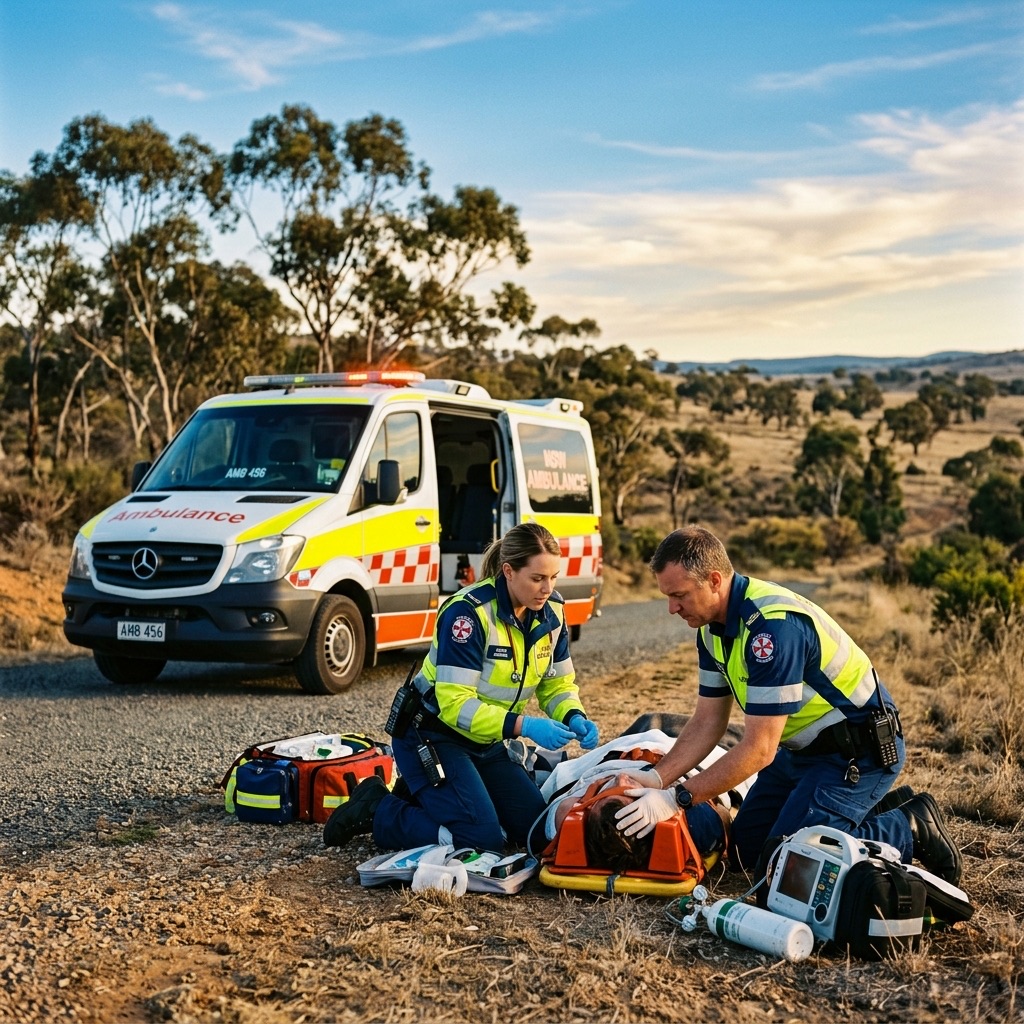
Australia faces a critical shortage of frontline emergency healthcare workers - and paramedics are right at the centre of that crisis. In regional and remote communities, ambulance response times are under pressure, state ambulance services are running international recruitment drives, and governments are fast-tracking nomination pathways for qualified pre-hospital care professionals. If you are looking to migrate as a paramedic to Australia, this is one of the strongest labour market positions you could hold in 2026.
But here's the catch: the migration process for paramedics is uniquely confusing. Unlike nursing - which has decades of established international pathways - paramedicine only became a nationally regulated profession under AHPRA in 2018. That means there are two entirely separate processes you must conquer: your VETASSESS skills assessment (which gives you the right to a visa) and your Paramedicine Board of Australia registration (which gives you the right to practise). Confusing the two - or getting the timing wrong - is the single biggest mistake overseas paramedics make.
This guide breaks down exactly what you need to know in 2026, from ANZSCO code selection to AHPRA registration, visa pathways, and country-specific tips for UK, NZ, US, Canadian, and South African paramedics.
Step 1: Choose Your ANZSCO Code - Ambulance Officer vs. Intensive Care Paramedic
The Department of Home Affairs classifies pre-hospital emergency care into two distinct ANZSCO occupations. Choosing the right one affects your qualification requirements, skills assessment pathway, and visa eligibility. Getting this wrong at the start can cost you months of wasted time and fees.
| Feature | Ambulance Officer (411111) | Intensive Care Ambulance Paramedic (411112) |
|---|---|---|
| Skill Level | ANZSCO Skill Level 2 | ANZSCO Skill Level 1 |
| VETASSESS Group | Group C | Group A |
| Minimum Qualification | AQF Diploma equivalent | AQF Bachelor's Degree equivalent |
| Typical Role | Emergency patient transport, basic life support, primary assessment | Advanced pre-hospital care, invasive procedures, drug administration, critical interventions |
| Employment Requirement | 1 year post-qualification in last 5 years | 1 year post-qualification in last 5 years |
| Assessment Body | VETASSESS | VETASSESS |
The critical distinction: The 411112 Intensive Care Ambulance Paramedic code requires a qualification comparable to an Australian Bachelor of Paramedicine (AQF Level 7). The 411111 Ambulance Officer code can be satisfied with a Diploma-level qualification (AQF Level 5). This matters enormously for international applicants.
North American applicants - read this carefully: Australian paramedicine is degree-based. The standard pathway in Australia is a three-year Bachelor of Paramedicine. This is fundamentally different from the US and Canadian systems, where many paramedics hold certificate-level qualifications. If you hold a US NREMT-Paramedic certification without a bachelor's degree, you will likely need to target the 411111 (Ambulance Officer) pathway. If you hold a degree-level paramedic science qualification - increasingly common from universities like Creighton, Western Carolina, or UBC - you may be eligible for 411112.
Don't guess your ANZSCO code. Use our ANZSCO Occupation Search tool to verify which code matches your qualifications and experience. The wrong code can lead to a skills assessment refusal.
Step 2: The VETASSESS Skills Assessment - Your Ticket to a Visa
Your VETASSESS skills assessment is what the Department of Home Affairs requires for visa eligibility. Without a positive outcome, you cannot lodge a skilled visa application - regardless of how experienced you are or whether you already hold AHPRA registration.
What VETASSESS Assesses
VETASSESS evaluates two components:
- Your Qualification: Is it comparable in level and content to the required Australian qualification?
- Your Employment: Have you completed at least one year of post-qualification, highly relevant employment in the last five years, working 20 or more hours per week?
Requirements by ANZSCO Code
411111 - Ambulance Officer (VETASSESS Group C):
- Qualification at AQF Diploma level or higher in a field highly relevant to the occupation
- At least 1 year of post-qualification, highly relevant employment completed in the last 5 years
- If your qualification is NOT highly relevant: 2 years of post-qualification relevant employment required (reduced to 1 year if you also hold an additional relevant AQF Certificate IV or higher)
411112 - Intensive Care Ambulance Paramedic (VETASSESS Group A):
- Qualification at AQF Bachelor's degree level or higher in a field highly relevant to the occupation
- At least 1 year of post-qualification, highly relevant employment completed in the last 5 years
VETASSESS Fees and Processing
| Service | Cost (AUD) |
|---|---|
| Full Skills Assessment | $1,096 (excl. GST) |
| Priority Processing | $825 (additional) |
| Points Test Advice | $311 (additional) |
Processing times typically range from 8 to 12 weeks for the standard pathway. Priority processing can reduce this to approximately 4-6 weeks. These fees are current as of October 2025 and are subject to change.
Start your VETASSESS application early. Many applicants underestimate the documentation requirements. You will need certified copies of your qualification transcripts, evidence of curriculum content (to demonstrate relevance), and detailed statements of service from your employers covering dates, hours, and duties performed.
The Critical Difference: VETASSESS vs AHPRA
This is where most overseas paramedics get confused:
| VETASSESS | AHPRA (Paramedicine Board) | |
|---|---|---|
| Purpose | Migration skills assessment - for visa eligibility | Professional registration - for the right to practise in Australia |
| Who needs it? | Anyone applying for a skilled visa (189/190/491/482) | Anyone who wants to work as a paramedic in Australia |
| Can you do both simultaneously? | Yes - and you should | Yes |
| Processing time | 8-12 weeks | Variable - can take 3-6+ months depending on outcome |
| Does one satisfy the other? | No | No |
Strategic timing: Apply for both your VETASSESS assessment and your AHPRA qualification assessment at the same time. Do not wait for one to finish before starting the other. Parallel processing can save you 3-6 months.
Step 3: Paramedicine Board Registration - Your Licence to Practise
Since December 2018, paramedicine has been a nationally regulated profession under the National Registration and Accreditation Scheme (NRAS). This means you cannot practise as a paramedic in Australia without registration from the Paramedicine Board of Australia, administered through AHPRA. This is separate from - and additional to - your VETASSESS skills assessment.
The Assessment Process for Overseas-Qualified Paramedics
If your qualification was obtained outside Australia, you must go through a formal qualification equivalence process:
Step A - Portfolio Assessment: You submit a Portfolio for the Assessment of Non-Approved Qualifications (PNAQ) to AHPRA. This includes your full academic transcripts, curriculum details, evidence of clinical placements, and proof of current registration in your home country.
Step B - Assessment Outcome: The Board will determine one of three outcomes:
| Outcome | What It Means | What Happens Next |
|---|---|---|
| Substantially Equivalent | Your qualification meets Australian standards | Proceed to registration application |
| Requires Competency Assessment | Your qualification has gaps | Complete a paramedicine competency assessment |
| Not Equivalent | Significant gaps identified | May need to complete bridging education or additional study in Australia |
Step C - Registration Application: Once your qualifications are assessed as suitable, you apply for registration. You must also satisfy:
- English Language Skills (see requirements below)
- Criminal History Check (national and international)
- Recency of Practice - evidence of recent clinical practice
- Professional Indemnity Insurance - typically provided by your employer
English Language Requirements for AHPRA Registration
The Paramedicine Board uses the standard AHPRA English language requirements (revised March 2025):
| Test | Overall | Listening | Reading | Speaking | Writing |
|---|---|---|---|---|---|
| IELTS Academic | 7.0 | 7.0 | 7.0 | 7.0 | 6.5 |
| PTE Academic | 66 | 66 | 66 | 66 | 56 |
| OET | - | B | B | B | C+ |
You may achieve these scores across a maximum of two test sittings within a 12-month period. The writing component threshold was reduced in March 2025 - a welcome change for many international applicants.
Education pathway alternative: If you completed at least two years of secondary education AND your paramedicine degree in a recognised English-speaking country (UK, Ireland, USA, Canada, NZ, or South Africa), you may be exempt from the test requirement through the Combined Education Pathway.
AHPRA registration is the #1 reason paramedic visa applications get delayed or fail. Many applicants secure a positive VETASSESS outcome and a visa invitation, only to discover their AHPRA registration process takes 6+ months. If you arrive in Australia on an employer-sponsored visa but cannot register with AHPRA, you cannot legally work as a paramedic. Start this process as early as possible.
AHPRA Registration Fee
The annual registration fee for paramedics is $250 for the 2025/2026 registration period (1 December 2025 to 30 November 2026). This is significantly lower than many other AHPRA-registered professions.
Step 4: Best Visa Pathways for Paramedics in 2026
Paramedics benefit from strong demand across multiple visa pathways. Here is a strategic breakdown of your options:
Visa Pathway Comparison
| Pathway | Visa Subclass | Application Fee (AUD) | Type | Key Advantage |
|---|---|---|---|---|
| Skilled Nominated | 190 | $4,910 | Permanent | Direct PR - states actively prioritise healthcare |
| Skilled Work Regional | 491 | $4,910 | Provisional (5 yr) → PR via 191 | Fastest route - lower point thresholds, +15 state nomination points |
| Employer Sponsored | 482 | $1,730 | Temporary (up to 4 yr) | No points test - employer sponsors directly |
| Employer Nomination Scheme | 186 | $4,770 | Permanent | Direct PR through employer - no points test |
Subclass 190 - Skilled Nominated (State Sponsorship)
The 190 visa is the permanent residency golden ticket for skilled paramedics. State governments actively prioritise frontline healthcare workers during nomination rounds. You need:
- A positive VETASSESS skills assessment
- At least 65 points on the GSM points test (including the +5 state nomination bonus)
- An Expression of Interest (EOI) in SkillSelect
- A nomination invitation from a state or territory government
In practice, competitive scores for healthcare occupations in 2025-26 have ranged from 65-80 points depending on the state. The key advantage for paramedics is that healthcare workers are often prioritised even at lower point scores.
Subclass 491 - Skilled Work Regional (The Fastest Route)
The 491 visa is arguably the most accessible pathway for paramedics in 2026. Regional Australia faces the most acute paramedic shortages - rural and remote ambulance services struggle to recruit, and the 491's generous +15 state nomination points make it achievable for many applicants.
The 491 is a 5-year provisional visa. After living and working in a designated regional area for 3 years and meeting the income threshold ($53,900 per year), you can apply for the Subclass 191 permanent visa. Given that paramedic salaries in regional areas typically range from $85,000 to $160,000+ depending on the state and experience level, the income requirement is rarely a barrier.
"Regional" includes more than you think. Under Australia's regional visa framework, designated regional areas include everywhere except Sydney, Melbourne, and Brisbane metro. This means Gold Coast, Perth, Adelaide, Hobart, Canberra, and Newcastle are all classified as regional. You are not limited to remote outback stations.
Subclass 482/186 - Employer Sponsorship
State ambulance services (Ambulance Victoria, NSW Ambulance, QLD Ambulance Service, St John WA, and SA Ambulance Service) regularly run international recruitment campaigns, particularly targeting UK-trained paramedics. Private patient transport companies (such as Royal Flying Doctor Service, CareFlight, and various private ambulance operators) also sponsor overseas paramedics.
The employer sponsorship pathway has significant advantages:
- No points test required - your employer nominates you directly
- TSMIT threshold ($73,150) is well below typical paramedic salaries
- Direct PR via 186 is available after 2-3 years on a 482
Salary Expectations
Australian paramedic salaries are competitive by international standards:
| State/Territory | Estimated Salary Range (AUD) | Notes |
|---|---|---|
| New South Wales | $71,000 - $135,000+ | Multi-year union-negotiated increases |
| Victoria | $75,000 - $130,000+ | Pay scales vary by classification |
| Queensland | $80,000 - $160,000+ | Remote/regional roles attract higher pay |
| Western Australia | $115,000 - $160,000+ | Pilbara/Kimberley premiums |
| South Australia | $80,000 - $155,000+ | Rolled-in penalty rates in some areas |
| Tasmania | $83,000 - $140,000+ | Year 1 to Year 7+ progression |
| Northern Territory | $110,000 - $160,000+ | Higher base for remote conditions |
These figures include base salary but often exclude penalty rates for shift work (nights, weekends, public holidays), which can add 15-30% to take-home pay. Paramedic salaries are governed by state-based enterprise agreements - check the relevant state ambulance service website for current pay schedules.
State nomination requirements and occupation lists are subject to change. Please confirm current availability before applying. Each state publishes its own skilled occupation list independently, and paramedic nominations fluctuate based on workforce demand.
Step 5: Country-Specific Tips
If paramedicine is not quite the right fit, you may also want to explore our guides for related healthcare professions: Registered Nurse Migration to Australia and Allied Health Workers: Which State Needs You Most? cover similar AHPRA registration processes with different assessing bodies and scope-of-practice requirements.
🇬🇧 United Kingdom (HCPC-Registered Paramedics)
The UK is the dominant source of overseas paramedics in Australia - and for good reason. UK BSc Paramedic Science degrees and HCPC registration align closely with Australian standards, making UK paramedics highly desirable candidates.
Key advantages:
- Three-year BSc (Hons) Paramedic Science maps directly to Australian Bachelor of Paramedicine equivalence
- HCPC registration demonstrates a regulated professional standard
- English language exemption usually available through the Combined Education Pathway (no IELTS/PTE required for AHPRA)
- Strong bilateral recruitment agreements - multiple Australian ambulance services actively recruit in the UK
What to expect: Many UK paramedics receive a "substantially equivalent" outcome from the Paramedicine Board's portfolio assessment. However, some may be required to complete a supervised practice period upon arrival in Australia to familiarise themselves with Australian medication protocols, scope of practice differences, and local procedures.
🇳🇿 New Zealand (The Fast-Track Pathway)
If you are currently registered as a paramedic in New Zealand, you have access to the Trans-Tasman Mutual Recognition Act (TTMRA) - the fastest pathway to Australian practice.
Under TTMRA, NZ-registered paramedics can apply directly for Australian registration with the Paramedicine Board without undergoing the full portfolio equivalence assessment. You must still meet suitability requirements (criminal history, recency of practice, English language where applicable), but the qualification assessment is effectively waived.
This makes the NZ→Australia pathway significantly faster and simpler than for any other country. If you are a paramedic considering Australia, registering in NZ first (if you are eligible) could be a strategic stepping stone.
🇿🇦 South Africa
South Africa produces clinically strong paramedics with extensive field experience, particularly in trauma management. South African Emergency Care Technician (ECT) and National Diploma in Emergency Medical Care qualifications are generally well-regarded.
Important considerations:
- English language testing is mandatory. Even though South Africa is an English-speaking country, AHPRA's education pathway exemption requires that your qualifying degree was taught and assessed entirely in English at a recognised institution. Some South African qualifications may still require formal IELTS/PTE/OET testing - confirm with AHPRA before assuming an exemption.
- Degree-level qualification required for 411112. The National Diploma in Emergency Medical Care (3 years) may align with AQF Diploma level, directing you toward 411111. The BTech or Bachelor of Emergency Medical Care aligns with 411112.
🇺🇸 United States & 🇨🇦 Canada
The US and Canadian paramedicine systems differ significantly from Australia's degree-based model. Many US paramedics hold certificate-level qualifications (NREMT-Paramedic) without a bachelor's degree.
If you DON'T have a bachelor's degree:
- Target ANZSCO 411111 (Ambulance Officer) - assessed at AQF Diploma level
- Consider employer sponsorship (482/186) where the specific qualification requirements may be more flexible if combined with extensive experience
- Explore upskilling options: some Australian universities offer bridging or conversion programmes for experienced paramedics
If you DO have a bachelor's degree:
- Target ANZSCO 411112 (Intensive Care Ambulance Paramedic)
- US/Canadian BSc Paramedicine degrees from accredited universities (e.g., Creighton, Oregon Health & Science University, Western Carolina, University of British Columbia) generally map well to Australian AQF Level 7
- English language exemption should be available through the Combined Education Pathway
How First Migration Can Help
Navigating the dual-track process of VETASSESS skills assessment and AHPRA Paramedicine Board registration - while simultaneously identifying the right visa pathway and state nomination strategy - is one of the most complex migration journeys in Australian healthcare. The timing between these parallel processes is critical, and mistakes can delay your move by 12 months or more.
At First Migration Service Centre, our registered migration agents specialise in healthcare migration pathways. We help paramedics and ambulance officers from the UK, New Zealand, South Africa, the US, and Canada navigate every step - from ANZSCO code selection and VETASSESS documentation preparation to state nomination strategy and AHPRA registration timing.
Australia needs your skills right now, and state ambulance services are actively hiring. Don't let paperwork hold you back from your dream move.
👉 Submit a free visa assessment so we can understand your situation and provide tailored advice on the fastest pathway for your qualifications and experience.
RMA R. Weng
MARA 1569835Registered Migration Agent | Master of Laws (ANU) | Bachelor of Laws (Deakin)
Certified by the Migration Agents Registration Authority (MARA). Specializing in skilled migration, employer-sponsored visas, and partner visas. Admitted to practice law in Victoria.
Related Articles
What the 67-Day 189 Blackout Actually Means (And What It Does Not)
South Australia Skilled Migration Reopens 26 August 2026: What 190/491 Applicants Should Check Before Lodging

Mining Engineers: Complete Migration Guide to Australia 2026
Disclaimer: This information is general in nature and does not constitute formal migration advice. Immigration laws and policies change frequently. Always consult a MARA-registered migration agent for advice specific to your circumstances. First Migration Service Centre (MARA 1569835) provides this content for informational purposes only.
MARA Registered Agent
Registration No. 1569835
Certified by the Migration Agents Registration Authority. Your trusted partner for Australian visa applications.

South Australia DAMA Expires 30 September 2026: What the Deadline Means and Whether You Should Lodge Before It
What the 67-Day 189 Blackout Actually Means (And What It Does Not)
South Australia Skilled Migration Reopens 26 August 2026: What 190/491 Applicants Should Check Before Lodging
Onshore vs Offshore in 2026: How Location Sets Your Queue Position

Adding a Dependent Child Over 18 to Your Australian Visa (2026)
Office Hours
Mon-Fri: 9AM-5PM Sat: 10AM-2PM