
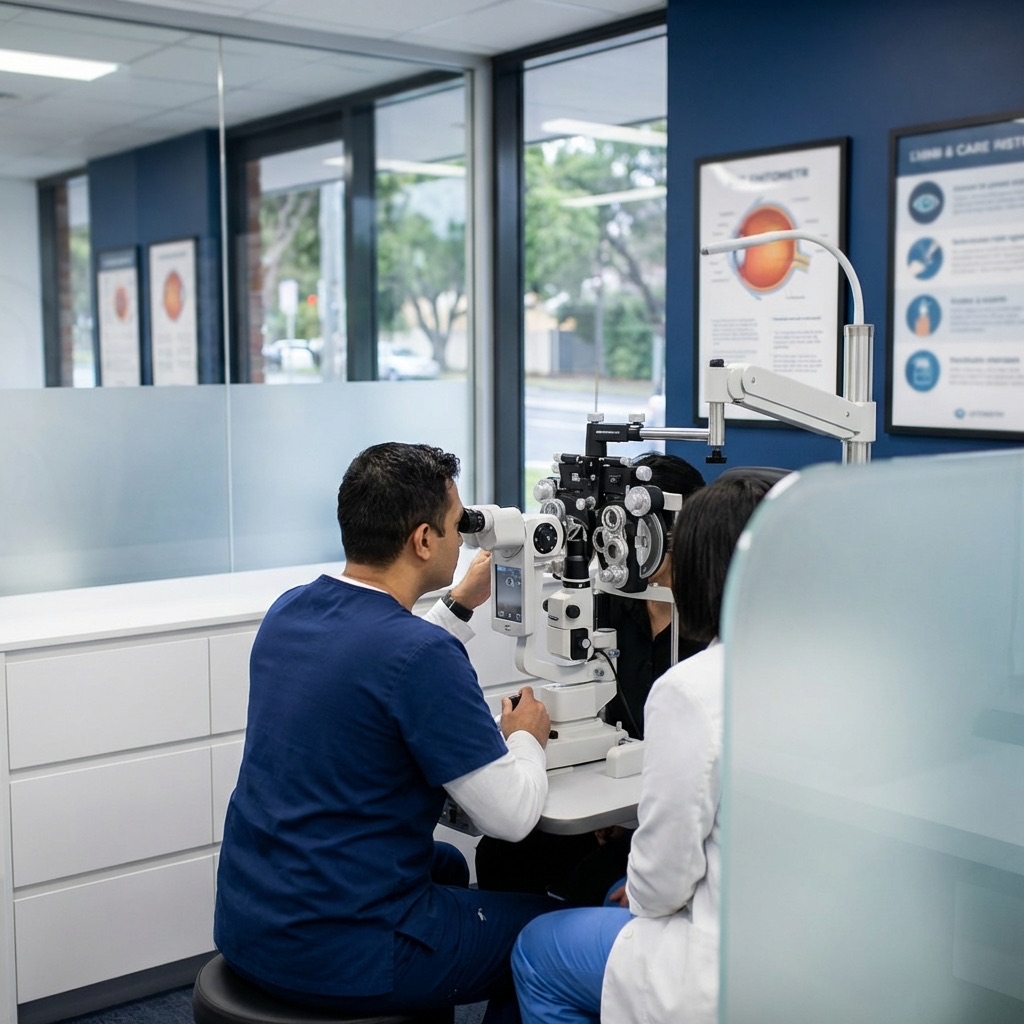
Considering bringing your optometry expertise to Australia? Whether you're a qualified optometrist from the UK, India, South Africa, Ireland, Taiwan, Hong Kong, or China, this comprehensive guide breaks down everything you need to know-from the OCANZ competency assessment to AHPRA registration and skilled visa pathways.
Australia's healthcare sector faces a growing shortage of eye care professionals, making optometrists highly sought-after-particularly in regional areas. With clear pathways to permanent residency and Medicare billing eligibility, 2026 offers excellent opportunities. However, successful migration requires more than just securing a visa; it demands a synchronized strategy that aligns your visa conditions with Medicare provider number eligibility.
The Critical Insight: While the 189 visa offers permanent residency, Medicare Section 19AB creates a 10-year moratorium on billing in metropolitan areas. This means the Subclass 491 regional visa often provides the most pragmatic pathway-its regional residence requirement aligns perfectly with Medicare Distribution Priority Area (DPA) exemptions, allowing immediate billing rights.
Why Optometry Is a Golden Ticket Occupation
Optometrists enjoy several advantages that make this one of the most favourable healthcare professions for Australian migration:
| Advantage | Details |
|---|---|
| MLTSSL Listed | Optometrist (ANZSCO 251411) is on the Medium and Long-term Strategic Skills List |
| Eligible for 189 | Direct pathway to permanent residency without state or employer sponsorship |
| Medicare Eligible | Can bulk-bill patients in Distribution Priority Areas |
| High Regional Salaries | Metro: $75,000-$115,000 AUD; Regional: $90,000-$180,000+ AUD |
| Corporate Support | Major chains (Specsavers, OPSM) actively sponsor visas and provide structured pathways |
The Regional Advantage: "Healthcare shortage" in Australia means regional shortage. Overseas optometrists who target regional positions-rather than competing for saturated metro roles-access higher salaries, immediate Medicare billing rights, and faster visa pathways.
Understanding the Three Regulatory Layers
Before diving into the specifics, it's crucial to understand that Australia's optometry regulation involves three separate authorities with distinct functions:
Loading diagram...
| Authority | Function | Key Impact |
|---|---|---|
| OCANZ | Skills assessment for visa; Competency exam for registration | Controls exam eligibility via Form 2/Form 3 pathways |
| Optometry Board (AHPRA) | Professional registration | Determines General vs Endorsed registration |
| Medicare (Services Australia) | Provider numbers for billing | Section 19AB restricts metro billing for 10 years |
A positive OCANZ skills assessment allows you to apply for a skilled visa, but it does not grant you the right to practise. You must separately pass the full OCANZ Competency in Optometry Examination (COE) and register with AHPRA. Even then, Medicare Section 19AB may restrict where you can bill.
OCANZ Assessment: Form 2 vs Form 3 Pathways
The first strategic step is determining your eligibility pathway. OCANZ maintains "Appendix B"-a list of recognized overseas qualifications. This effectively divides applicants into two streams.
Direct Entry Pathway (Form 2)
Candidates holding qualifications listed in Appendix B can sit the exam immediately, bypassing curriculum assessment.
Recognized Qualifications by Country:
| Country | Recognized Institutions/Qualifications |
|---|---|
| United Kingdom | BSc (Hons) or MOptom from GOC-approved universities (Aston, Bradford, Cardiff, City, Manchester, Ulster, Glasgow Caledonian) + pre-registration year + College of Optometrists exams |
| Ireland | Dublin Institute of Technology BSc Hons in Optometry |
| South Africa | University of Johannesburg, UKZN, University of the Free State (post-1980/2005 dates apply) |
| USA/Canada | Doctor of Optometry (OD) from ACOE-accredited schools |
| India (Limited) | BITS Pilani/Bausch & Lomb (BS Optom from 2000), Bharati Vidyapeeth (B.Clin.Optom from 2004), Amity University (B.Clin.Optom from 2018), Bharathiar University (BSc Optom from 2016) |
New Zealand Exception: Optometrists registered with New Zealand's ODOB with therapeutic scope can apply directly to AHPRA under the Trans-Tasman Mutual Recognition Act. They are exempt from the COE, ACOT, and English testing.
Assessment Pathway (Form 3)
Applicants from non-listed institutions-including most universities in China, Taiwan, Hong Kong, and non-listed Indian institutions-must submit Form 3 for curriculum assessment.
Assessment Criteria:
| Requirement | Minimum Standard |
|---|---|
| Duration | 4 years full-time study, OR 3 years + 1 year supervised clinical practice |
| Instruction Hours | 2,000 hours (one-third in biomedical, visual, and optical sciences) |
| Clinical Training | 400+ hours supervised patient contact |
Common Denial Reason: Degrees with insufficient "biomedical" content-common in some optical-focused programs-may be deemed ineligible. Meticulous documentation of your curriculum is essential for Form 3 success.
The OCANZ Competency in Optometry Examination (COE)
The COE is a rigorous, high-stakes assessment with three components:
Component 1: Written Examinations (Remote)
Since 2024, these exams are online and remotely proctored-you can sit them from your home country.
| Paper | Format | Duration |
|---|---|---|
| Clinical Science | Multiple-choice questions | 3 hours |
| Diagnosis and Management | Short-answer clinical cases | 3 hours |
2026 Examination Dates:
| Series | Dates | Applications Close |
|---|---|---|
| March Series | 2-3 March 2026 | 5 February 2026 |
| August Series | 3-4 August 2026 | 3 July 2026 |
Re-sit Policy: If you pass one paper but fail the other, you can carry the pass forward for one subsequent attempt. Failing twice requires re-sitting both papers.
Component 2: Cultural Safety Training
Mandatory since July 2023, this online module must be completed after passing the written exams but before the clinical exam.
- Content: History of colonisation, systemic racism in healthcare, culturally safe care for Aboriginal and Torres Strait Islander peoples
- Cost: $291 AUD (non-refundable)
Component 3: Clinical Examination (Melbourne)
This face-to-face assessment at the Australian College of Optometry (ACO) in Melbourne is the final hurdle.
| Component | Assessment |
|---|---|
| Skills Station | Retinoscopy, slit lamp biomicroscopy, applanation tonometry, gonioscopy |
| Patient Examination | Four real patient consultations with diagnosis and management plans |
2026 Clinical Dates:
| Series | Sessions | Applications Close |
|---|---|---|
| Series 1 | Weeks of 15 June & 22 June 2026 | 7 May 2026 |
| Series 2 | Weeks of 9, 16, 23 November 2026 | 8 October 2026 |
Clinical exam slots sell out quickly. Do not book travel until OCANZ confirms your allocated session. Failure in the Skills Station prevents progression to the Patient Examination in that session.
OCANZ Fee Schedule (July 2025 - June 2026)
| Stage | Item | Fee (AUD) |
|---|---|---|
| Eligibility | Form 2 Application (Direct) | $868 |
| Form 3 Application (Assessment) | $868 | |
| Written Exams | Both Papers | $3,534 |
| Single Paper Repeat | $1,858 | |
| Cultural Safety | Online Training Module | $291 |
| Clinical Exams | Skills Examination | $2,863 |
| Patient Examination | $4,722 | |
| Therapeutics | ACOT Examination | $3,213 |
| ACOT Application | $868 | |
| Total (Minimum) | Base Assessment Path | ~$12,278 |
All fees are payable per attempt and are non-refundable. The clinical component alone costs $7,585 AUD. Budget for potential resits when planning your migration finances.
The Therapeutic Divide: General vs Endorsed Registration
This is the most critical-and often overlooked-distinction for overseas optometrists. In 2026, approximately 80% of Australian optometrists are therapeutically endorsed, meaning they can prescribe Schedule 4 medicines (antibiotics, corticosteroids, anti-glaucoma agents).
Why Endorsement Matters
| Registration Type | Prescribing Rights | Employability |
|---|---|---|
| General Registration | Basic only (non-prescription) | Very limited-requires referrals for common conditions |
| Endorsed for Scheduled Medicines | Schedule 2, 3, 4 medicines (topical) | Full employability-essential for private practice |
The Employment Reality: A non-endorsed optometrist is significantly harder to employ. Corporate employers (Specsavers, Luxottica) and rural practices almost exclusively recruit endorsed practitioners. Without endorsement, you cannot independently manage common conditions like bacterial conjunctivitis or glaucoma.
The UK/Ireland "Therapeutic Gap"
This creates the highest friction for UK and Irish optometrists. Even those with UK Independent Prescribing (IP) rights do not receive automatic recognition in Australia.
The Problem: UK IP training is viewed as distinct from Australia's endorsement model. UK graduates typically pass the COE (gaining General Registration) but must then complete additional steps for therapeutic endorsement.
The Solution: UK/Ireland graduates must either:
- Sit the ACOT examination (Assessment of Competence in Ocular Therapeutics) - approximately $4,000 AUD, or
- Complete an Australian Graduate Certificate in Ocular Therapeutics (12 months part-time)
ACOT Examination Requirements
| Requirement | Details |
|---|---|
| Eligibility | Must hold an overseas therapeutic qualification |
| Case Reports | Submit 3 patient case reports demonstrating therapeutic management |
| Oral Examination | 1-hour viva voce assessment |
| Cost | ~$4,081 AUD (application + examination) |
For India, China, Taiwan, Hong Kong: Degrees from these jurisdictions rarely include therapeutic training. The recommended strategy is to gain General Registration first, then enrol in a part-time Graduate Certificate in Ocular Therapeutics (offered by UNSW, ACO, or QUT) while working in Australia. This takes approximately 12 months.
Medicare Section 19AB: The Economic Barrier
For an optometrist to operate in private practice, they need a Medicare Provider Number to bill the government or allow patient rebates. Access is heavily restricted for overseas-trained practitioners.
The 10-Year Moratorium
Under Section 19AB of the Health Insurance Act 1973, overseas-trained practitioners face a 10-year restriction on Medicare billing from their first Australian registration date.
| Location Type | Can You Bill Medicare? |
|---|---|
| Distribution Priority Areas (DPAs) | ✅ Yes - Section 19AB exemption applies |
| Metropolitan Areas (Sydney, Melbourne, Brisbane, Perth, Adelaide CBD) | ❌ No - Cannot bill for 10 years |
The Metro Trap: An optometrist who migrates on a 189 visa and moves to Sydney may be legally allowed to practice, but cannot bill Medicare. Patients would pay the full fee with no rebate-commercially unviable in most clinics.
How to Access Medicare Billing Rights
| Strategy | How It Works |
|---|---|
| Work in a DPA | Most regional areas qualify. Immediate Section 19AB exemption. |
| Scaling Credits | Remote (RA4/RA5) work can reduce the 10-year moratorium to 5-6 years |
| Locum Exemption | Temporary exemption (up to 6 months) for replacing other practitioners |
The Golden Path: The Subclass 491 visa requires living in a regional area for 3 years. This requirement perfectly aligns with Medicare DPA requirements. What appears to be a visa restriction becomes an asset-you gain both visa requirement compliance AND immediate Medicare billing rights simultaneously.
Visa Pathways for Optometrists
Optometrists (ANZSCO 251411) are on the Medium and Long-term Strategic Skills List (MLTSSL), providing access to the widest range of skilled visa options.
Strategic Visa Comparison
| Visa | Pros | Cons | Medicare Alignment |
|---|---|---|---|
| 189 Skilled Independent | Permanent residency; no sponsor needed | Highly competitive (85+ points); no Medicare exemption for metro | ⚠️ Still requires DPA work for billing |
| 190 State Nominated | +5 points; permanent residency | 2-year state commitment; metro nominations subject to 19AB | ⚠️ Depends on nomination location |
| 491 Skilled Regional | +15 points; lower competition | 3-year regional requirement; provisional visa | ✅ Aligns perfectly with DPA exemption |
| 482 Employer Sponsored | Fast processing; employer support | Tied to sponsor; temporary | ✅ If regional employer |
Use our GSM Points Calculator to estimate your eligibility.
State Nomination Policies (2025-2026)
| State | Status | Strategic Insight |
|---|---|---|
| New South Wales | Open | Health workers prioritised. 491 via RDA offices is primary route; Sydney (190) saturated |
| Victoria | Open | "Fast Track" for health professionals. 491 for Geelong, Bendigo, Ballarat offers streamlined path |
| Queensland | Open | Requires registration eligibility. Regional QLD (Townsville, Cairns) has high demand |
| Western Australia | Open | Actively inviting candidates with 80+ points. Schedule 1 includes Optometrists |
| South Australia | Priority | Strong state support for health professionals |
| Tasmania | Regional priority | 491 pathway strongly supported |
| Northern Territory | Critical shortage | DAMA pathways with age concessions available |
State Nomination Disclaimer: State nomination requirements and occupation lists are subject to change. Please confirm current availability with each state's skilled migration authority before applying.
Visa Application Fees (Current as of July 2025)
| Visa | Main Applicant | Partner (18+) | Child (under 18) |
|---|---|---|---|
| 189 | $4,910 | $2,455 | $1,230 |
| 190 | $4,910 | $2,455 | $1,230 |
| 491 | $4,910 | $2,455 | $1,230 |
Country-Specific Strategic Guidelines
United Kingdom & Ireland
| Factor | Details |
|---|---|
| Qualification Status | Appendix B (Direct Entry via Form 2) |
| Assessment Path | Form 2 → Written COE → Clinical COE |
| Therapeutic Gap | ⚠️ Major friction-UK IP not automatically recognised. Plan ACOT or Grad Cert immediately after COE |
| Migration Strategy | Strong candidates for 189/190 due to English proficiency, but 491 recommended for Medicare alignment |
| Job Market | Highly sought by Specsavers/OPSM who value similar clinical training |
India
| Factor | Details |
|---|---|
| Qualification Status | Mixed-check Appendix B for your institution |
| Direct Entry | BITS Pilani, Bharati Vidyapeeth, Amity, Bharathiar only |
| Other Institutions | Form 3 required-meticulous 2000-hour and 400-hour clinical documentation essential |
| English | IELTS 7.0 in each band is common stumbling block-preparation essential |
| Therapeutics | Bridging course required (Graduate Certificate) |
| Migration Strategy | High points competition. Regional visas (491) in WA or SA most viable |
South Africa
| Factor | Details |
|---|---|
| Qualification Status | Appendix B (Direct Entry) for Johannesburg, UKZN, Free State |
| Assessment Path | Form 2 → Written COE → Clinical COE |
| Therapeutics | Training often clinically robust, but ACOT or bridging likely required |
| Job Market | Integrates well into rural Australian practice; strong demand in QLD and WA |
China, Taiwan, Hong Kong
| Factor | Details |
|---|---|
| Qualification Status | Form 3 (Assessment Pathway) required for most |
| Key Challenge | Desktop audit is critical-insufficient "biomedical" content (common in optical-focused degrees) may cause denial |
| English | IELTS 7.0 / OET B mandatory |
| Therapeutics | Bridging course required |
| Migration Strategy | Points strategy vital-Age, English, and Regional Nomination (491) are key levers |
Employment & Salary: Metro vs Regional
The narrative that "Australia pays well" holds true, but only outside major cities. Metro saturation has led to salary stagnation for entry-level roles.
| Role | Metro Salary (AUD) | Regional Salary (AUD) |
|---|---|---|
| Graduate Optometrist (0-2 years) | $75,000 - $85,000 | $90,000 - $110,000 |
| General Optometrist (3-5 years) | $95,000 - $115,000 | $120,000 - $145,000 |
| Senior/Lead Optometrist (5+ years) | $120,000 - $140,000 | $150,000 - $180,000+ |
| Locum Optometrist | $60 - $80/hr | $100 - $150/hr |
Corporate vs Independent Sector
| Sector | Characteristics | For Migrants |
|---|---|---|
| Corporate (Specsavers, OPSM/Luxottica) | Structured graduate programs; visa sponsorship via 482; therapeutic upskilling support; Specsavers "Partnership" model can yield $200,000+ | Best entry point-actively sponsor visas |
| Independent Practices | More clinical autonomy; longer consult times (30-40 mins vs 20 mins) | Prefer "job-ready" endorsed candidates; less likely to sponsor |
English Language Requirements
For Visa Applications
| Test | Competent English | Proficient (+10 points) | Superior (+20 points) |
|---|---|---|---|
| IELTS | 6.0 each band | 7.0 each band | 8.0 each band |
| PTE Academic | 50 each band | 65 each band | 79 each band |
| OET | B each band | B each band (not for higher points) | - |
For healthcare professionals, OET (Occupational English Test) is often easier as it uses healthcare-specific scenarios. A grade of B in each component is generally accepted as equivalent to Competent English.
Timeline: From Assessment to Practice
Here's a realistic timeline for an overseas-trained optometrist:
| Stage | Timeframe |
|---|---|
| Gather documents and apply for OCANZ Form 2/3 | 2-4 weeks |
| OCANZ eligibility assessment | 4 weeks |
| Prepare for and sit written exam | 2-6 months |
| Complete Cultural Safety Training | 2-4 weeks |
| Wait for clinical exam slot | 3-6 months |
| Sit clinical examination (in Melbourne) | 1-2 weeks in Australia |
| Apply for visa (189/190/491) | Variable (EOI + invitation) |
| Visa processing | 6-12 months |
| Apply for AHPRA registration | 4-8 weeks |
| ACOT or Graduate Certificate (if required) | 6-12 months |
| Total estimated timeline | 18-30 months |
Clinical examination slots are limited and competitive. Plan your timeline carefully and apply for exam spots as soon as you're eligible.
What You Should Do Now
- Identify your pathway: Check if your qualification is in OCANZ Appendix B (Form 2) or requires assessment (Form 3)
- Apply for OCANZ assessment: Start the eligibility process-this takes approximately 4 weeks
- Book your English test: Complete IELTS, PTE, or OET (OET B is sufficient for registration)
- Calculate your points: Use our GSM Points Calculator to estimate your score
- Consider the 491 regional pathway: If your points are below 85, the 491 visa offers 15 bonus points AND Medicare alignment
- Plan for therapeutic endorsement: If from UK/Ireland, budget for ACOT; if from Asia, plan for Graduate Certificate
- Plan finances: Budget approximately $25,000-$35,000 AUD for assessment fees, visa costs, therapeutic bridging, and relocation
How First Migration Can Help
Navigating the complex intersection of OCANZ assessment, AHPRA registration, Medicare restrictions, and visa applications can be overwhelming. At First Migration Service Centre, our registered migration agents specialise in guiding healthcare professionals through every step of the process.
Ready to take the next step? We invite you to submit a free visa assessment so we can understand your situation and provide tailored advice.
RMA R. Weng
MARA 1569835Registered Migration Agent | Master of Laws (ANU) | Bachelor of Laws (Deakin)
Certified by the Migration Agents Registration Authority (MARA). Specializing in skilled migration, employer-sponsored visas, and partner visas. Admitted to practice law in Victoria.
Related Articles
Subclass 407 Training Visa: The Hidden Stepping Stone to Employer Sponsorship in Australia (2026)
Student Visa Show Money 2026: The New $29,710 Financial Requirement
CELPIP, MET & LanguageCert: Australia's New English Tests Explained (2026 Guide)
Disclaimer: This information is general in nature and does not constitute formal migration advice. Immigration laws and policies change frequently. Always consult a MARA-registered migration agent for advice specific to your circumstances. First Migration Service Centre (MARA 1569835) provides this content for informational purposes only.
MARA Registered Agent
Registration No. 1569835
Certified by the Migration Agents Registration Authority. Your trusted partner for Australian visa applications.
Subclass 407 Training Visa: The Hidden Stepping Stone to Employer Sponsorship in Australia (2026)
Student Visa Show Money 2026: The New $29,710 Financial Requirement
CELPIP, MET & LanguageCert: Australia's New English Tests Explained (2026 Guide)

Mining Engineers: Complete Migration Guide to Australia 2026

How to Migrate as a Paramedic or Ambulance Officer to Australia in 2026: Visa, AHPRA & VETASSESS Guide
Office Hours
Mon-Fri: 9AM-5PM Sat: 10AM-2PM