
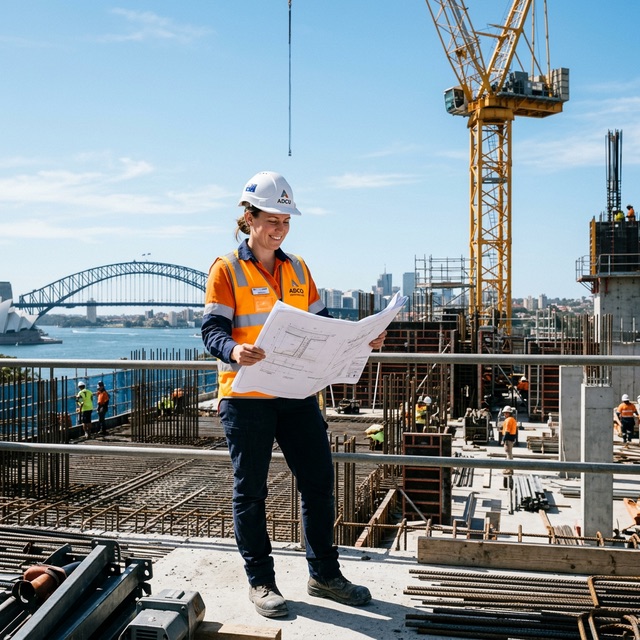
Australia's infrastructure boom is in full swing - with over $120 billion committed to transport, energy, and housing projects, civil engineers are among the most sought-after professionals in the country. Civil Engineer (ANZSCO 233211) consistently receives the highest number of invitations in Australia's skilled migration programme, and the demand extends across structural, geotechnical, and quantity surveying disciplines. If you're a civil engineer planning to migrate, this guide covers everything from writing a winning Competency Demonstration Report (CDR) to choosing the right skilled visa pathway.
Which ANZSCO Codes Are Covered?
Australia's civil engineering unit group (2332) includes four closely related occupations - all assessed by Engineers Australia and all eligible for the same visa pathways:
| ANZSCO Code | Occupation | Skill List |
|---|---|---|
| 233211 | Civil Engineer | MLTSSL |
| 233212 | Geotechnical Engineer | MLTSSL |
| 233213 | Quantity Surveyor | MLTSSL |
| 233214 | Structural Engineer | MLTSSL |
All four appear on the Medium and Long-term Strategic Skills List (MLTSSL), meaning they qualify for Subclass 189, 190, 491, and 482 visas. You can search for your exact ANZSCO code to confirm your occupation's eligibility.
If your degree covers multiple civil disciplines, choose the ANZSCO code that best matches your work experience, not just your degree title. Engineers Australia assesses your CDR against the specific occupation you nominate.
Engineers Australia CDR: The Skills Assessment
For civil engineers without a Washington Accord-accredited degree, Engineers Australia requires a Competency Demonstration Report (CDR) to assess your qualifications and competency. Even if you hold an accredited degree, understanding the CDR framework helps you present the strongest possible case.
What's in a CDR?
A complete CDR submission includes:
| Component | Requirements |
|---|---|
| 3 Career Episodes (CEs) | Narratives of 1,000-2,500 words each, describing personal engineering achievements |
| Summary Statement (SS) | A matrix mapping your competencies to specific paragraphs in each Career Episode |
| Continuing Professional Development (CPD) | A record of your professional growth - courses, conferences, certifications |
CDR Assessment Fees (July 2025 Pricing)
| Package | Fee (inc. GST) |
|---|---|
| Standard CDR assessment | $1,001 |
| CDR + skilled employment assessment | $1,452 |
| CDR + overseas PhD assessment | $1,281.50 |
| CDR + employment + PhD | $1,732.50 |
| Fast-track add-on (20 business days) | +$385 |
Standard processing takes 8-12 weeks. Fees are current as of July 2025 and are subject to change.
Engineers Australia updated their competency standards in 2025. All new CDR submissions must align with the updated Australian Engineering Competency Standards framework.
Writing Winning Career Episodes for Civil Engineering
Your Career Episodes are the heart of your CDR. Each one must demonstrate your personal contribution to a specific engineering project - not your team's work. Here's what Engineers Australia assessors want to see from civil engineers:
Career Episode Topics by Discipline
Civil Engineer (233211):
- Road and highway design using Civil 3D or 12d Model
- Stormwater drainage design and flood mitigation modelling
- Site grading, earthworks calculations, and mass-haul optimisation
- Traffic engineering and intersection design
Structural Engineer (233214):
- High-rise building structural design using SAP2000 or ETABS
- Bridge design and rehabilitation - load analysis, reinforcement solutions
- Seismic retrofitting of existing structures
- Steel frame design for industrial warehouses
Geotechnical Engineer (233212):
- Soil investigation, borehole sampling, and foundation recommendations
- Slope stability analysis for highways or mining operations
- Ground improvement techniques - chemical stabilisation, grouting, stone columns
- Retaining wall design and lateral earth pressure calculations
Quantity Surveyor (233213):
- Cost estimation for commercial or infrastructure projects
- Bill of quantities preparation and tender evaluation
- Variation management and final account settlement
- Life-cycle cost analysis for public infrastructure
CDR Writing Tips That Actually Matter
- Use "I", not "We" - Write "I designed the drainage system" rather than "We designed the drainage system." Your personal contribution must be crystal clear
- Name your tools and standards - Reference specific software (AutoCAD Civil 3D, STAAD Pro, SAFE, Plaxis, ETABS) and standards (AS/NZS 1170, AS 3600, AS 4100, Eurocode)
- Show the problem-solving chain - Define the technical problem → explain your engineering approach → describe the outcome with measurable results
- Vary your three episodes - Choose projects from different phases of your career or different sub-disciplines to demonstrate breadth
Visa Pathways for Civil Engineers
Civil engineers on the MLTSSL have access to multiple visa pathways. For a broader overview of engineering migration, see our complete guide for engineers moving to Australia. For a detailed comparison of the three points-tested visas, read 189 vs 190 vs 491: Which Skilled Visa is Right for You?.
Here's how the main pathways compare for civil engineers:
| Feature | Subclass 189 | Subclass 190 | Subclass 491 | Subclass 482 |
|---|---|---|---|---|
| Type | Skilled Independent | State Nominated | Skilled Work Regional | Employer Sponsored |
| PR? | ✅ Direct PR | ✅ Direct PR | Provisional → 191 PR | Temporary → 186 PR |
| Points Test? | Yes (min 65) | Yes (min 65 + 5) | Yes (min 65 + 15) | No |
| State Nomination? | No | Yes (required) | Yes (required) | No (employer sponsors) |
| Application Fee | $4,910 | $4,910 | $4,910 | $1,730 |
| Regional Requirement | No | 2-year commitment | 3 years in regional area | No |
Fees are current as of July 2025 and are subject to change. The next fee adjustment is expected on 1 July 2026.
The Subclass 189 visa allocation for 2025-26 was largely exhausted after the August and November 2025 rounds. If you missed out, the next major round is expected in the 2026-27 programme year. In the meantime, Subclass 190 and 491 are your strongest pathways.
Points Strategy for Civil Engineers
The minimum points required is 65, but competitive scores for civil engineers are significantly higher. Use our GSM Points Calculator to estimate your score.
| Factor | Typical Civil Engineer Profile | Points |
|---|---|---|
| Age (25-32) | Most applicants | 30 |
| Bachelor of Civil Engineering | 4-year degree | 15 |
| Proficient English (IELTS 7 / PTE 65) | Common benchmark | 10 |
| 3-5 years overseas experience | Mid-career engineer | 5 |
| Subtotal (no nomination) | 60 | |
| State Nomination (190) | +5 | 65 ✅ |
| State Nomination (491) | +15 | 75 ✅ |
| Improve English to Superior (IELTS 8 / PTE 79) | +10 more | 70/80 |
How to Reach 85+ Points
If you're targeting 189 or a competitive 190, here's how to bridge the gap:
- Superior English (IELTS 8.0 / PTE 79+): +20 points total (the single biggest booster)
- Australian study requirement: +5 points (2 academic years of CRICOS study)
- Professional Year Programme: +5 points (12-month structured programme)
- NAATI community language credential: +5 points
- STEM qualification: +10 points (most civil engineering degrees qualify)
- Partner skills + English: up to +10 points
State Nomination Strategy for Civil Engineers (2026)
State nomination is where civil engineers have a major advantage. Infrastructure demand varies by state, and knowing where to apply can make or break your invitation.
| State | Demand for Civil Engineers | Typical Points (190/491) | Key Sectors |
|---|---|---|---|
| NSW | 🔥 Very High | 80-90 | WestConnex, Sydney Metro, Western Sydney Airport |
| Queensland | 🔥 Very High | 75-85 | Cross River Rail, Olympic infrastructure, mining |
| Victoria | High | 75-85 | Suburban Rail Loop, North East Link, Metro Tunnel |
| Western Australia | High | 75-80 | Mining, Metronet, Port Hedland expansion |
| South Australia | High | 70-75 | Adelaide infill, defence precinct, Torrens to Darlington |
| Tasmania | Moderate | 65-70 | Regional projects, lower competition |
State nomination requirements and occupation lists are subject to change. Please confirm current availability before applying.
Timeline: From CDR to PR
Here's a realistic timeline for a civil engineer applying from overseas:
| Step | Timeframe |
|---|---|
| Prepare CDR (3 Career Episodes + CPD + Summary Statement) | 4-8 weeks |
| Engineers Australia assessment | 8-12 weeks (standard) |
| English test (IELTS / PTE) | 2-4 weeks |
| Lodge EOI on SkillSelect | Immediate |
| Receive invitation (190/491) | 2-12 weeks (varies by state) |
| Lodge visa application | Within 60 days of invitation |
| Visa processing | 6-12 months |
| Total | ~9-18 months |
How First Migration Can Help
Australia needs civil engineers - but the path from CDR to PR involves detailed documentation, strategic state selection, and precise timing. At First Migration Service Centre, our registered migration agents specialise in skilled visa applications for engineers.
We can help you:
- Choose the right ANZSCO code for your profile
- Review and refine your CDR Career Episodes
- Maximise your points score before lodging your EOI
- Identify the best state nomination strategy for your situation
Ready to take the next step? We invite you to submit a free visa assessment so we can understand your situation and provide tailored advice.
RMA R. Weng
MARA 1569835Registered Migration Agent | Master of Laws (ANU) | Bachelor of Laws (Deakin)
Certified by the Migration Agents Registration Authority (MARA). Specializing in skilled migration, employer-sponsored visas, and partner visas. Admitted to practice law in Victoria.
Related Articles
Disclaimer: This information is general in nature and does not constitute formal migration advice. Immigration laws and policies change frequently. Always consult a MARA-registered migration agent for advice specific to your circumstances. First Migration Service Centre (MARA 1569835) provides this content for informational purposes only.
MARA Registered Agent
Registration No. 1569835
Certified by the Migration Agents Registration Authority. Your trusted partner for Australian visa applications.

Points Test Reform Consultation Is Open: What It Means for You

Australia's Age Pension Explained: Rates, Tests & Residency (2026)

Australian Visa Fees Jump 25% on 1 July 2026: New Cost of Every Visa

Dietitians: Migration & Skills Assessment Guide to Australia 2026

Truck Drivers: The Real Migration Pathway to Australia 2026 (DAMA)
Office Hours
Mon-Fri: 9AM-5PM Sat: 10AM-2PM