
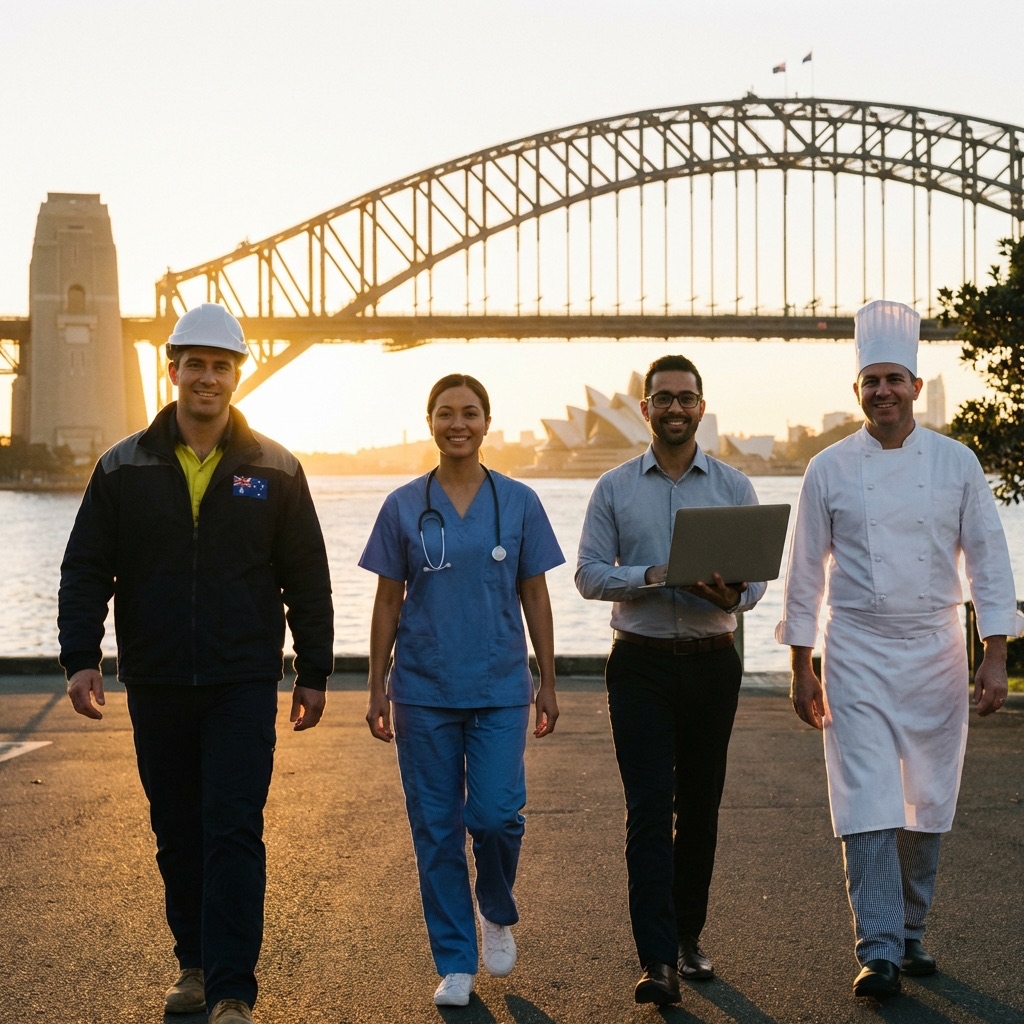
Australia's permanent migration program for 2025-2026 has been confirmed at 185,000 places, unchanged from the previous year. At the same time, net overseas migration (NOM) has fallen sharply from its post-pandemic peak of 538,000 to 306,000-a 43% contraction in two years. Understanding the difference between these two numbers, and where you fit in this program, is more important than ever.
Watch our video explainer:
Two Numbers People Confuse: 185,000 vs 306,000
Before diving into the details, let's clarify a common source of confusion:
- 185,000 = the permanent Migration Program planning level (a policy "tap")
- 306,000 = net overseas migration in 2024-25 (a population "thermometer")
The permanent program controls how many people receive PR each year. NOM measures the net population change from all migration-temporary and permanent-based on arrivals minus departures. Critically, around 60-70% of permanent visas are granted to people already in Australia (onshore), meaning "permanent intake" doesn't equal "new arrivals."
The Big Picture: 185,000 Permanent Places
The Albanese Government has maintained the 2025-26 Migration Program at 185,000 places following consultation with states and territories. This represents a balanced approach: large enough to address critical skills shortages while managing population growth concerns.
| Stream | Places | Percentage |
|---|---|---|
| Skill Stream | 132,200 | 71% |
| Family Stream | 52,500 | 28% |
| Special Eligibility | 300 | 1% |
| Total | 185,000 | 100% |
The 71:29 Skill/Family split reflects Australia's policy priority: skilled migration drives the permanent program. If you're a skilled worker, you're in the favoured category.
Skill Stream Breakdown: 132,200 Places
The Skill stream is where the action is. Here's the precise allocation across visa pathways:
| Visa Category | Places | Key Visas |
|---|---|---|
| Employer Sponsored | 44,000 | 186, Skills in Demand |
| State/Territory Nominated | 33,000 | 190 |
| Skilled Regional | 33,000 | 491, 494 |
| Skilled Independent | 16,900 | 189 |
| Talent and Innovation | 4,300 | 858 (NIV) |
| Business Innovation | 1,000 | Legacy BIIP |
What the Numbers Tell Us
Employer Sponsored (44,000) is the largest category-33% of all skilled places. This reflects labour-market reality: employers, not government, identify where skills gaps exist. If you have a job offer from an Australian employer, you're in the strongest position.
State/Territory Nominated + Regional (66,000 combined) shows the policy push toward decentralisation. However, actual state nomination allocations for 2025-26 were set at only 20,350-well below the 33,000 planning level-creating intense competition for state sponsorship.
Skilled Independent (16,900) has shrunk significantly from historical levels (30,000+ in previous years). Without a sponsor, you face a highly competitive points-test environment with cut-offs often exceeding 85-95 points.
New in 2025-26: Talent and Innovation Category
The Talent and Innovation category (4,300 places) consolidates the previous Global Talent, Distinguished Talent, and Business Innovation programs into the new National Innovation Visa (NIV). This visa eliminates points testing for eligible candidates-instead requiring proof of "internationally recognised exceptional talent" in priority sectors:
- Renewables and low-emissions technologies
- Medical science and health
- Critical technologies (AI, quantum, cyber security)
- Advanced manufacturing
If you're an elite professional, researcher, or entrepreneur in these fields, this pathway offers fast-track permanent residency without occupation list restrictions.
Family Stream: 52,500 Places
The Family stream supports social cohesion and family reunification. Here's the detailed breakdown:
| Visa Category | Places | Key Visas |
|---|---|---|
| Partner | 40,500 | 820/801, 309/100 |
| Parent | 8,500 | 143, 864, 103 |
| Child | 3,000 | 101, 802 |
| Other Family | 500 | Various |
Partner and Child visas are demand-driven with indicative planning levels, meaning the government processes all eligible applications rather than applying strict caps. This category cannot be easily "turned off" without major policy change.
If you're applying for a partner visa, processing times have improved, though you should still expect 12-18 months for most cases. Parent visas remain heavily backlogged, with non-contributory queues exceeding 30 years and over 100,000 applications waiting.
Net Overseas Migration: The Bigger Migration Picture
While the permanent program sits at 185,000, net overseas migration (NOM)-the total population change from all migration-tells a different story.
| Financial Year | Net Overseas Migration | Treasury Forecast |
|---|---|---|
| 2022-23 | 538,000 (record high) | - |
| 2023-24 | 429,000 | - |
| 2024-25 | 306,000 | - |
| 2025-26 | - | 260,000 |
According to the Australian Bureau of Statistics, NOM dropped by 124,000 in 2024-25, driven by:
- 14% decrease in migrant arrivals (from 661,000 to 568,000)
- 13% increase in migrant departures (from 232,000 to 263,000)
The fall is largely driven by temporary visa holders. International student departures surged 48% as post-pandemic cohorts completed their studies. Treasury forecasts NOM will continue falling to around 260,000 in 2025-26, approaching pre-pandemic levels of 190,000-235,000.
The key insight: reducing permanent visa places won't directly cut NOM in the short term, because most PR recipients are already counted in the temporary population. The government is managing NOM through temporary visa levers-stricter student requirements, shorter graduate visas, and tighter compliance-not by cutting permanent migration.
What This Means for You
If you're pursuing PR through skilled migration or employer sponsorship, the pathway remains open and stable. But if you're on a student or Working Holiday visa, converting to permanent residency requires careful planning-the "side doors" are closing.
The Skills in Demand Visa: The New Temporary Foundation
The Skills in Demand (SID) visa replaced the Temporary Skill Shortage (TSS 482) visa from 7 December 2024. It introduces a three-tier structure:
| Stream | Salary Threshold | Key Features |
|---|---|---|
| Specialist Skills | $135,000+ | No occupation list (except trades), 7-day processing target |
| Core Skills | $73,150-$135,000 | Tied to Core Skills Occupation List (CSOL) |
| Essential Skills | Below $73,150 | Labour Agreements only (aged care, meat processing) |
Worker mobility is a game-changer: SID visa holders can now leave their sponsor and have 180 days to find a new employer (previously 60 days). This empowers workers to negotiate better conditions and leave exploitative employers.
Who Benefits from This Program?
Winners
- Employer-sponsored workers: The Skills in Demand visa offers faster processing and a guaranteed pathway to PR
- Healthcare professionals: Nurses, aged care workers, and doctors remain in critical demand across all states
- High-income professionals: The Specialist Skills stream ($135,000+ salary) bypasses occupation list restrictions entirely
- Trades workers: Electricians, plumbers, and carpenters are prioritised, especially in regional areas
- Regional migrants: 491 and 494 visa holders enjoy state support and eventual PR pathways
Challenges
- Students: Stricter Genuine Student requirements, higher English thresholds (IELTS 6.5), and shorter graduate visas
- Independent applicants: With only 16,900 places and points cut-offs exceeding 85-95, the 189 visa is increasingly competitive
- Occupations off the list: If your job isn't on the Core Skills Occupation List, employer sponsorship via Specialist stream may be your only option
- Older applicants: Age remains a points barrier for those over 40 (though DAMA pathways offer concessions)
Priority Occupations for 2025-26
The 132,200 skilled places are allocated based on Jobs and Skills Australia data. Priority sectors include:
- Healthcare and Aged Care: Registered nurses, GPs, aged care workers, allied health professionals
- Engineering: Civil, structural, mechanical, environmental, and cyber security engineers
- ICT: Software engineers, cybersecurity specialists, data scientists
- Construction and Trades: Electricians, plumbers, carpenters, welders
- Education: Early childhood, primary, secondary, and special education teachers
What You Should Do Now
-
Check your occupation: Use our ANZSCO Search tool to confirm your role is on the relevant occupation list for your target visa. Use our points calculator to assess your skilled visa eligibility.
-
Get your skills assessed: Whether through TRA, VETASSESS, ACS, or AHPRA, a positive skills assessment is your foundation.
-
Consider state nomination: Each state has different priorities and limited allocations. NSW, Victoria, and WA control the largest quotas. Research which state aligns with your profession.
-
Act on employer sponsorship: If you have an employer willing to sponsor, the Skills in Demand visa offers the clearest pathway to PR. High earners ($135,000+) can bypass occupation lists entirely.
-
Plan for timing: Invitation rounds, state nomination windows, and processing times all affect your timeline. Don't wait until your current visa expires.
How First Migration Can Help
Navigating these changes can be complex, but you don't have to do it alone. At First Migration Service Centre, our registered migration agents are ready to guide you through every step-from skills assessment to visa lodgement to PR.
Ready to take the next step? We invite you to submit a free visa assessment so we can understand your situation and provide tailored advice.
RMA R. Weng
MARA 1569835Registered Migration Agent | Master of Laws (ANU) | Bachelor of Laws (Deakin)
Certified by the Migration Agents Registration Authority (MARA). Specializing in skilled migration, employer-sponsored visas, and partner visas. Admitted to practice law in Victoria.
Related Articles
Subclass 407 Training Visa: The Hidden Stepping Stone to Employer Sponsorship in Australia (2026)
Student Visa Show Money 2026: The New $29,710 Financial Requirement
CELPIP, MET & LanguageCert: Australia's New English Tests Explained (2026 Guide)
Disclaimer: This information is general in nature and does not constitute formal migration advice. Immigration laws and policies change frequently. Always consult a MARA-registered migration agent for advice specific to your circumstances. First Migration Service Centre (MARA 1569835) provides this content for informational purposes only.
MARA Registered Agent
Registration No. 1569835
Certified by the Migration Agents Registration Authority. Your trusted partner for Australian visa applications.
Subclass 407 Training Visa: The Hidden Stepping Stone to Employer Sponsorship in Australia (2026)
Student Visa Show Money 2026: The New $29,710 Financial Requirement
CELPIP, MET & LanguageCert: Australia's New English Tests Explained (2026 Guide)

Mining Engineers: Complete Migration Guide to Australia 2026

How to Migrate as a Paramedic or Ambulance Officer to Australia in 2026: Visa, AHPRA & VETASSESS Guide
Office Hours
Mon-Fri: 9AM-5PM Sat: 10AM-2PM