
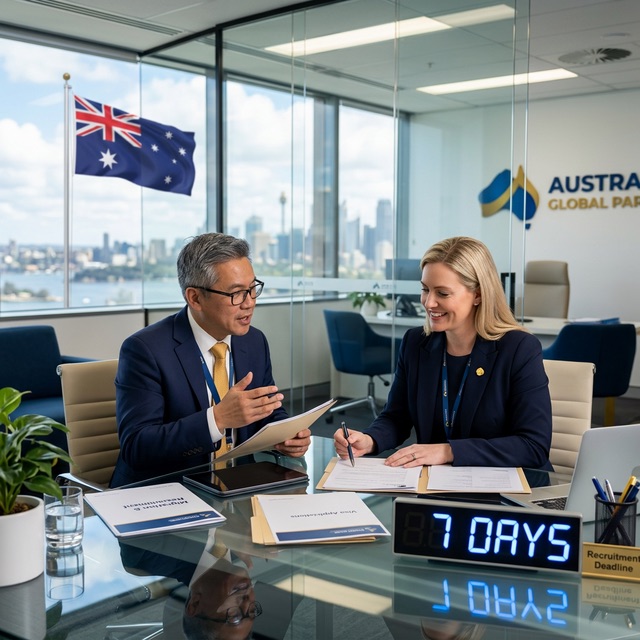
Seven days. That's the Department of Home Affairs' new processing target for Specialist Skills pathway nominations under the Skills in Demand (SID) visa - down from a historical average of two to four months. For Core Skills pathway nominations, the target is 21 days. These benchmarks, introduced as part of the 6 March 2026 visa processing overhaul, represent the most aggressive employer-sponsored visa processing targets Australia has ever set. But hitting those targets requires employers to submit what the Department calls a "decision-ready" application - and that changes everything about how businesses should approach sponsorship.
What Are the New Processing Targets?
The March 2026 overhaul introduced tiered processing benchmarks specifically for employer-sponsored visas:
| SID Pathway | Processing Target | Income Threshold (Current) | Income Threshold (From 1 Jul 2026) |
|---|---|---|---|
| Specialist Skills | 7 days | $141,210 AUD | $146,717 AUD |
| Core Skills | 21 days | $76,515 AUD | $79,499 AUD |
| Essential Skills (Labour Agreement) | Case-by-case | Varies by agreement | Varies by agreement |
These are internal Department benchmarks, not guaranteed timeframes. They apply to "decision-ready" applications - meaning every document, every form, and every piece of evidence must be complete and correct at the time of lodgement. Incomplete applications may still face delays or, under the new AI triaging system, faster refusals.
The Specialist Skills pathway does not require an occupation to be on the Core Skills Occupation List (CSOL). Any occupation qualifies - except trades workers, machinery operators, drivers, and labourers - provided the guaranteed annual earnings meet the threshold.
Why This Matters for Employers
Before these targets, an employer nominating an overseas worker could reasonably expect a two-to-five-month wait for a 482/SID nomination decision. During that time, the role sat unfilled or relied on temporary arrangements. For businesses in competitive sectors - tech, healthcare, engineering, mining - that delay meant lost productivity and revenue.
The new targets fundamentally change the calculation:
| Scenario | Before (Old Average) | After (Decision-Ready) |
|---|---|---|
| Software architect earning $180,000 | 2-4 months | 7 days (Specialist Skills) |
| Registered nurse earning $85,000 | 2-5 months | 21 days (Core Skills, CSOL) |
| Chef earning $78,000 | 2-5 months | 21 days (Core Skills, CSOL) |
| Aged care worker on Labour Agreement | Case-by-case | Case-by-case (Essential Skills) |
For HR managers running workforce planning, the difference between "maybe three months" and "seven working days" is transformational - but only if the nomination is truly decision-ready.
The Decision-Ready Checklist for Employers
To hit these processing targets, the Department expects every employer nomination to arrive complete. Here's what "decision-ready" means in practice:
Sponsorship (Standard Business Sponsor)
- Active Standard Business Sponsorship (SBS) - valid for 5 years
- Business is lawfully operating in Australia
- No outstanding compliance issues or sanctions
- SAF levy payment ready at nomination lodgement
Nomination Package
- Genuine position evidence: detailed job description matching the nominated ANZSCO code, organisational chart, evidence of business need
- Market salary rate: employment contract showing guaranteed annual earnings above the relevant threshold (CSIT or SSIT), plus evidence that the salary meets the Annual Market Salary Rate (AMSR)
- Labour Market Testing (if required): advertisements placed within the required timeframe on recognised platforms
- SAF levy paid in full at lodgement:
| Employer Turnover | SID Visa (Per Year) | 186 PR (One-Off) |
|---|---|---|
| Under $10M | $1,200 | $3,000 |
| $10M or more | $1,800 | $5,000 |
The SAF levy cannot be passed on to the employee. Employers who attempt to recover sponsorship or nomination costs from workers risk sanctions and potential barring as a sponsor.
Visa Applicant's Documents (Lodged Simultaneously)
- Valid passport with sufficient validity
- Skills assessment outcome (if required for the occupation - check your ANZSCO code before applying)
- English language test results meeting minimum requirements
- Health examination completed (HAP ID uploaded)
- Police clearances from every country of residence (12+ months)
- At least one year of relevant work experience in the past five years
Common Mistakes That Blow the 7-Day Target
Even with a well-prepared nomination, common errors can push your application into the "requires further information" queue - effectively losing the speed advantage:
-
Job description doesn't match ANZSCO: If the duties listed in the employment contract don't align with the nominated occupation's typical tasks, expect a delay or refusal. Use the ANZSCO Occupation Search to verify the right code before nominating.
-
Salary below threshold: The guaranteed annual earnings must meet the relevant income threshold and the market salary rate. Base salary alone may not suffice - ensure the contract specifies guaranteed earnings including any guaranteed allowances.
-
Stale Labour Market Testing: LMT evidence must meet the prescribed timeframe requirements. Recycling old job advertisements is a common rejection trigger.
-
Health and police checks not uploaded at lodgement: Under the new AI triaging system, applications without completed health and character checks may be deprioritised or refused rather than held for further information.
-
Paying SAF levy late: The levy must be paid at the time of nomination lodgement, not after.
The PR Pathway: Two Years, Not Three
A significant advantage of the SID visa for both employers and workers is the streamlined permanent residency pathway. After two years of employment with the sponsoring employer in the nominated occupation, a SID visa holder can apply for the Subclass 186 Employer Nomination Scheme (ENS) visa through the Temporary Residence Transition (TRT) stream.
This is shorter than the previous three-year pathway under the old 482 visa framework, making sponsorship a more attractive proposition for both parties.
Workers who lose their employment now have 180 days (up from 60 days under the old 482 framework) to find a new sponsor. This increased mobility protection makes the SID visa significantly more attractive to skilled candidates.
What Employers Should Do Now
1. Audit Your Sponsorship Status
Check that your Standard Business Sponsorship is current and free of compliance issues. If your SBS has expired or is due for renewal, lodge the renewal well before you need to nominate a worker.
2. Prepare Nomination Packs in Advance
Don't wait until you've found the right candidate. Prepare template nomination packs with pre-written job descriptions (aligned to ANZSCO codes), organisational charts, and market salary evidence. When the right candidate appears, you can move immediately.
3. Brief Your Candidates Early
Tell prospective workers to complete health examinations, police checks, and English tests before the nomination is lodged. Simultaneous lodgement of a decision-ready nomination and visa application is the fastest path.
4. Understand Your Ongoing Obligations
Sponsoring an overseas worker carries ongoing obligations including:
- Notifying the Department within 28 days of any significant changes (worker ceases employment, role changes, business restructure)
- Ensuring equivalent pay and conditions to Australian workers
- Maintaining records related to sponsored employees
- Not recovering sponsorship costs from the worker
For a detailed comparison of all employer-sponsored visa options, see our 482 vs 186 vs Skills in Demand comparison guide.
How First Migration Can Help
The new 7-day and 21-day processing targets are achievable - but only for applications that arrive decision-ready. At First Migration Service Centre, we help businesses and HR teams prepare complete, audit-proof nomination packs that take full advantage of the new speed targets.
Our registered migration agents can:
- Audit your current sponsorship status and identify gaps
- Prepare ANZSCO-aligned job descriptions and market salary evidence
- Coordinate health, police, and skills assessment requirements with your candidate
- Lodge nomination and visa applications simultaneously for the fastest possible outcome
Ready to take the next step? We invite you to submit a free visa assessment so we can understand your sponsorship needs and provide tailored advice on how to achieve the fastest possible processing under the new targets.
RMA R. Weng
MARA 1569835Registered Migration Agent | Master of Laws (ANU) | Bachelor of Laws (Deakin)
Certified by the Migration Agents Registration Authority (MARA). Specializing in skilled migration, employer-sponsored visas, and partner visas. Admitted to practice law in Victoria.
Related Articles
Disclaimer: This information is general in nature and does not constitute formal migration advice. Immigration laws and policies change frequently. Always consult a MARA-registered migration agent for advice specific to your circumstances. First Migration Service Centre (MARA 1569835) provides this content for informational purposes only.
MARA Registered Agent
Registration No. 1569835
Certified by the Migration Agents Registration Authority. Your trusted partner for Australian visa applications.

Dietitians: Migration & Skills Assessment Guide to Australia 2026

Truck Drivers: The Real Migration Pathway to Australia 2026 (DAMA)

Physiotherapists: Migration & Registration Guide to Australia 2026

Pharmacists: Migration & Registration Guide to Australia 2026

Occupational Therapists: Your Regional Migration Pathway to Australia 2026
Office Hours
Mon-Fri: 9AM-5PM Sat: 10AM-2PM