
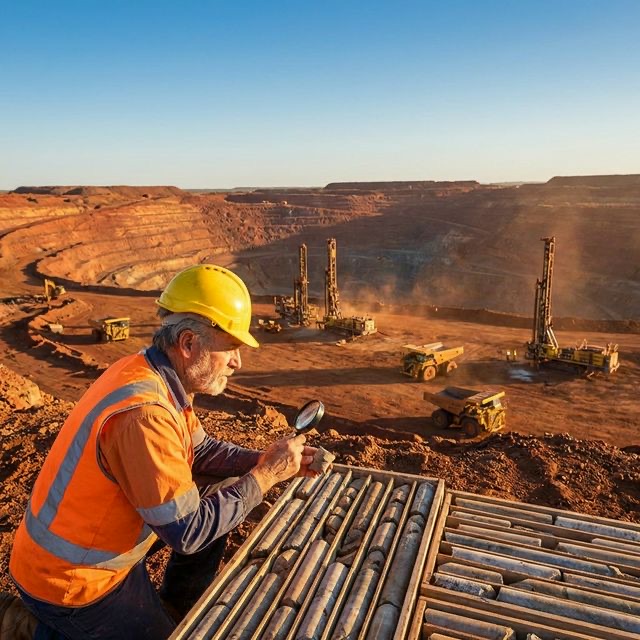
Australia's mining sector is booming, and the country needs geologists more than ever. As the world's largest lithium producer and a top-five rare earths supplier, Australia's Critical Minerals Strategy (2023-2030) is driving unprecedented demand for geoscientists - and the workforce simply cannot keep up. With 31% of Australia's geoscience professionals projected to retire by 2031, the door to permanent residency has never been wider for qualified geologists, geophysicists, and hydrogeologists.
Why Australia Is Recruiting Geoscientists Now
Australia isn't just any mining economy - it's the mining economy. The country's critical minerals push, centred on lithium, rare earths, cobalt, and nickel, has turned geoscientists into some of the most sought-after professionals in the migration programme.
Here's what makes the timing exceptional:
- National shortage confirmed: All three geoscience occupations (Geologist, Geophysicist, Hydrogeologist) are listed as national shortage occupations on the 2025 Skills Priority List
- Retirement cliff: Nearly a third of the existing geoscience workforce is projected to retire within the next five years
- Critical minerals investment: The "Future Made in Australia" policy is injecting billions into exploration and downstream processing
- State competition: Western Australia, Queensland, South Australia, and the Northern Territory are actively competing for overseas geoscientists through state nomination and DAMA pathways
Eligible Occupations & ANZSCO Codes
Search for your geoscience occupation to check which visa lists it appears on:
| Occupation | ANZSCO Code | Skills Assessment Body | Occupation List |
|---|---|---|---|
| Geologist | 234411 | VETASSESS | MLTSSL |
| Geophysicist | 234412 | VETASSESS | MLTSSL |
| Hydrogeologist | 234413 | VETASSESS | MLTSSL |
All three occupations appear on the Medium and Long-term Strategic Skills List (MLTSSL), making them eligible for the full range of skilled visa pathways - including the Subclass 189 (Skilled Independent), 190 (State Nominated), and 491 (Skilled Work Regional) visas.
VETASSESS Skills Assessment: What You Need
Geoscience occupations are classified as VETASSESS Group A, which means the assessment requirements are qualification-focused and relatively straightforward compared to many other occupations.
Qualification Requirements
You must hold a qualification assessed as comparable to an Australian Bachelor degree (AQF Level 7) or higher. Your major field of study must be highly relevant to your nominated occupation.
| Occupation | Relevant Fields of Study |
|---|---|
| Geologist (234411) | Geology, Applied Geology, Earth Sciences, Sedimentology, Petrology, Environmental Geoscience |
| Geophysicist (234412) | Geophysics, Applied Geophysics, Physics (with geophysics specialisation) |
| Hydrogeologist (234413) | Hydrogeology, Groundwater Hydrology, Environmental Hydrogeology |
Employment Requirements
You must demonstrate at least one year of post-qualification employment at an appropriate skill level, completed within the last five years, working 20 hours or more per week. The tasks performed must be highly relevant to the nominated occupation.
Unlike many trade occupations, geoscientists do not need to complete a Job Ready Program (JRP). The VETASSESS pathway is a document-based assessment - no workplace observation required.
VETASSESS Fees
| Service | Fee (excl. GST) |
|---|---|
| Full Skills Assessment | AUD $1,096 |
| Priority Processing (add-on) | AUD $825 |
| Post-Study-Work (Subclass 485) Assessment | AUD $416 |
Fees current as of October 2025. GST applies to applicants assessed within Australia.
Visa Pathways for Geoscientists
Subclass 189 - Skilled Independent
The 189 visa grants permanent residency without requiring state nomination or employer sponsorship. You lodge an Expression of Interest (EOI) and wait for an invitation based on your points score.
Minimum points: 65 (competitive scores are typically 70-85)
Subclass 190 - State Nominated
State nomination adds 5 bonus points to your score and requires a two-year commitment to the nominating state. Several states are actively seeking geoscientists:
| State/Territory | Geoscientist Demand | Notes |
|---|---|---|
| Western Australia (WA) | Very High | World's largest lithium and iron ore producer |
| Queensland (QLD) | High | Coal, bauxite, critical minerals expansion |
| South Australia (SA) | High | Copper, rare earths (Olympic Dam region) |
| Northern Territory (NT) | Moderate-High | DAMA pathways available for mining |
| New South Wales (NSW) | Moderate | All ANZSCO 2344 listed on NSW Skills List |
State nomination requirements and occupation lists are subject to change. Please confirm current availability before applying.
Subclass 491 - Skilled Work Regional
The 491 visa offers a pathway to permanent residency (via Subclass 191) after living and working in a regional area for three years. This is an excellent option for geoscientists, as most mining operations are located in designated regional areas - including Perth, the Goldfields, the Pilbara, and the Bowen Basin.
The 491 visa adds 15 bonus points to your score.
Employer Sponsorship
Major mining companies like BHP, Rio Tinto, Fortescue, South32, and Mineral Resources regularly sponsor overseas geoscientists. Employer-sponsored visa pathways include:
- Subclass 482 (Temporary Skill Shortage) → pathway to Subclass 186 (permanent)
- Subclass 494 (Regional Employer Sponsored) → pathway to Subclass 191 (permanent)
- Skills in Demand (SID) visa → the new employer-sponsored pathway replacing some 482 streams
DAMA Pathways
Designated Area Migration Agreements (DAMAs) in the Northern Territory and South Australia offer additional sponsorship options, sometimes with relaxed English language or salary requirements. These can be particularly valuable for geoscientists willing to work in remote mining regions.
The Points Test: How Geoscientists Can Score
Use our GSM Points Calculator to estimate your score.
| Factor | Points Available | Typical Geoscientist Profile |
|---|---|---|
| Age (25-32) | 30 | Peak points bracket |
| English (Superior - IELTS 8+) | 20 | Higher scores = significant advantage |
| Overseas employment (8+ years) | 15 | Senior geologists benefit strongly |
| Qualifications (Bachelor) | 15 | Standard for the profession |
| Qualifications (PhD) | 20 | Exploration and research geologists |
| Australian study | 5-10 | If studied in Australia |
| Regional study | 5 | If studied in regional Australia |
| State nomination (190) | 5 | Added by state government |
| State/family nomination (491) | 15 | Added by state or regional body |
Salary Expectations
Geoscientist salaries in Australia are among the highest in the world, particularly in the mining sector:
| Role | Salary Range (AUD/year) |
|---|---|
| Graduate/Entry-Level Geologist | $90,000 - $110,000 |
| Mine Geologist (3-5 years) | $120,000 - $150,000 |
| Senior Geologist / Project Geologist | $150,000 - $185,000 |
| Principal Geologist / Chief Geologist | $185,000 - $250,000+ |
| Hydrogeologist (environmental consulting) | $100,000 - $150,000 |
Source: Industry salary data as of 2025. Mining salaries are typically higher for fly-in, fly-out (FIFO) roles where allowances and bonuses are included.
Many FIFO mining roles include additional benefits such as free accommodation, meals on-site, travel allowances, and roster patterns (e.g., 2 weeks on / 1 week off) that further increase the effective salary.
Visa Application Costs
| Component | Cost (AUD) |
|---|---|
| VETASSESS Skills Assessment | ~$1,096 |
| English Language Test (IELTS/PTE/OET) | $400-$600 |
| Visa Application Fee (189/190/491 - main applicant) | $4,910 |
| Visa Application Fee - additional adult (18+) | $2,455 |
| Visa Application Fee - dependent child (under 18) | $1,230 |
| Medical Examination | $400-$800 |
| Police Clearances | $50-$300 (varies by country) |
Visa fees current as of 1 July 2025. Fees are subject to change, typically adjusted on 1 July each year.
Step-by-Step: Your Migration Roadmap
- Get your VETASSESS assessment - gather your degree transcripts, employment references, and CV. Submit a Group A skills assessment application.
- Take an English test - IELTS Academic, PTE Academic, or OET. Aim for Superior (IELTS 8.0) or Proficient (IELTS 7.0) for maximum points.
- Calculate your points - use the points calculator to determine your score and best visa pathway.
- Lodge an EOI - submit an Expression of Interest in SkillSelect for your chosen visa subclass (189, 190, and/or 491).
- Apply for state nomination - if targeting Subclass 190 or 491, apply directly to the relevant state or territory government.
- Receive your invitation - once invited, lodge your visa application within 60 days.
- Alternatively, secure employer sponsorship - apply directly with mining companies who can sponsor your employer-sponsored visa.
Do not wait until all components are "perfect" to start. VETASSESS assessments can take 8-12 weeks, and state nomination programmes can close without notice. Begin with your skills assessment as early as possible.
How First Migration Can Help
Navigating these changes can be complex, but you don't have to do it alone. At First Migration Service Centre, our registered migration agents are ready to guide you through every step - from choosing the right VETASSESS occupation code to maximising your points score and securing state nomination.
Ready to take the next step? We invite you to submit a free visa assessment so we can understand your situation and provide tailored advice.
RMA R. Weng
MARA 1569835Registered Migration Agent | Master of Laws (ANU) | Bachelor of Laws (Deakin)
Certified by the Migration Agents Registration Authority (MARA). Specializing in skilled migration, employer-sponsored visas, and partner visas. Admitted to practice law in Victoria.
Related Articles
Disclaimer: This information is general in nature and does not constitute formal migration advice. Immigration laws and policies change frequently. Always consult a MARA-registered migration agent for advice specific to your circumstances. First Migration Service Centre (MARA 1569835) provides this content for informational purposes only.
MARA Registered Agent
Registration No. 1569835
Certified by the Migration Agents Registration Authority. Your trusted partner for Australian visa applications.

Dietitians: Migration & Skills Assessment Guide to Australia 2026
Truck Drivers: The Real Migration Pathway to Australia 2026 (DAMA)
Physiotherapists: Migration & Registration Guide to Australia 2026

Pharmacists: Migration & Registration Guide to Australia 2026

Occupational Therapists: Your Regional Migration Pathway to Australia 2026
Office Hours
Mon-Fri: 9AM-5PM Sat: 10AM-2PM