
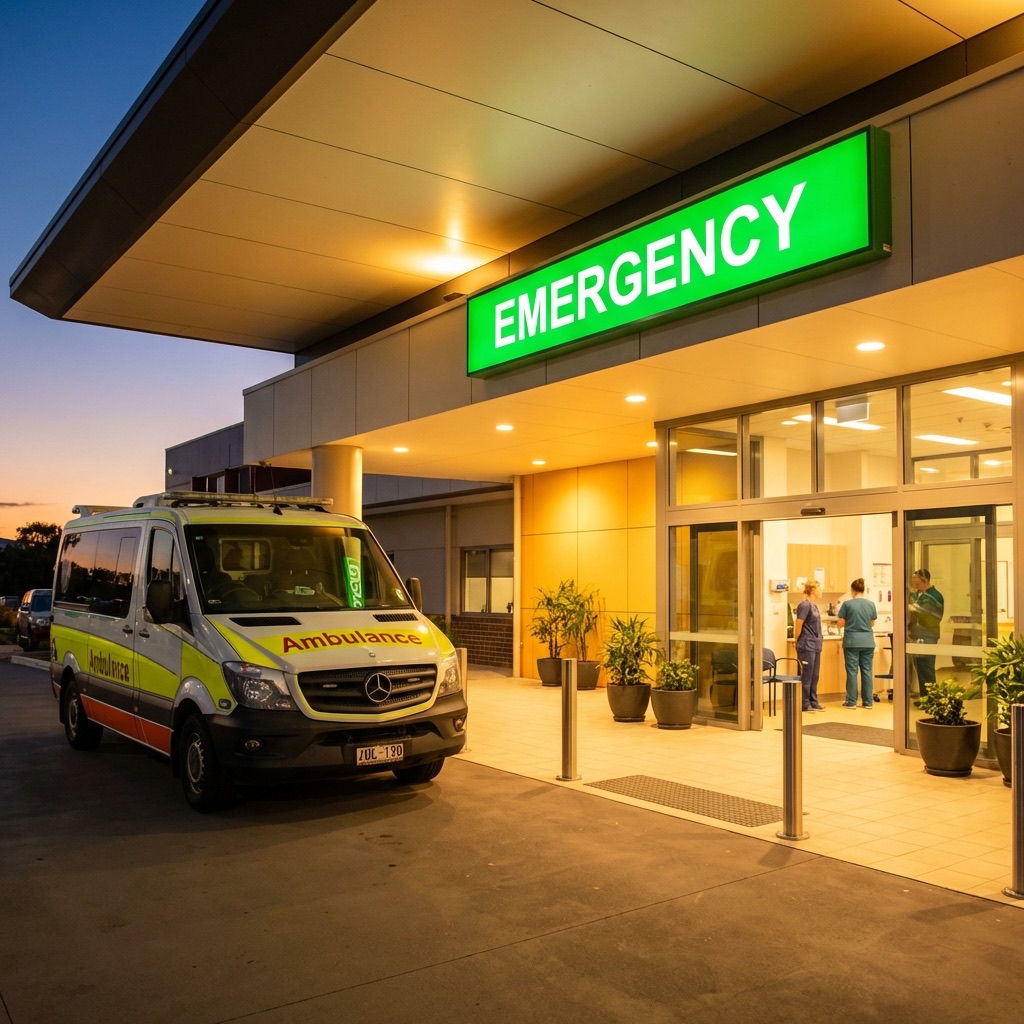
Knowing how to access emergency services could save your life-but understanding the costs could save you from financial disaster. Whether you're on a student visa, working holiday, or skilled migration pathway, this guide covers the critical distinction between 000 (Triple Zero) and non-emergency services, explains hospital and ambulance costs for visa holders, and lists the free 24/7 crisis support available to everyone in Australia.
Watch our video explainer:
Save These Numbers Now
| Service | Number | Purpose |
|---|---|---|
| Emergency (Police, Fire, Ambulance) | 000 | Life-threatening or time-critical emergencies |
| Emergency (Mobile alternative) | 112 | Routes to 000 (GSM international standard) |
| Text Emergency (Deaf/Speech Impaired) | 106 | TTY text-based emergency relay |
| Police Assistance Line | 131 444 | Non-urgent police matters |
| Crime Stoppers | 1800 333 000 | Anonymous crime reporting |
| State Emergency Service (SES) | 132 500 | Floods, storms, fallen trees |
| Healthdirect | 1800 022 222 | 24/7 nurse health advice |
| Poisons Information Centre | 13 11 26 | Poisoning, overdose, bites, stings |
| Lifeline | 13 11 14 | 24/7 crisis support & suicide prevention |
| 1800RESPECT | 1800 737 732 | Domestic, family & sexual violence |
| 13YARN | 13 92 76 | Indigenous crisis support |
| TIS National (Interpreter) | 131 450 | Free interpreting service |
Triple Zero (000): When to Call
000 is the national emergency number for life-threatening or time-critical situations requiring immediate response from Police, Fire, or Ambulance.
Call 000 For
- Someone is seriously injured or needs urgent medical help
- Your life or property is in immediate danger
- You witness a serious accident or crime in progress
- All fires (house fires, bushfires, car fires)
- Chest pain, difficulty breathing, stroke symptoms
- Severe bleeding, unconsciousness, major trauma
- Mental health crisis with immediate risk of self-harm
Do NOT Call 000 For
- Minor injuries or illness
- Noise complaints or neighbour disputes
- Lost property or theft reports (after the fact)
- Non-urgent police matters
- General enquiries
Call 000 only for genuine emergencies. Inappropriate calls delay responses to real emergencies elsewhere. For non-urgent matters, use 131 444 (Police) or 1800 022 222 (health advice).
How 000 Works
- Dial 000 from any phone (landline, mobile, or payphone)-calls are free
- The operator asks: "Police, Fire, or Ambulance?"-answer clearly
- You're connected to the relevant state/territory dispatch centre
- Provide your location (street address, nearest cross street, suburb)
- Answer their questions and stay on the line until told to hang up
- Follow any instructions given
If You Can't Speak (or It's Not Safe to Speak)
If you call 000 and don't respond, you may be prompted to press 55 to confirm you need help. This "silent call" feature is designed for situations where speaking would put you in danger.
If You Don't Speak English Confidently
Stay on the line-a translator can be arranged at no cost. Simply say your language (e.g., "Mandarin" or "Vietnamese") and wait for connection.
Advanced Mobile Location (AML) Technology
When you call 000 from a smartphone, Advanced Mobile Location (AML) automatically activates your device's GPS and Wi-Fi to calculate your precise coordinates. This data is transmitted to emergency services, allowing dispatchers to locate you within metres-even if you don't know your exact address or are too distressed to speak.
Download the Emergency+ app (free). It displays your GPS coordinates and nearest address, making it easier to read your location to the 000 operator.
Alternative Emergency Numbers
| Number | When to Use |
|---|---|
| 112 | Works on mobiles, routes to 000 (GSM standard used in Europe). No priority over 000. |
| 106 | Text-based emergency for deaf, hard-of-hearing, or speech-impaired callers using TTY/textphone |
SMS will not work for 000. You cannot text emergency services via standard SMS. Use 106 or the National Relay Service if you cannot make voice calls.
National Relay Service (NRS) for Deaf/Speech Impaired
For people who are deaf, hard of hearing, or have a speech impairment:
- 106 (TTY): Type PPP for Police, FFF for Fire, AAA for Ambulance
- NRS App: Visual interface with buttons for each service
- SMS Relay: Text 0423 677 767 with format: "000, [Service], [Name], [Location], [Details], GA"
- Video Relay (Auslan): Available via Skype/Microsoft Teams with sign language interpreter
131 444: Police Assistance Line (Non-Emergency)
For police matters that aren't emergencies, call 131 444. This includes:
- Reporting a crime that has already happened (burglary, theft)
- Noise complaints
- Minor traffic incidents (no injuries)
- Property damage or vandalism
- Suspicious behaviour (not immediate danger)
- General police enquiries
The Police Assistance Line operates 24/7 across all states. When you report a crime, you'll receive an Event Number-keep this for insurance claims.
Many states offer online reporting for non-urgent crimes (graffiti, theft from vehicle). This is useful if you're anxious about speaking on the phone due to language barriers.
Crime Stoppers: 1800 333 000
Crime Stoppers is for anonymous intelligence reporting-not for victims reporting crimes, but for witnesses providing information about criminal activity.
- Report drug dealing, suspicious activity, or information about wanted persons
- Complete anonymity-no need to give your name
- Information is passed to detectives; this does not trigger a patrol car dispatch
Ambulance Services: The Financial Risk
Ambulance transport is NOT free in most Australian states. For visa holders without adequate insurance, a single ambulance trip can cost $1,000-$2,000+. This is one of the biggest unmanaged financial risks for temporary residents.
Ambulance Costs by State
| State/Territory | Emergency Ambulance Cost | Notes |
|---|---|---|
| Victoria | $1,437 (metro), $2,121 (regional) | Membership available (~$50/year) |
| New South Wales | $415 callout + $3.74/km | Residents pay levy via tax |
| Queensland | Free for Qld residents | Visitors/visa holders pay ~$1,294+ |
| Tasmania | Free for Tas residents | Visitors/visa holders pay full cost |
| South Australia | $1,207 + $6.90/km | User pays |
| Western Australia | $1,000+ | User pays |
| ACT | $1,143 + $15/km (outside ACT) | User pays |
| Northern Territory | $800+ | Subscription available |
"Treatment Without Transport" Fee
Even if you call an ambulance but don't go to hospital, you may still be charged. In Victoria, this fee is approximately $620. The cost is incurred by the deployment of paramedics and the clinical assessment provided on scene.
OSHC/OVHC Ambulance Coverage
Your student (OSHC) or visitor (OVHC) health insurance should cover emergency ambulance transport. However:
- If paramedics code the trip as "non-emergency," your insurer may refuse the claim
- Inter-hospital transfers may not be covered
- Read your policy carefully for exclusions
Ambulance Membership (Recommended)
If your insurance coverage is unclear, consider purchasing direct ambulance membership:
- Victoria: ~$50/year covers all emergency and clinically necessary transport
- Other states have similar schemes
This effectively immunises you against $1,000+ ambulance fees.
Hospital Emergency vs GP vs Urgent Care
Understanding your options saves time, money, and ensures appropriate care.
Hospital Emergency Departments (ED)
Go to hospital ED for:
- Severe injuries (broken bones, deep cuts, head injuries)
- Chest pain, difficulty breathing, stroke symptoms
- Severe allergic reactions (anaphylaxis)
- Poisoning or overdose
- Mental health crisis with immediate risk of self-harm
- Major trauma or accidents
Triage system: Patients are seen by urgency (Australasian Triage Scale), not arrival time:
- Category 1: Immediate life threat (seen immediately)
- Category 2: Imminent threat (within 10 minutes)
- Category 3: Potentially life-threatening (within 30 minutes)
- Category 4-5: Semi-urgent/Non-urgent (may wait 4-8 hours)
If your condition isn't life-threatening, you may wait several hours in ED. For minor injuries, Medicare Urgent Care Clinics or GP clinics are faster and cheaper.
Hospital Costs for Visa Holders
If you're not eligible for Medicare, you are treated as a private patient and fully responsible for all costs:
| Service | Approximate Cost |
|---|---|
| ED presentation (facility fee) | $400-$600 |
| Standard ward bed (per night) | $783+ |
| Intensive Care Unit (per day) | $6,300+ |
| Medical services, tests, imaging | Variable (hundreds to thousands) |
Your OSHC/OVHC should cover public hospital costs at "gazetted rates." However, if the hospital doesn't have direct billing with your insurer, you may need to pay upfront and claim reimbursement.
Reciprocal Health Care Agreements (RHCA)
Australia has Reciprocal Health Care Agreements with 11 countries, allowing their citizens to access Medicare for "medically necessary" emergency treatment:
RHCA Countries: Belgium, Finland, Italy, Malta, Netherlands, New Zealand, Norway, Republic of Ireland, Slovenia, Sweden, United Kingdom
RHCA covers emergency treatment for unexpected illness/injury only-not elective surgery, pre-arranged treatment, or ongoing care. Students from some RHCA countries still require OSHC as a visa condition.
Medicare Urgent Care Clinics (UCC)
Medicare UCCs are a middle ground between GP and ED-for urgent issues that don't need an emergency department:
- Minor fractures and sprains
- Cuts requiring stitches
- Infections, burns, UTIs
- Walk-in, no appointment needed
- Open 7 days, typically 8am-10pm
- Bulk-billed for Medicare card holders
For visa holders: UCCs are designed around Medicare funding. If you're not Medicare-eligible, you may be charged private fees or directed elsewhere.
Victorian Priority Primary Care Centres (PPCC)
Victoria has state-funded Priority Primary Care Centres that are free for everyone-with or without Medicare:
- Minor fractures, cuts, burns, infections
- X-ray capabilities on-site
- Faster than ED, zero cost
- Available to all visa holders
Victorian Virtual Emergency Department (VVED)
The VVED is a free telehealth service connecting you to emergency doctors via video call:
- Available to anyone physically in Victoria
- Completely free regardless of visa status
- Suitable for: COVID-19, mild head injury, gastro, UTI, non-life-threatening emergencies
- Can organise prescriptions or ambulance transport if needed
- Interpreter services available directly in the video call
Access at: vved.org.au
GP (General Practitioner) Clinics
See a GP for:
- Flu, colds, infections
- Minor injuries and sprains
- Prescriptions and referrals
- Health check-ups, chronic condition management
Bulk billing means the GP bills Medicare directly-you pay nothing. Since visa holders typically don't have Medicare, you'll pay the full fee ($80-$100) and claim from your insurer.
Direct Billing Clinics (OSHC/OVHC)
OSHC providers have networks of Direct Billing clinics that bill your insurer directly-so you pay $0 (or a small co-payment):
- Use your insurer's "Find a Doctor" app to locate these clinics
- Often clustered near universities and CBD areas
- Non-network GPs will charge a "gap fee" you must pay out-of-pocket
After-Hours Home Doctor: 13SICK (13 74 25)
When GP clinics are closed (nights, weekends, public holidays):
- 13SICK (13 74 25): Home doctor visits
- Free for many OSHC holders (billed directly to insurer)
- Treats high fevers, ear infections, severe flu
- Prevents unnecessary ED trips
Mental Health Crisis Support
Mental health crisis services are free for everyone regardless of visa status. If someone's life is in danger, call 000 first.
24/7 Crisis Support Lines
| Service | Number | For |
|---|---|---|
| Lifeline | 13 11 14 | Crisis support, suicide prevention (phone, text, online chat) |
| Beyond Blue | 1300 22 4636 | Anxiety, depression support |
| Suicide Call Back Service | 1300 659 467 | Suicide support; offers up to 6 follow-up sessions |
| 13YARN | 13 92 76 | Indigenous crisis support (by and for Aboriginal/Torres Strait Islander people) |
| Kids Helpline | 1800 55 1800 | Young people aged 5-25 |
| headspace | 1800 650 890 | Young people aged 12-25 |
| 1800RESPECT | 1800 737 732 | Domestic, family, sexual violence (24/7 counselling) |
| MensLine Australia | 1300 78 99 78 | Men's mental health, relationship issues |
| SANE Australia | 1800 18 7263 | Complex mental health conditions |
| PANDA | 1300 726 306 | Perinatal anxiety/depression for new parents (Mon-Fri 9am-7:30pm) |
Lifeline: 13 11 14
Lifeline is Australia's leading crisis support service, receiving over one million calls annually:
- Phone: 13 11 14 (free, 24/7)
- Text: 0477 13 11 14
- Online chat: lifeline.org.au
- Calls are confidential; trained crisis supporters listen without judgment
- Interpreter services available-say your language when connected
Medicare Mental Health Services (Free)
- Medicare Mental Health Phone Service: 1800 595 212 (Mon-Fri 8:30am-5pm)
- Medicare Mental Health Walk-in Centres: Free access to mental health professionals, no appointment or Medicare card needed
University Counselling Services
International students can access free counselling through their university. These services are confidential and separate from academic departments-a good first stop for academic-related stress.
Other Important Numbers
| Service | Number | When to Use |
|---|---|---|
| State Emergency Service (SES) | 132 500 | Floods, storm damage, fallen trees (not life-threatening) |
| Poisons Information Centre | 13 11 26 | Poisoning, overdose, medication mistakes, bites, stings (24/7) |
| Healthdirect | 1800 022 222 | 24/7 nurse health advice-unsure what care you need? Start here |
| TIS National (Interpreter) | 131 450 | Free interpreting for government services |
| Dental Emergency Hotline | 0407 111 117 | 24/7 dental emergencies (toothache, trauma, abscesses) |
Quick FAQ
Can I dial 112 instead of 000? Yes on a mobile-it routes to the same service. No priority over 000.
Can I text 000 in an emergency? No. Standard SMS does not work for 000. Use 106 (TTY) or NRS if you cannot make voice calls.
What if I can't speak when I call 000? You may be prompted to press 55 to confirm you need help (silent call feature).
I'm not sure if it's an emergency-what should I do? Call Healthdirect on 1800 022 222 for 24/7 nurse advice on whether you need ED, GP, or can manage at home.
Will I be charged for calling 000? The call is free. However, ambulance transport and hospital treatment may incur costs depending on your insurance and visa status.
What if I have no insurance and need emergency care? Go to the hospital-life-saving treatment comes first. Speak to the Patient Liaison Officer afterward about payment plans or hardship waivers.
How First Migration Can Help
While emergency services are available to everyone in Australia, understanding your visa rights-including healthcare entitlements and insurance requirements-is crucial for your settlement journey. At First Migration Service Centre, we help clients understand their visa conditions and plan their migration pathway.
Ready to take the next step? We invite you to submit a free visa assessment so we can understand your situation and provide tailored advice.
RMA R. Weng
MARA 1569835Registered Migration Agent | Master of Laws (ANU) | Bachelor of Laws (Deakin)
Certified by the Migration Agents Registration Authority (MARA). Specializing in skilled migration, employer-sponsored visas, and partner visas. Admitted to practice law in Victoria.
Related Articles

Budget 2026-27 for Employer Sponsors: Hire Onshore, Lock CSIT Before 1 July
Federal Budget 2026-27: 185,000 Migration Places - But Only 55,110 for Offshore
189 Visa May 2026: 178 Days Without a Round - And Your Plan B Just Shrank
Disclaimer: This information is general in nature and does not constitute formal migration advice. Immigration laws and policies change frequently. Always consult a MARA-registered migration agent for advice specific to your circumstances. First Migration Service Centre (MARA 1569835) provides this content for informational purposes only.
MARA Registered Agent
Registration No. 1569835
Certified by the Migration Agents Registration Authority. Your trusted partner for Australian visa applications.
Budget 2026-27 for Employer Sponsors: Hire Onshore, Lock CSIT Before 1 July
Federal Budget 2026-27: 185,000 Migration Places - But Only 55,110 for Offshore
189 Visa May 2026: 178 Days Without a Round - And Your Plan B Just Shrank

WA DAMA 2026: How the State-Wide Consolidation Changes Regional Sponsorship

National Innovation Visa (NIV): What Replaced the Global Talent Visa & How to Qualify in 2026
Office Hours
Mon-Fri: 9AM-5PM Sat: 10AM-2PM