
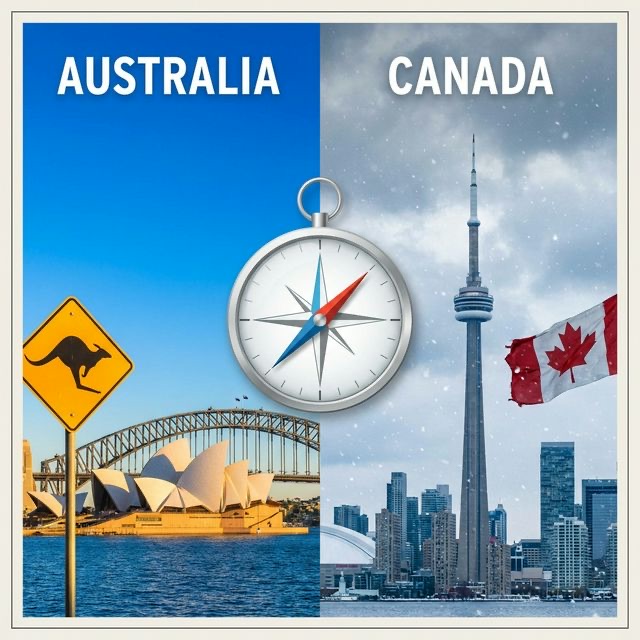
If you're a skilled professional weighing up Australia vs Canada for immigration in 2026, the landscape has shifted dramatically. Canada has slashed its permanent residency targets, tightened Express Entry requirements, and frozen some pathways - while Australia is maintaining 185,000 migration programme places and actively recruiting in healthcare, trades, technology, and engineering. Here's a side-by-side breakdown to help you make the right decision.
Watch our video explainer:
Canada in 2026: Tighter Doors, Higher Barriers
Canada's once-welcoming immigration system has undergone significant tightening:
| Change | Details |
|---|---|
| PR targets cut | 380,000 places for 2026, down from 483,000 in 2024 - a 21% reduction |
| Temporary residents squeezed | Target of 385,000 new temporary arrivals in 2026; aiming for temp residents under 5% of total population by end of 2027 |
| Express Entry work experience | Minimum increased from 6 months to 12 months within the past 3 years for category-based draws |
| CRS scores remain high | Canadian Experience Class draws averaging 508-515 CRS in early 2026 |
| New category-based selection | Priority given to physicians, researchers, transport workers, and military recruits with Canadian experience |
Canada's Express Entry system now strongly favours candidates already working in Canada. If you're applying from overseas without Canadian work experience, your chances of receiving an Invitation to Apply have dropped significantly.
The message is clear: Canada is shifting from broad-based immigration to a highly targeted model that prioritises applicants who are already in the country.
Australia in 2026: Doors Open for the Right Skills
Australia's skilled migration programme tells a different story:
| Feature | Details |
|---|---|
| Migration programme | 185,000 places for 2025-26, with skilled migration as the largest category |
| Visa fees | $4,910 AUD for 189, 190, and 491 visas (current as of July 2025; fees are subject to change) |
| Points threshold | 65 points minimum; trades invited at 65 points, professionals typically 85-90+ |
| Quarterly invitation rounds | Structured schedule with 10,000+ invitations per round |
| Skills in Demand visa | New employer-sponsored pathway replacing the old 482 visa, with streamlined processing |
| Regional pathways | 491 visa provides a 3-year pathway to permanent residency (191 visa) |
Construction trades such as bricklayers, carpenters, electricians, and plumbers are receiving 189 visa invitations at just 65 points - the lowest possible threshold. If you have a trade qualification, Australia is rolling out the welcome mat.
Key Pathways Available Right Now
-
Subclass 189 - Skilled Independent: No employer or state sponsor needed. Points-tested. Ideal for applicants with high English scores, in-demand occupations, and relevant work experience.
-
Subclass 190 - State Nominated: Requires a state or territory nomination (adds 5 points). Each state has its own occupation lists and requirements.
-
Subclass 491 - Skilled Work Regional: Requires state nomination or family sponsorship (adds 15 points). Live and work in regional Australia for 3 years, then apply for the permanent 191 visa.
-
Employer Sponsored (Skills in Demand): Your employer sponsors you directly. Core Skills stream for most occupations; Specialist Skills stream for high-income professionals earning above $141,210 AUD.
State nomination requirements and occupation lists are subject to change. Always confirm current availability before applying.
Head-to-Head: Australia vs Canada for Skilled Workers
| Factor | 🇦🇺 Australia | 🇨🇦 Canada |
|---|---|---|
| PR places (2026) | 185,000 | 380,000 |
| Points system | SkillSelect (65 min, 85-90 realistic) | CRS (no fixed minimum, 467-515 typical) |
| Overseas applicants | Can apply without local experience | Strongly favours Canadian experience |
| Trades demand | Very high - invitations at 65 points | Limited draws for trades |
| Employer sponsorship | Strong pathway (Skills in Demand visa) | LMIA-dependent, complex |
| Regional incentives | 491 → 191 PR pathway, extra points | Provincial Nominee Programs (PNP) |
| Processing times | Varies; employer-sponsored often faster | Express Entry: ~6 months |
| Healthcare sector | Critical demand, fast-tracking available | Priority category, but limited spots |
| Minimum salary (sponsored) | $76,515 AUD (CSIT/TSMIT) | Varies by province and occupation |
| Climate | Warm, varied; from tropical to temperate | Cold winters in most provinces |
Why Skilled Workers Are Pivoting to Australia
1. You Don't Need Local Experience
Unlike Canada, where Express Entry now requires 12 months of Canadian work experience for most category-based draws, Australia's 189 visa lets you apply from anywhere in the world based on your skills, qualifications, and points score alone.
2. Trades Are in Extraordinary Demand
Australia is experiencing a construction boom driven by infrastructure projects and housing shortages. Construction trades are being invited at the minimum 65-point threshold - something almost unheard of for professional occupations. If you're a licensed electrician, plumber, carpenter, or bricklayer, Australia needs you now.
3. Employer Sponsorship Is Simpler
The new Skills in Demand visa has replaced the old 482 visa with a more streamlined process. Unlike Canada's LMIA (Labour Market Impact Assessment), which requires employers to prove they couldn't find a Canadian worker, Australia's system focuses on matching skills to demand.
4. Multiple Pathways, Not Just One
Between the 189, 190, 491, and employer-sponsored routes, Australia offers skilled workers at least four distinct pathways to permanent residency. Use our GSM Points Calculator to see where you stand.
5. Quality of Life
Australia consistently ranks among the top countries for quality of life, with world-class healthcare (Medicare for PR holders), outdoor lifestyle, and strong wages. The minimum salary threshold for employer-sponsored workers is $76,515 AUD - ensuring sponsored workers receive fair pay.
What You Should Do Now
If you're considering the move, here's your action plan:
- Check your occupation - Search for your occupation on Australia's Skilled Occupation List to verify eligibility. Different lists apply to different visa subclasses.
- Calculate your points - Use the GSM Points Calculator to estimate your score for the 189, 190, or 491 visa.
- Get a skills assessment - You'll need your qualifications assessed by the relevant Australian assessing authority before you can apply.
- Book an English test - IELTS, PTE, or OET scores are required. Higher English scores can add up to 20 points.
- Seek professional advice - A registered migration agent can help you identify the strongest pathway and avoid costly mistakes.
How First Migration Can Help
Navigating these changes can be complex, but you don't have to do it alone. At First Migration Service Centre, our registered migration agents are ready to guide you through every step - from skills assessment strategy to visa lodgement.
Ready to take the next step? We invite you to submit a free visa assessment so we can understand your situation and provide tailored advice.
RMA R. Weng
MARA 1569835Registered Migration Agent | Master of Laws (ANU) | Bachelor of Laws (Deakin)
Certified by the Migration Agents Registration Authority (MARA). Specializing in skilled migration, employer-sponsored visas, and partner visas. Admitted to practice law in Victoria.
Related Articles

CCS 3-Day Guarantee + 1 July 2026 Reset: What PR-Pathway Families Actually Get
HECS-HELP 2.8% Indexation on 1 June 2026: Why PR Doesn't Unlock the Loan

Paid Parental Leave 26 Weeks + 12% Super: 1 July 2026 Visa Guide
Disclaimer: This information is general in nature and does not constitute formal migration advice. Immigration laws and policies change frequently. Always consult a MARA-registered migration agent for advice specific to your circumstances. First Migration Service Centre (MARA 1569835) provides this content for informational purposes only.
MARA Registered Agent
Registration No. 1569835
Certified by the Migration Agents Registration Authority. Your trusted partner for Australian visa applications.
CCS 3-Day Guarantee + 1 July 2026 Reset: What PR-Pathway Families Actually Get
HECS-HELP 2.8% Indexation on 1 June 2026: Why PR Doesn't Unlock the Loan
Paid Parental Leave 26 Weeks + 12% Super: 1 July 2026 Visa Guide

Onshore vs Offshore Partner Visa in 2026-27: Why the 820 Queue Now Moves Faster Than 309
Home Affairs Processing Times May 2026: 186 Now 20 Months at 90%
Office Hours
Mon-Fri: 9AM-5PM Sat: 10AM-2PM