
Part 3: Government and the Law in Australia
[L4 Ultimate Edition] Decoding the source code of the nation. Master the grueling conditions of a Double Majority referendum, the mechanics of the 151-seat House vs the 76-seat Senate, and the strict boundaries of the 3 tiers of government.
🎯 Learning Objectives and Core Exam Syllabus
While the previous chapters explored history and morality, this chapter is purely about the "hardware architecture" of the state. There is no ambiguity here—only raw numbers, rigid hierarchies, and the absolute division of power. You must master these four critical engines:
- The Australian Constitution: Understanding the supreme authority of this document and the punishingly difficult "Double Majority" requirement necessary to alter even a single word within it.
- The Head of State & The Governor-General: Clarifying the role of the British Monarch as Australia's sovereign, and the sweeping executive powers held by their proxy, the Governor-General.
- The Separation of Powers: Identifying the exact defensive firewalls (Legislative, Executive, and Judicial) designed to prevent dictatorship by distributing power absolutely.
- Parliaments and Tiers of Government: Memorising the exact seat distribution of the House of Representatives versus the Senate, and knowing precisely which tier of government (Federal, State, or Local) is responsible for fixing a pothole versus declaring war.
Section 1: The Supreme Source Code: The Constitution
1. What is The Australian Constitution?
- The Ultimate Authority: The Australian Constitution is not merely a set of guidelines. It is the absolute, supreme legal document of the land. It came into full effect on 1 January 1901.
- The Blueprint of Power: Think of the Constitution as the "operating system" for the entire country. It dictates the fundamental rules on how the Federal Government operates, precisely what areas it is legally allowed to govern (like defence or foreign affairs), and exactly where its power ends and the powers of the State Governments begin. If any law passed by parliament contradicts the Constitution, the High Court will instantly strike it down.
2. Altering the Constitution: The Referendum
- This is an absolute must-know exam concept.
- In Australia, politicians in Parliament can easily pass or change standard laws (like modifying tax rates or tweaking speed limits) with a simple majority vote among themselves. However! Politicians have absolutely zero legal authority to alter the Constitution.
- The only lawful method to change the Constitution is deliberately difficult: the government must ask the people. They must initiate a national vote known as a Referendum, placing a specific "Yes or No" proposal directly to every single enrolled voter in the country.
3. The Grueling "Double Majority" Test
Successfully passing a Referendum is notoriously difficult (the majority in Australian history have failed). This is because it must satisfy two intensely strict conditions simultaneously, known as a Double Majority:
- Condition 1 (National Majority): Firstly, when you count up every single vote cast across the entire nation, more than 50% of the totals must be a "Yes."
- Condition 2 (State Majority): Secondly—and this is where most referendums die—there must be a majority of "Yes" votes in at least four out of the six States. (Note: Votes from the Territories are counted towards the national total in Condition 1, but they are not counted towards the individual State threshold in Condition 2).
If a proposal achieves 55% "Yes" nationally, but only 3 States vote "Yes" against 3 States voting "No", the Referendum fails, and the Constitution remains totally unchanged.
Section 2: The Monarch and Their Proxy
1. Constitutional Monarchy
- Australia is an incredibly robust, independent democracy, yet it intentionally operates as a "Constitutional Monarchy."
- The official Head of State of Australia is the reigning British Monarch (currently King Charles III).
- Although the King resides on the other side of the planet in the United Kingdom, he maintains the highest ceremonial authority under the Australian Constitution.
2. The Power of the Governor-General
- Because the King does not live in Australia, he must appoint a proxy to perform his constitutional duties on an everyday basis. This figure is the Governor-General of Australia, an individual chosen and recommended to the King by the Australian Prime Minister.
- Royal Assent (Exam Trap 📌): For a new law to be created, passing a vote in both houses of Parliament is not enough. The printed bill must be physically delivered to the Governor-General. Only when the Governor-General signs the document—an act known as giving Royal Assent—does it officially ignite and become the binding law of Australia.
- Commander-in-Chief: The Governor-General performs vital constitutional, ceremonial, and command duties, including nominally acting as the Commander-in-Chief of the Australian Defence Force (ADF).
- The State Level: It is crucial to remember that the Governor-General acts on behalf of the King at the national/federal level. At the individual State level, the King’s representative is called the Governor. (Neither the Northern Territory nor the ACT has a Governor; instead, the NT has an 'Administrator'.)
Section 3: The Separation of Powers (The Anti-Dictatorship Firewall)
To guarantee that Australia never descends into an authoritarian dictatorship where one group has total control, power is rigidly severed into three distinct branches. They constantly police and check each other.
-
Legislative Power (Parliament)
- Operators: The Federal Parliament (The House of Representatives and the Senate) along with the Governor-General.
- Core Function: They are the lawmakers. They debate massive national policies, draft bills, and vote to pass new laws or amend obsolete ones.
-
Executive Power (The Government / Cabinet)
- Operators: The Prime Minister and their selected Cabinet Ministers.
- Core Function: They are the implementers. Once Parliament passes a law, the powerful Executive branch takes control. They command government departments (like Border Force, the Tax Office, the Federal Police) to put the laws into practical action and run the daily affairs of the nation.
-
Judicial Power (The Courts)
- Operators: Judges across all courts, culminating in the High Court of Australia.
- Core Function: They are the interpreters and referees. They operate with complete independence. Their job is to interpret the meaning of the laws in complex disputes and apply justice. Crucially, if the Government illegally tries to overstep the limits placed on them by the Constitution, the Judiciary has the absolute power to strike those actions down.
Section 4: Anatomy of the Federal Parliament
To control the country, a political party must dominate the epicentre of power in Canberra: The Federal Parliament. It operates on a two-house (bicameral) system.
🟢 The Green Room: The House of Representatives
- Seat Capacity (Must Know 📌): There are exactly 151 seats (or Members of Parliament, MPs).
- Distribution Logic: Australia is divided into 151 distinct geographical electoral divisions (electorates). Each division contains roughly the same number of voters. Therefore, heavily populated states like New South Wales possess vastly more electorates—and thus vastly more MPs—than a sparsely populated state like Tasmania.
- Forming the Government (The Ultimate Prize):
- The outcome in the House of Representatives dictates who runs the entire country!
- At a federal election, if a political party (or a tight coalition of parties) wins the absolute majority—meaning 76 seats or more out of 151—they instantly earn the right to form the Australian Government.
- The leader of that winning party automatically becomes the immense power broker: The Prime Minister of Australia.
🔴 The Red Room: The Senate (The House of Review)
- Seat Capacity (Must Know 📌): There are only 76 seats in total.
- Distribution Logic (Protecting the Weak): The Senate was designed specifically to protect the smaller states from being bullied by the larger ones. Therefore, seats here are distributed completely ignoring population size!
- Every single State (all 6 of them), regardless of size, gets an entirely equal block of 12 Senators (6 x 12 = 72).
- The two mainland Territories (NT and ACT) are granted 2 Senators each (2 x 2 = 4).
- Total: 72 + 4 = 76 seats.
- The Core Function: The Senate acts primarily as a powerful "House of Review." Any new bill that the House of Representatives creates must be sent up to the Senate. If the Senate believes the bill is flawed or dangerous, they will block it, delay it, or mandate punishing amendments.
Section 5: The Three Tiers of Government
To manage a continent efficiently without the Federal Government micromanaging every tiny suburb, power and responsibility are sliced into three highly distinct tiers.
1. Federal Government
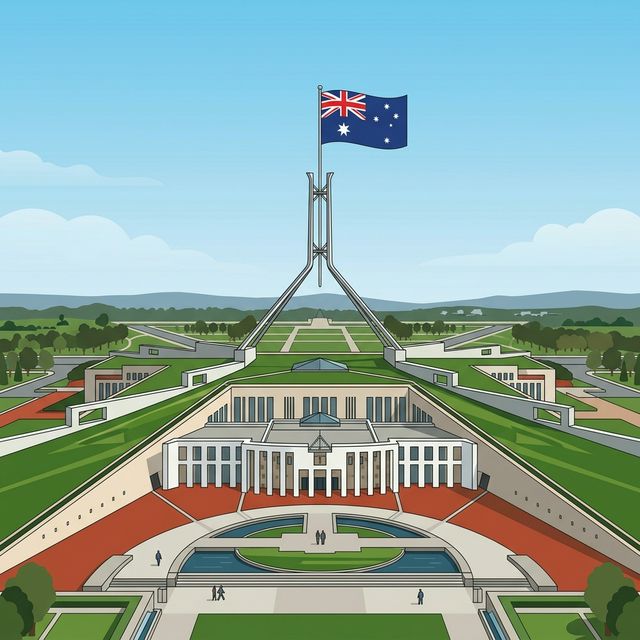
Led by the Prime Minister. Operates out of Parliament House (Canberra).
- • Defense & Army
- • Immigration
- • Foreign Affairs
- • Trade & Currency
2. State/Territory Government
Led by Premiers (States) or Chief Ministers (Territories).
- • Hospitals
- • Schools & Education
- • State Police
- • Public Transport
3. Local Government
Led by Mayors or Shire Presidents. Represents local councils.
- • Rubbish Collection
- • Town Planning
- • Local Roads
- • Pet Control
Chapter completed!
Test your knowledge immediately by taking a targeted practice quiz on this exact section.