
Part 1: Australia and its People
[L4 Ultimate Edition] The absolute textbook deep-dive into the Official Handbook's First Chapter. Covering Aboriginal spirituality, colonisation timelines, geographic mastery, all National Flags, the Coat of Arms, and Anzac Day history.
🎯 Learning Objectives and Core Exam Syllabus
To successfully conquer the first chapter of the official citizenship exam, you must demonstrate total mastery over these four critical domains:
- Indigenous Culture and History: Understanding the phenomenal 65,000-year history of the First Australians, the spiritual depth of 'The Dreaming', and the distinction between Aboriginal and Torres Strait Islander peoples.
- The Colonisation and Nation-Building Timeline: Memorising exact dates (1788 vs 1901) and understanding how Penal Colonies and the Gold Rush rapidly transformed the continent into modern Australia.
- Geographic Mastery: Identifying the 6 States and 2 Territories, matching them with their Capital Cities, and knowing their defining official landmarks.
- National Symbols and Honours: Recognising the exact design elements of the three official flags, the animals on the Coat of Arms, the national flower/colours, and understanding the solemn history behind Anzac Day.
Section 1: The First Australians
- Timeline: The oldest continuous living culture in the world, here for over 65,000 years.
- Two Groups: Aboriginal People (mainland/Tasmania) and Torres Strait Islander People (islands north of QLD).
- Core Belief: "The Dreaming" outlines their deep spiritual custodian relationship to the land, rather than treating it merely as property.
1. The World’s Oldest Continuous Living Culture
Aboriginal and Torres Strait Islander peoples are collectively known and deeply respected as the First Australians. Overwhelming scientific and archaeological evidence (such as the ancient rock art found in Kakadu National Park) proves that Aboriginal peoples have continuously inhabited the Australian continent for well over 65,000 years. This extraordinary timeline makes them globally recognised as possessing the oldest continuous living culture on the planet.
2. Two Distinct Indigenous Groups (A Critical Distinction)
Many newcomers mistakenly group all First Australians together, but they represent two entirely distinct cultural heritages:
- Aboriginal People: The original inhabitants of mainland Australia and the island of Tasmania. They are not a single monolithic group; rather, they comprise hundreds of diverse regional communities, each possessing their own complex languages, cultural practices, and tribal borders.
- Torres Strait Islander People: These peoples originate from the Torres Strait—a network of islands located in the far north of Queensland, situated between the Cape York Peninsula and Papua New Guinea. They have their own distinct languages and cultural traditions that are deeply connected to the ocean and closely align with Melanesian and wider Pacific Island cultures.
3. A Deep, Spiritual Connection to the Land
This is a high-frequency exam concept.
- To early European explorers, land was considered a commodity to be conquered, claimed, and farmed.
- However, for Indigenous Australians, the land, the oceans, and the skies hold an infinitely deeper, profoundly sacred spiritual meaning.
- They do not view themselves merely as "owners" of real estate, but as the traditional custodians (caretakers) of the land. The land nourishes them, and they are responsible for protecting it via traditional ceremonies.
- This ancient and unbroken relationship is expressed, maintained, and passed down to children through traditional art (like dot painting), ceremonial dances, songs, and powerful creation myths collectively known as the Dreamtime (or The Dreaming). The Dreamtime explains how ancestral spirits formed the mountains, rivers, and animals, establishing the social laws that guide Indigenous life.
Section 2: European Settlement and the Birth of a Nation
- 26 January 1788: First Fleet arrives (Captain Arthur Phillip) to establish a British Penal Colony. Now Australia Day.
- 1851 Gold Rush: Sparked a population boom and early demands for democratic rights.
- 1 January 1901: Federation! 6 separate colonies united to form the single Commonwealth of Australia.
1. The Arrival of the First Fleet
- The Crucial Date: 26 January 1788.
- The Historical Event: A fleet consisting of 11 small British ships, commanded by Captain Arthur Phillip, sailed into Sydney Cove in New South Wales after a perilous eight-month voyage from Great Britain.
- The Nature of the Colony (Exam Trap 📌): Note that this was not a glamorous expedition of rich nobles. The First Fleet was entirely orchestrated by the British Government to establish a remote Penal Colony (a prison settlement). The very first wave of European settlers were predominantly convicted criminals (convicts) serving harsh sentences, accompanied by the British Royal Marines tasked with guarding them.
- The Origin of Australia Day: Because Arthur Phillip raised the Union Jack to officially claim New South Wales for the British Empire on 26 January, this date is now celebrated nationally as Australia Day.
2. Free Settlers and the Agricultural Boom
- As the grim penal colony eventually stabilised and surveyors successfully crossed the imposing Blue Mountains, it sparked a new era.
- Alongside emancipated (freed) convicts, thousands of voluntary "Free Settlers" began arriving from Great Britain and Ireland. They were drawn by the promise of cheap, expansive land.
- These settlers pioneered massive agricultural industries, especially breeding Merino sheep for wool exports. This economic boom coined the historical phrase that Australia was "Riding on the sheep's back."
3. The Transforming Era: The 1851 Gold Rush
- The Event: In 1851, massive deposits of gold were uncovered in New South Wales and Victoria (particularly around Ballarat and Bendigo).
- The Global Stampede: The news triggered worldwide hysteria. The population of the colonies nearly tripled within a mere ten years. Hundreds of thousands of fortune-seekers flooded in from the UK, continental Europe, and notably, China.
- The Democratic Impact: The immense wealth generated by the Gold Rush financed major infrastructure projects like railways and telegraphs. Furthermore, these gold miners (many bringing progressive political ideas from Europe) fiercely demanded democratic voting rights. Events like the famous 'Eureka Stockade' miner rebellion became pivotal milestones in establishing early democratic freedoms in Australia.
4. Federation: The Commonwealth is Born (1901)
- The Pre-1901 Chaos: Throughout the entire 1800s, there was absolutely no such thing as an "Australian Government." The continent was divided into six entirely independent British colonies. They operated like rival countries—charging each other import tariffs, maintaining separate colonial militaries, and even building railways with different track widths, forcing passengers to change trains at state borders.
- The Crucial Date: 1 January 1901.
- Federation (Exam Concept 📌): Following a series of democratic referendums, the six colonies finally agreed to unite. On New Year's Day 1901, they officially merged to form a single, independent, democratic nation: the Commonwealth of Australia.
- The Legal Framework: On this exact day, the Australian Constitution legally took effect, creating the federal system of government we operate under today and establishing a unified national parliament.
Section 3: Geographic Mastery of States and Territories
- NSW: Sydney (First Fleet site).
- VIC: Melbourne (Smallest mainland state).
- QLD: Brisbane (Sunshine State).
- WA: Perth (Largest state by landmass).
- SA: Adelaide (Rugged coastline).
- TAS: Hobart (The ONLY Island State).
- ACT: Canberra (Nation's capital, inland).
- NT: Darwin (Tropical and Red Centre).
Operating a nation the size of a continent requires dividing massive administrative responsibilities. Australia features 6 distinct States and 2 primary mainland Territories. You must be able to match the State, the Capital City, and its defining features perfectly.
The Six Sovereign States
-
New South Wales (NSW)
- Capital City: Sydney
- Key Features: The site where the First Fleet landed. It remains the most populous and economically powerful state. It is globally famous for architectural marvels like the Sydney Opera House and the Sydney Harbour Bridge.
-
Victoria (VIC)
- Capital City: Melbourne
- Key Features: The smallest of the mainland states, yet extremely densely populated. It is universally renowned for its incredibly rich Gold Rush-era architecture, deep arts culture, and an obsession with major sporting events (e.g., the Australian Open tennis, the AFL Grand Final, and the Formula 1 Grand Prix).
-
Queensland (QLD)
- Capital City: Brisbane
- Key Features: Occupying the tropical north-east, this is the second-largest state by area. Often marketed as the "Sunshine State", it is defined by warm tropical weather, vast rainforests, and the world-heritage-listed Great Barrier Reef.
-
Western Australia (WA)
- Capital City: Perth
- Key Features: An absolute giant. It is the largest state by landmass, covering the entire western third of the continent. While the interior is vast, harsh desert, the state is an economic powerhouse driven by massive gold, iron ore, and natural gas mining operations.
-
South Australia (SA)
- Capital City: Adelaide
- Key Features: Celebrated for its stunning rugged coastlines and impeccably preserved colonial-era stonework. It is also globally recognised as one of Australia's premium wine-producing regions (e.g., the Barossa Valley).
-
Tasmania (TAS)
- Capital City: Hobart
- Key Features (Highly Tested 📌): Physically separated from the mainland by the treacherous Bass Strait, it holds the distinct title of being the only Island State. It boasts massive expanses of pristine, untouched wilderness and heritage-listed national parks.
The Two Mainland Territories
-
Australian Capital Territory (ACT)
- Capital City: Canberra
- Key Features: A small, entirely inland territory purposefully carved out between Sydney and Melbourne solely to serve as the nation's political nerve centre. It houses the federal Parliament House, the High Court, and numerous national institutions.
-
Northern Territory (NT)
- Capital City: Darwin
- Key Features: Diverse and extreme. The coastline is distinctly tropical and prone to cyclones, while the vast southern stretch is a striking desert landscape referred to as the 'Red Centre'. It is home to the world-famous massive monolith Uluru and Kakadu National Park. The NT also features a highly significant demographic concentration of Indigenous Australians.
Section 4: National Symbols, Flags, and Holy Days
- National Flower: Golden Wattle (Green and Gold colors).
- Coat of Arms: Kangaroo and Emu (neither can step backwards, symbolizing moving forward).
- Anzac Day (25 April): Solemn remembrance of the Gallipoli landing and all who served/died in conflicts.
This section frequently causes exam failures because candidates assume they know the flag, but they cannot identify its specific components when asked a tricky multiple-choice question.
1. The Three Official Flags of Australia
The Australian Government officially recognises three distinct flags.
-
The Australian National Flag:
- Background: Dark Navy Blue.
- Top Left Corner: Features the Union Jack (the British flag). This is an explicit acknowledgement of Australia's historical settlement connection to Great Britain.
- Bottom Left: A massive seven-pointed white star known as the Commonwealth Star. Six of the points represent the 6 original states, while the seventh point represents all the territories combined.
- Right Half: Five white stars that form the Southern Cross. This is an iconic constellation of stars that prominently guides navigation in the Southern Hemisphere night sky.
-
The Australian Aboriginal Flag: (Designed by Aboriginal artist Harold Thomas in 1971)
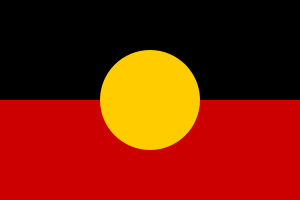
- Top Half: Black, symbolising the Aboriginal peoples of Australia.
- Bottom Half: Red, symbolising the red earth of the Australian outback and the spiritual relationship (and blood) tied to the land.
- The Centre: A bold, bright Yellow Circle, which represents the Sun—the eternal giver of life and protector.
-
The Torres Strait Islander Flag: (Designed by the late Bernard Namok in 1992)
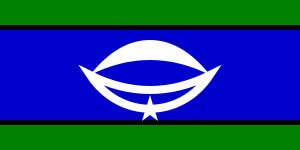
- The Stripes: Thick Green stripes at the top and bottom stand for the land. A wide Blue panel in the centre stands for the sea. These are separated by thin Black lines representing the people themselves.
- The Symbols: In the exact centre sits a white Dhari (a traditional ceremonial dancer's headdress). Directly beneath the Dhari is a white five-pointed star. The five points represent the five major island groups, and the colour white is a universal symbol of peace.
2. Mandatory National Emblems and Flora/Fauna
- The Commonwealth Coat of Arms:
- This is the ultimate official seal of the Australian federal government, used to authenticate national documents and property.
- It features a central shield containing the badges of the six states.
- The shield is proudly supported by a Kangaroo and an Emu.
- The Meaning (Exam Trap 📌): Why these two animals? It is firmly believed that neither the kangaroo nor the emu can easily move backwards in their natural locomotion. They were chosen to boldly symbolise a dynamic nation that constantly pushes forward and never retreats.
- The National Flower: The Golden Wattle. It is a tough, resilient native shrub that erupts into thousands of tiny, bright yellow, ball-shaped flowers during spring.
- The National Colours: They are officially Green and Gold, directly reflecting the colours of the Golden Wattle in full bloom. You will immediately recognise these colours on the uniforms of Australia's Olympic athletes and the national cricket team.
- The National Anthem: An inspiring orchestral piece titled "Advance Australia Fair".
- The National Gemstone: The Opal. According to Indigenous legends, opals are "a rainbow fallen to earth." Australia is the world's most dominant producer of opals.
3. The Most Sacred National Holidays
- Australia Day (26 January): A massive national public holiday. Across the country, thousands of new migrants take their final pledges at Citizenship Ceremonies. It commemorates the historical arrival of the First Fleet in 1788 at Sydney Cove, while also serving as a complex day to celebrate multicultural achievements.
- Anzac Day (25 April):
- This is the most deeply revered, solemn, and emotionally sacred day on the Australian calendar.
- 'ANZAC' is an acronym standing for the Australian and New Zealand Army Corps.
- The Historical Origin: At dawn on 25 April 1915, during the horrors of World War 1, thousands of young, brave ANZAC troops executed a difficult amphibious landing on the hostile beaches of Gallipoli, Turkey.
- The Modern Meaning: The campaign was a brutal military defeat with horrific casualties. However, the legendary courage, resilience under fire, and absolute loyalty to one another (Mateship) displayed by the troops forged what is known as the "Anzac Spirit." Today, Anzac Day is not a celebration of war; it is a solemn day of remembrance to honour all Australian men and women who have served, suffered, and died in all wars, conflicts, and dangerous peacekeeping missions globally.
🎯 Exam Checkpoint: Simulated Death Match
Do not proceed to Chapter 2 until you can rapidly fire off the correct answers to these simulated exam questions.
-
What is the deepest meaning of 'The Dreaming' or 'Dreamtime' for Aboriginal Australians?
Answer: B – The complex creation myths detailing how ancestral spirits formed the land, laws, and life. -
Which of the following events occurred exactly on 1 January 1901?
Answer: C – Federation: Six colonies united to form the Commonwealth of Australia. -
What is the only Island State in the Commonwealth of Australia?
Answer: B – Tasmania -
Which two animals proudly support the shield on the Commonwealth Coat of Arms?
Answer: C – The Kangaroo and the Emu (because they cannot move backward!) -
Why do Australians commemorate Anzac Day on April 25th?
Answer: B – To remember and honour all Australians who served and died in wars, conflicts, and peacekeeping operations.
Passed the checkpoint? Excellent. You are now armed with the foundational history. Move immediately into Part 2: Democratic Beliefs.
Chapter completed!
Test your knowledge immediately by taking a targeted practice quiz on this exact section.