
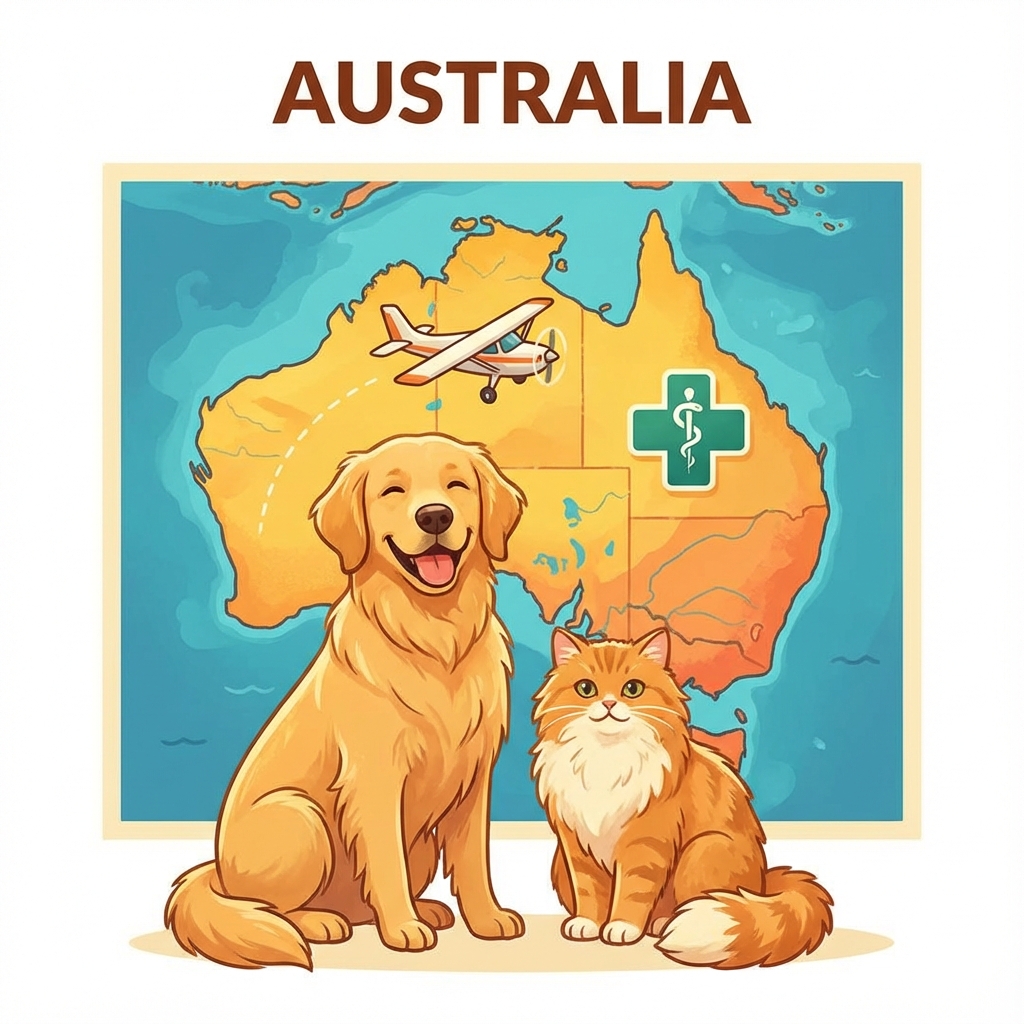
Thinking of bringing your furry family member to Australia? You're not alone-and while Australia's biosecurity rules are among the strictest in the world, thousands of pet owners successfully relocate their cats and dogs every year. This comprehensive guide covers everything you need to know about import permits, the Mickleham quarantine facility, rabies testing timelines, and the costs involved.
Why Australia Has Strict Pet Import Rules
Australia is one of the few rabies-free countries in the world, and the government is determined to keep it that way. The Department of Agriculture, Fisheries and Forestry (DAFF) oversees all animal imports through strict biosecurity protocols governed by the Biosecurity Act 2015. The introduction of rabies could devastate Australia's native wildlife-which lack evolutionary defenses against many placental mammal diseases-and cause catastrophic losses to the livestock industry.
The good news? With proper planning and patience, you can bring your beloved pet to Australia safely.
Understanding Country Categories
Australia categorises countries into three groups based on rabies risk. Your country of origin determines your timeline and requirements:
| Group | Risk Level | Quarantine | Timeline | Example Countries |
|---|---|---|---|---|
| Group 1 | Rabies-free territories | No quarantine | 2-4 weeks | New Zealand, Norfolk Island, Cocos Islands |
| Group 2 | Rabies-free countries | 10 days minimum | 2-3 months | Japan, Singapore, Hawaii, Fiji, Papua New Guinea |
| Group 3 | Rabies controlled | 10-30 days | 6-7+ months | USA, UK, Canada, Taiwan, most of Europe, Hong Kong |
Important: Countries not listed in any group (including China, Thailand, Indonesia, and most of Southeast Asia) are considered non-approved. Pets from these countries must first relocate to a Group 2 or 3 country and reside there for at least 180 days before they can enter Australia. This effectively doubles the relocation timeline and cost.
The Complete Pet Import Timeline
For Group 3 Countries (Including Taiwan, USA, UK)
The process takes at least 6-7 months and follows this critical sequence:
| Timeframe Before Travel | Action Required |
|---|---|
| 7-8 months | Microchip your pet (ISO 11784/11785 compliant) |
| 7-8 months | Administer rabies vaccination (after microchipping) |
| 6.5 months | Identity Verification by government-approved vet (CRITICAL) |
| 6-7 months | Blood test for RNATT (must be AFTER identity check) |
| 6 months | Begin 180-day waiting period (from lab receipt date) |
| 3-5 months | Apply for import permit via BICON |
| 3 months | Book quarantine space at Mickleham |
| 45 days | Additional disease testing (Leptospira, Leishmania, Brucella) |
| 14 days | First parasite treatment |
| 5 days | Second parasite treatment and final health certificate |
| Travel day | Government veterinarian issues endorsed health certificate |
Critical: The 180-Day Waiting Period
For pets from Group 3 countries, the most important timeline to understand is the 180-day waiting period:
⚠️ Important Clarification: The 180-day countdown begins on the date the blood sample is received by the laboratory, NOT when blood is drawn. If your vet draws blood on January 1st but the sample arrives at the lab on January 5th, your 180 days starts on January 5th.
- Your pet can stay with you during this period-it's not quarantine, it's a "residency" requirement
- The RNATT result is valid for 12 months from the blood sample date
- This creates a 6-month travel window: you cannot travel before Day 180, and cannot travel after Day 365
The Identity Verification Bottleneck (10-Day vs 30-Day Quarantine)
This is the most misunderstood requirement and the key to avoiding extended quarantine:
| If Identity Verified... | Result |
|---|---|
| ✅ Before or same day as RNATT blood draw | 10-day quarantine |
| ❌ After the blood draw | 30-day quarantine (default) |
The Process:
- A government-approved veterinarian scans the microchip
- They take digital photos of your pet and the scanner displaying the chip number
- This "Identity Declaration" is submitted to the Competent Authority (e.g., USDA in the USA, DEFRA in UK)
- Only AFTER this verification can the RNATT blood be drawn for the 10-day pathway
Warning: This step cannot be done retroactively. Blood drawn before identity verification = automatic 30-day quarantine.
The Mickleham Quarantine Facility
All pets requiring quarantine must complete their post-entry quarantine at Australia's only Post Entry Quarantine (PEQ) facility in Mickleham, Victoria, approximately 30km from Melbourne Airport.
Key facts about Mickleham:
- All pets must travel as manifest cargo and arrive on international flights into Melbourne (MEL) only
- No cabin travel or checked baggage permitted-regardless of animal size or "emotional support" status
- Minimum stay is 10 days (or 30 days if identity verification was missed)
- No visits to pets are permitted during quarantine (strict biosecurity bubble)
- Bookings are made through the Post Entry Biosecurity System (PEBS) after your import permit is granted
- Intake hours are limited (typically 05:00-14:30); late/weekend arrivals incur surcharges
- Full payment is required before release
Zero Tolerance on Ticks: If even a single tick is found on your pet during intake inspection, quarantine may be extended and remedial treatment applied at your expense.
Import Costs Breakdown
Bringing a pet to Australia is a significant financial investment. Here's a detailed breakdown:
DAFF Government Fees (2024/2025)
| Fee Type | Cost (AUD) |
|---|---|
| Import Permit Application | ~$480 |
| Reservation Charge (non-refundable) | $269 |
| Importation Charge | $1,078 |
| Daily Husbandry (10 days @ $53/day) | $530 |
| Document Assessment (if extra checking needed) | $80 per 30 mins |
| Out of Hours Collection | $170-$180 |
| Release Appointment | $170-$350 |
| Total Base Quarantine (10 days) | ~$2,100-$2,400 |
| 30-Day Husbandry (if applicable) | $1,590 |
Private Sector Costs
| Cost Type | Estimated (AUD) |
|---|---|
| Veterinary fees (vaccines, blood draws, certificates) | $1,500-$3,000 |
| RNATT laboratory fee | $200-$400 |
| Airfreight (varies enormously by size) | $1,500-$10,000+ |
| Professional pet transport agent fees | $2,000-$5,000 |
| IATA-compliant crate | $200-$800 |
Total Cost Estimate
For a standard dog import from a Group 3 country:
- Small dog or cat: $8,000-$12,000 AUD
- Medium dog: $10,000-$15,000 AUD
- Large dog (Great Dane, etc.): $15,000-$25,000+ AUD
Required Documentation
Your pet will need the following documentation:
- Microchip certificate (ISO 11784/11785 compliant, implanted BEFORE any rabies vaccination-otherwise vaccination is invalid)
- Identity Verification Declaration (endorsed by Competent Authority)
- Rabies vaccination certificate (inactivated virus vaccine, given after microchipping)
- RNATT test results (≥0.5 IU/mL from an OIE-approved laboratory)
- Import permit from DAFF (applied via BICON)
- Veterinary health certificate signed by a government-authorised veterinarian
- Proof of additional vaccinations for dogs (distemper, hepatitis, parvovirus, parainfluenza)
- Parasite treatment records (two treatments: 14 days before and 5 days before export)
Prohibited Animals
Banned Dog Breeds
The following breeds are strictly prohibited from entering Australia, including crosses:
- ❌ Pit Bull Terrier / American Pit Bull Terrier
- ❌ Dogo Argentino
- ❌ Fila Brasileiro
- ❌ Japanese Tosa
- ❌ Perro de Presa Canario
- ❌ Wolf hybrids (Czechoslovakian Wolfdog, Saarloos Wolfdog, Lupo Italiano, Kunming Wolfdog)
Note: The ban on "crosses" is enforced based on physical appearance. If a dog resembles a Pit Bull, biosecurity officers have discretion to flag the animal. DNA testing does not override visual assessment.
Bengal Cat Ban (March 2025)
Major Policy Change: Effective 1 March 2025, Bengal cats are effectively banned from importation into Australia. The previous exemption for 5th-generation (F5) Bengals has been revoked, as reviews found many "F5" cats still retained high wild genetics posing predation risks to native wildlife. A limited transition period applies: cats with exemptions applied before 28 February 2025 must arrive by 28 February 2026.
Savannah cats remain strictly prohibited (all generations).
What Pets Can Enter Australia?
Australia permits the import of:
- ✅ Dogs (excluding prohibited breeds)
- ✅ Cats (excluding Bengals from March 2025 and Savannahs)
- ✅ Rabbits (from New Zealand only)
- ✅ Horses
- ✅ Some birds (with strict conditions)
Not permitted:
- ❌ Ferrets
- ❌ Hamsters
- ❌ Guinea pigs (except from New Zealand)
- ❌ Most reptiles and exotic animals
Common Mistakes to Avoid
- Microchipping after vaccination: The microchip MUST be implanted BEFORE any rabies vaccination. If done in wrong order, the vaccination is invalid and you start over.
- Missing identity verification: If blood is drawn before the identity check is submitted to the Competent Authority, you get 30-day quarantine instead of 10 days.
- Misunderstanding the 180-day start date: The clock starts when the lab RECEIVES the sample, not when blood is drawn. Factor in shipping time.
- Missing the travel window: RNATT is valid 12 months from blood draw, but you can't travel until Day 180. This gives you a 6-month window-don't miss it.
- Booking flights before permits: Wait until import permit is approved and quarantine is booked.
- Attempting cabin travel: All pets must fly as manifest cargo. No exceptions.
- Arriving at wrong airport: Pets must arrive at Melbourne (MEL) on international flights. Domestic transfers are not permitted.
How First Migration Can Help
While our expertise is Australian visa and migration services, we understand that bringing your pet is an important part of your relocation journey. The pet import process shares many similarities with visa applications: strict timelines, complex documentation, and government approval processes.
If you're planning to migrate to Australia and wondering how to coordinate your visa application with your pet's import timeline, our registered migration agents can help you plan your move holistically.
Ready to take the next step? We invite you to submit a free visa assessment so we can understand your situation and provide tailored advice on your migration journey.
MARA Registered Agent
Registration No. 1569835
Certified by the Migration Agents Registration Authority. Your trusted partner for Australian visa applications.

189 Visa Quota Exhausted for 2025-26: Your Best Skilled Migration Options Right Now

Civil Engineers: CDR Writing, Skills Assessment & PR Pathway to Australia (2026)

Mechanical Engineers: CDR Guide, Skills Assessment & Australian PR Pathway (2026)

Working Holiday Health Insurance: Do You Need OVHC, Medicare & What's Actually Covered?
Working Holiday Visa Country Comparison: Which Passport Gets the Best Deal in Australia?
Office Hours
Mon-Fri: 9AM-5PM Sat: 10AM-2PM