
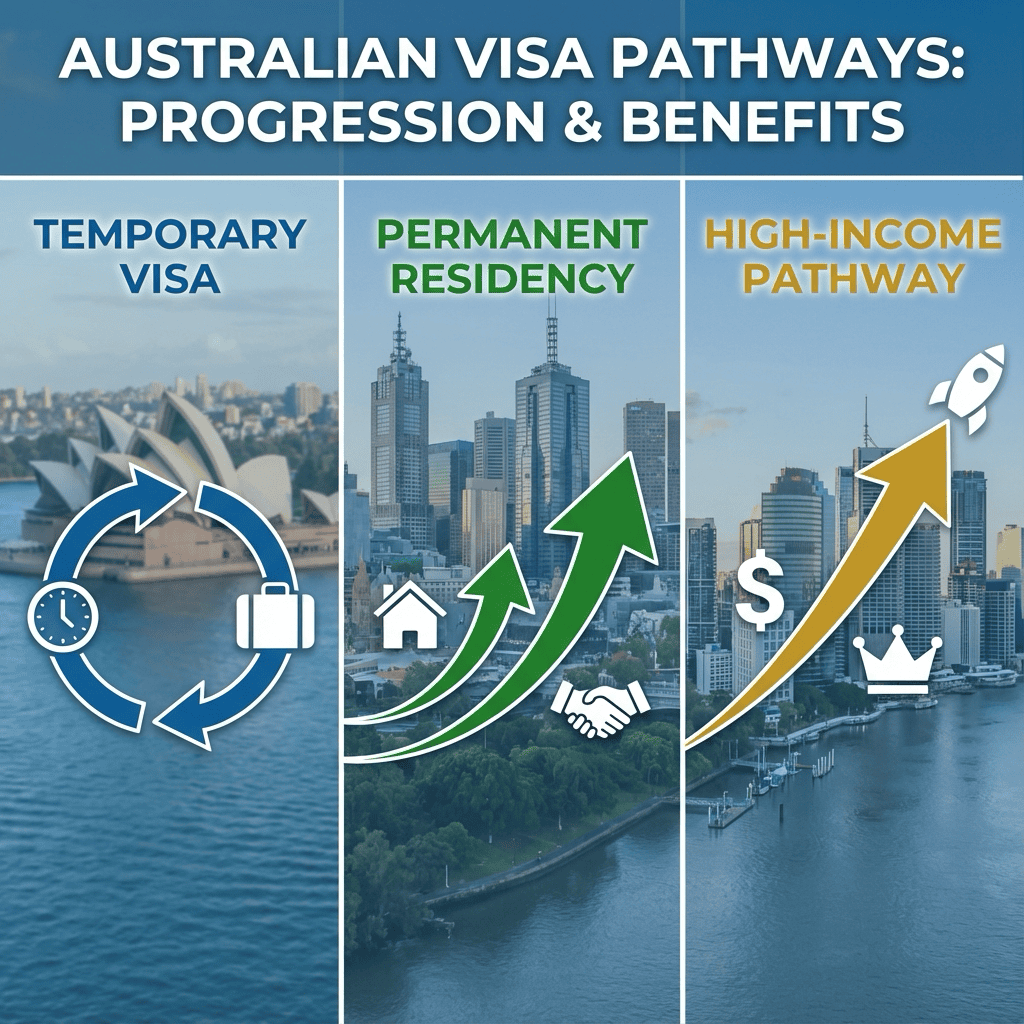
The Australian migration landscape underwent a fundamental structural transformation with the full operationalization of the Skills in Demand (SID) visa framework in January 2026. This marks the definitive end of the era defined by the Temporary Skill Shortage (TSS) visa and the inauguration of a system predicated on "skills-first" mobility, tiered income thresholds, and enhanced labour market fluidity.
For employers and skilled workers alike, this shift represents a move from a compliance-heavy, restriction-based model to a competitive, talent-centric ecosystem. Understanding the comparative advantages, regulatory pitfalls, and strategic applications of each pathway is now critical for success.
This comprehensive comparison guide breaks down the costs, processing times, eligibility requirements, and PR pathways-synthesizing the legislative realities of 2026 including the indexed income thresholds, the implications of the 180-day mobility rule, and the critical operational nuances that can make or break your application.
Quick Comparison Table
| Feature | SID - Core Skills | SID - Specialist Skills | 186 Direct Entry | 186 TRT |
|---|---|---|---|---|
| Visa Type | Temporary (up to 4 years) | Temporary (up to 4 years) | Permanent | Permanent |
| Min Salary | $76,515 (CSIT) | $141,210 (SSIT) | $76,515 (CSIT) | N/A (based on temp visa) |
| Experience | 1 year (reduced from 2) | Demonstrated by salary | 3 years post-qualification | 2 years with sponsor |
| Skills Assessment | Usually required | Not required | Required | Not required |
| Occupation List | CSOL (456 occupations) | No list (negative list) | MLTSSL | No list requirement |
| Processing Time | 21-70 days | 7-14 days | 8-18 months | 5-12 months |
| PR Pathway | Yes (2 years) | Yes (2 years) | Immediate PR | Immediate PR |
Note: Salary thresholds, visa fees, and processing times shown are indicative as of January 2026 and are subject to change. Always verify current requirements with the Department of Home Affairs.
The 2026 Policy Shift: From "Control" to "Competition"
The Skills in Demand framework is built on three pillars that represent a fundamental policy pivot:
1. Certainty of Residency
The explicit policy objective is now to provide all skilled temporary migrants with a realistic prospect of permanent residency through the Subclass 186 ENS. The "permanently temporary" migrant class-created by the old short-term stream with no PR pathway-is gone.
2. Worker Mobility
The introduction of the 180-day period to find a new sponsor (up from 60 days) shifts the balance of power from employer to employee. This is designed to spur wage growth and prevent exploitation-but it also creates significant retention risks for employers.
3. The "Broken Rung" Correction
A critical reform was reducing the mandatory work experience requirement from 2 years to 1 year. This opens the sponsored work visa system to recent international graduates, allowing employers to capture talent earlier in the development cycle.
Option 1: Skills in Demand - Core Skills Stream
The Core Skills stream is the "workhorse" of the new system, catering to the vast majority of technical, professional, and trade roles. It functions similarly to the legacy Medium-Term TSS stream but with broader application and reduced experience requirements.
The Core Skills Occupation List (CSOL)
Eligibility is strictly binary: your occupation must appear on the Core Skills Occupation List.
| Sector | Example Occupations on CSOL |
|---|---|
| Management | Chief Executives (111111), Finance Managers (132211), Engineering Managers (133211) |
| Technology | ICT Project Managers (135112), Data Analysts (224114), Cyber Security Specialists |
| Healthcare | Registered Nurses, Physiotherapists, Medical Practitioners |
| Trades | Electricians, Plumbers, Carpenters, Motor Mechanics |
| Agriculture | Dairy Cattle Farmers (121313), Apiarists (121311) |
List Composition: As of January 2026, the CSOL contains approximately 450+ occupations. Jobs and Skills Australia (JSA) advises the government on additions and removals based on labour market data, so this number may change.
Key Requirements
| Requirement | Details |
|---|---|
| Minimum salary | $76,515 CSIT (2025-26, indexed annually to AWOTE) |
| Occupation | Must be on CSOL |
| Skills assessment | Required for most occupations |
| English | Competent English (IELTS 5.0 each band or equivalent) |
| Experience | 1 year post-qualification (reduced from 2 years) |
| Age | Under 45 at application |
The 1-Year Experience Game-Changer
Strategic Implication: The reduction from 2 years to 1 year aligns the sponsored work visa system with post-study work rights. International graduates can now transition seamlessly from their 485 visa into the Core Skills stream, allowing employers to recruit promising graduates directly rather than importing only senior, expensive talent.
Processing Times
| Metric | Timeframe |
|---|---|
| 50% processed in | 21 days |
| 90% processed in | 70 days |
| Key variables | CSOL verification, LMT validity, skills assessment |
Option 2: Skills in Demand - Specialist Skills Stream
The Specialist Skills stream represents the most radical departure from traditional Australian migration policy. It effectively introduces a "negative list" system for high-income earners, prioritising speed and flexibility over granular occupational scrutiny.
The "Negative List" Mechanism
Unlike almost every other skilled visa in Australian history, the Specialist Skills stream does not require your occupation to be listed on any legislative instrument. Instead, eligibility is determined by what you are NOT.
| Eligible (ANZSCO Major Groups) | Excluded |
|---|---|
| ✅ 1: Managers (CEOs, CFOs, Specialist Managers) | ❌ 3: Trades Workers |
| ✅ 2: Professionals (Engineers, IT, Doctors, Architects) | ❌ 7: Machinery Operators/Drivers |
| ✅ 4: Community/Personal Services | ❌ 8: Labourers |
| ✅ 5: Clerical/Administrative | |
| ✅ 6: Sales Workers |
Future-Proofing: This mechanism eliminates the "ANZSCO lag." Emerging roles in Artificial Intelligence, quantum computing, or green energy finance-which may not yet have a dedicated ANZSCO code-are immediately eligible for sponsorship provided they command the requisite market salary. The role "Blockchain Architect" or "Generative AI Prompt Engineer" is eligible without needing to fit a 2013 occupation code.
Key Requirements
| Requirement | Details |
|---|---|
| Minimum salary | $141,210 (SSIT for 2025-26, indexed annually) |
| Occupation | Any skilled occupation (ANZSCO 1-2, 4-6), except trades |
| Skills assessment | Not required |
| English | Competent English (IELTS 5.0 or equivalent) |
| Experience | Demonstrated by high salary |
| Age | Under 45 at application |
The Salary Calibration: The $141,210 threshold was set to align with the 90th percentile of Australian earnings, serving as a proxy for high skill capability. If the market is willing to pay this premium, the applicant is presumed to possess specialist skills.
The 7-Day Processing Advantage
The Department of Home Affairs has committed to a median 7-day processing standard for this stream.
| Metric | Timeframe |
|---|---|
| 50% processed in | 7 days |
| 90% processed in | 14 days |
| Key variables | "Decision-ready" documents, Accredited Sponsor status |
Processing times are indicative and subject to change. Times may vary based on application completeness and Department priorities. Check the DHA website for current global processing times.
Business Impact: For multinational corporations and agile tech firms, this stream allows for "Just-In-Time" talent deployment. Project teams can be assembled in Sydney or Melbourne with a lead time measured in weeks, not months.
"Decision Ready" Applications
To achieve 7-day processing, applications must be complete at lodgement:
| Requirement | Status |
|---|---|
| Health examinations | ✅ Completed with HAP IDs attached |
| Police certificates | ✅ From every country of residence (last 10 years, 12+ months residence) |
| English test results | ✅ Valid IELTS/PTE attached |
| Sponsorship nomination | ✅ Valid nomination TRN linked |
⚠️ Critical Warning: A single missing document moves the application from the "priority" queue to the "RFI" (Request for Information) queue, potentially adding 2-3 months to the timeline.
Option 3: Subclass 186 Direct Entry (Permanent Residency)
The 186 Direct Entry stream provides immediate permanent residency for skilled workers who do not meet the TRT criteria but have substantial overseas experience.
Key Requirements
| Requirement | Details |
|---|---|
| Minimum salary | $76,515 CSIT (market rate must also be met) |
| Occupation | Must be on MLTSSL |
| Skills assessment | Mandatory positive assessment (within 3 years) |
| English | Competent English (IELTS 6.0 or equivalent) |
| Experience | 3 years full-time post-qualification |
| Age | Under 45 at application |
Processing Times
| Metric | Timeframe |
|---|---|
| 50% processed in | 8 months |
| 90% processed in | 12-18 months |
| Key variables | Skills assessment verification, genuineness checks |
Strategic Use
The Direct Entry stream is best utilized for senior hires arriving from overseas who:
- Demand PR as a condition of employment (e.g., C-suite executives)
- Can pass the rigorous skills assessment
- Have the requisite 3 years of experience
- Cannot wait 2 years for TRT eligibility
Option 4: Subclass 186 TRT (Temporary Residence Transition)
The 186 TRT stream is the natural progression for SID visa holders. It rewards loyalty and demonstrated integration into the Australian workforce.
The Two-Year Qualifying Period
The defining feature of the 2026 TRT stream is the reduced qualifying period: applicants must work in their nominated occupation for 2 years (down from 3 years in earlier iterations).
| Requirement | Details |
|---|---|
| Qualifying period | 2 years working for an approved sponsor |
| Same employer | Nominated by current employer, but time with previous sponsors may count |
| Skills assessment | Not required (already completed for temp visa) |
| English | Already met for temporary visa |
| Age | Under 45 at application |
The "Approved Sponsor" Continuity Trap ⚠️
Critical November 2025 Reform: For work experience to count toward the 2-year requirement, the employer must have been an Approved Work Sponsor for the entire duration of the claimed employment.
| The Risk | The Consequence |
|---|---|
| Employer's SBS expires-even for a few days | Work during the lapse is disqualified from the 2-year count |
| Gap between SBS expiry and renewal | Employee's PR eligibility clock effectively "pauses" or resets |
| Late SBS renewal | Massive reputational damage and potential liability for employer |
Compliance Imperative: Employers must maintain unbroken sponsorship approval. HR systems must track the 5-year SBS expiry date and ensure renewal is processed before expiration.
Processing Times
| Metric | Timeframe |
|---|---|
| 50% processed in | 5 months |
| 90% processed in | 10-12 months |
| Key variables | Sponsor compliance history |
Comprehensive Cost Comparison
Visa Application Charges (VAC) - As of July 2025
Visa fees are indexed annually on 1 July. The figures below were current from 1 July 2025. Please check the Department of Home Affairs fees page for the latest amounts.
| Applicant Type | SID (482) | 186 (ENS) |
|---|---|---|
| Primary applicant | $3,210 | $4,910 |
| Adult dependent | $3,210 | $2,455 |
| Child under 18 | $805 | $1,230 |
| Family of 4 (2 adults, 2 kids) | $8,030 | $9,825 |
Skilling Australians Fund (SAF) Levy
The SAF levy is the most substantial "sunk cost"-a tax on the employer that cannot be recovered from the employee.
| Business Size | SID (482) Levy | 186 Levy |
|---|---|---|
| Small (<$10M turnover) | $1,200/year (max $4,800) | $3,000 (one-off) |
| Large (≥$10M turnover) | $1,800/year (max $7,200) | $5,000 (one-off) |
SAF levy amounts are set by the Migration (Skilling Australians Fund) Charges Act 2018 and may be subject to legislative amendment.
The Mobility Risk: If an employer pays $7,200 for a 4-year SID visa, and the employee leaves after 6 months using the 180-day mobility rule, the employer effectively loses the balance of that levy. Refund provisions exist but are limited and bureaucratic.
Total Cost Summary
| Pathway | Employer Costs | Applicant Costs (Single) | Total Investment |
|---|---|---|---|
| SID Core (4 years, large biz) | $7,530 (nom + SAF) | $4,015 (visa + assessment) | ~$11,545 |
| SID Specialist (4 years, large biz) | $7,530 (nom + SAF) | $3,210 (visa only) | ~$10,740 |
| 186 Direct Entry (large biz) | $5,540 (nom + SAF) | $5,410 (visa + assessment) | ~$10,950 |
| 186 TRT (large biz) | $5,540 (nom + SAF) | $4,910 (visa only) | ~$10,450 |
The 180-Day Mobility Rule: Strategic Implications
The extension from 60 days to 180 days represents a fundamental shift in employer-employee dynamics.
What Changed
| Aspect | Legacy TSS | Skills in Demand |
|---|---|---|
| Time to find new sponsor | 60 days | 180 days |
| Work rights during grace | Limited | Full work rights (any employer, any occupation) |
| Maximum grace period | N/A | 365 days over visa lifetime |
For Workers
- Career Safety: Senior roles face higher volatility. 6 months provides meaningful job search time.
- Negotiation Leverage: Reduced friction in changing sponsors allows testing the market for better opportunities.
- Free Agent Status: Executive search firms now aggressively target SID visa holders already in Australia.
For Employers
| Risk | Mitigation Strategy |
|---|---|
| Employee leaves after 6 months | Contractual clawback clauses for relocation/visa fees (excluding SAF) |
| Lose SAF levy investment | Sponsor 1-2 year terms initially; extend only after retention is proven |
| Poaching by competitors | Retention bonuses at 18-month mark; initiate 186 TRT as soon as eligible |
Strategic Priority: The 180-day window makes retention strategies as critical as recruitment compliance. Initiate 186 TRT nominations as soon as the 2-year eligibility window opens-this is the only effective hedge against mobility risk.
The 186 vs SID Decision Matrix
For Employers
| Your Situation | Best Option | Strategic Rationale |
|---|---|---|
| Need to fill role urgently | SID Specialist | 7-day processing; "Just-In-Time" deployment |
| Standard skilled position | SID Core | 1-year experience opens graduate pipeline |
| Want to retain proven employee | 186 TRT | PR locks them in; rewards loyalty |
| Hiring senior offshore talent | 186 Direct Entry | Immediate PR attracts top candidates |
| Lower budget | 186 (either) | Lower total SAF ($3-5k vs $4.8-7.2k) |
| High-value hire ($141k+) | SID Specialist | No skills assessment; no occupation list risk |
For Skilled Workers
| Your Situation | Best Option | Strategic Rationale |
|---|---|---|
| Salary $141,210+ | SID Specialist | 7-day processing; no assessment; future-proofed |
| On temporary visa 2+ years | 186 TRT | Clear pathway; already qualified |
| Never sponsored before | 186 Direct Entry | Immediate PR; no waiting |
| Recent graduate (1 year exp) | SID Core | Opens pathway previously blocked |
| Occupation not on MLTSSL | SID Core | CSOL has 456 occupations (broader) |
| Testing the market | SID Core | 180-day grace period provides flexibility |
Need personalised advice? Every migration case is unique. Submit a free visa assessment → and our registered migration agents will review your situation.
Sectoral Strategic Analysis
Healthcare and Social Assistance
Scenario: A hospital group needs 50 Registered Nurses and 10 Specialist Surgeons.
| Role | Best Stream | Why |
|---|---|---|
| Specialist Surgeons | SID Specialist | Salary >$141k; no occupation list friction; visa in 7 days |
| Registered Nurses | SID Core | RNs on CSOL; 1-year experience allows UK/Philippines grad nurses |
| Aged Care Workers | Essential Skills / Labour Agreement | Salaries below $76.5k; union consultation mandatory |
Technology and Cyber Security
Scenario: A fintech startup needs a Lead Developer and a Junior Coder.
| Role | Best Stream | Considerations |
|---|---|---|
| Lead Developer ($160k) | SID Specialist | No need to fit specific ANZSCO; "Blockchain Architect" eligible |
| Junior Coder ($85k) | SID Core | Must fit "Developer Programmer" ANZSCO; 21-day wait |
Retention Warning: Pay retention bonuses at 18-month mark to prevent the Lead Developer from leveraging the 180-day mobility rule to jump to a bank.
Construction and Infrastructure
Scenario: A Tier 1 builder needs Civil Engineers and Electricians.
| Role | Best Stream | Critical Bottleneck |
|---|---|---|
| Civil Engineer | SID Core | Straightforward; professional stream |
| Electrician | SID Core | Mandatory TRA skills assessment adds 2-3 months before visa lodgement |
Trade Reality: Skills assessment from Trades Recognition Australia (TRA) creates a bottleneck that makes "rapid" deployment of trades impossible compared to professionals.
Key Differences: Legacy 482 TSS vs New Skills in Demand
| Feature | Legacy 482 TSS | Skills in Demand | Strategic Implication |
|---|---|---|---|
| Experience Requirement | 2 years | 1 year | Opens access to graduates; reduces reliance on senior hires |
| Mobility Window | 60 days | 180 days | Creates "free agent" market; increases retention risk |
| Path to PR | Restricted (Medium-Term only) | Universal (all streams) | Ends "permanently temporary" status |
| Income Thresholds | Single TSMIT (~$70k) | Tiered: $141k / $76.5k | Bifurcates market; expedites high earners |
| Occupation Lists | Rigid (STSOL/MLTSSL) | Negative list (Tier 1) / CSOL (Tier 2) | Removes ANZSCO friction for high earners |
| Processing Time | Standard (months) | 7 days (Tier 1) / Standard (Tier 2) | Enables agile workforce planning |
Common Compliance Pitfalls
For Employers
| Mistake | Consequence | Prevention |
|---|---|---|
| SBS expiry gap | Employee's TRT time resets | Track 5-year SBS expiry; renew early |
| Paying below market rate | Nomination refused | Obtain salary surveys / comparables |
| Missing Labour Market Testing | Nomination refused | 4 weeks on 2+ platforms; include salary |
| Recovering SAF levy from worker | Sponsorship cancellation; serious breach | Never pass costs to employee |
| Not notifying cessation (28 days) | Sanctions; possible sponsor bar | Immediate notification system |
| Late 186 TRT nomination | Lose employee to competitors | Initiate at 2-year mark |
For Workers
| Mistake | Consequence | Prevention |
|---|---|---|
| Assuming bonus counts toward $141k | Visa refused | Only guaranteed salary counts |
| Changing occupation without new nomination | Visa breach | Nomination must match actual duties |
| Working for different employer | Immediate visa breach | Sponsored work only |
| Waiting too long after job loss | Becoming unlawful | Act within 180-day window |
| Not checking employer's SBS status | TRT time may not count | Request confirmation of SBS validity |
Strategic Recommendations
For Employers
-
Audit Sponsorship Status Now Immediately verify the expiry date of your Standard Business Sponsorship. Ensure there is no gap between expiry and renewal.
-
Leverage the Specialist Stream For any role paying over $141,210, abandon the Core stream. The Specialist stream removes occupation list risk and skills assessment delays.
-
Contractual Clawbacks Update employment contracts to include enforceable repayment clauses for relocation and visa application fees (excluding SAF) if the employee leaves within 12-24 months.
-
Early PR Transition Do not wait for the 4-year visa to expire. Initiate 186 TRT nominations as soon as the 2-year window opens. This is the only effective hedge against retention risks.
-
Minimize SAF Exposure Consider sponsoring 1-2 year terms initially rather than 4 years to reduce levy exposure until retention is proven.
For Workers
-
Negotiate Guaranteed Salary If targeting the Specialist stream, ensure your base salary (excluding bonus/commission) meets the $141,210 threshold.
-
Track Your Employer's SBS Status Your 2-year count toward 186 TRT only counts if your employer was an Approved Sponsor continuously.
-
Leverage the 180-Day Window If considering a move, you have 6 months with full work rights. Use this negotiating leverage wisely.
-
Push for 186 TRT at 2 Years Request your employer nominate you for 186 TRT as soon as you hit the 2-year mark-before you become a target for competitors.
How First Migration Can Help
The 2026 Australian migration system is a high-stakes environment. The Skills in Demand visa offers unprecedented speed and access to talent, but it transfers significant risk to both employers and workers. Success requires treating immigration policy as a core component of competitive advantage.
At First Migration Service Centre, our registered migration agents specialise in employer-sponsored visas and can help you navigate this complex landscape:
For Employers:
- SBS compliance audits and renewal management
- Strategic pathway selection (Specialist vs Core vs 186)
- Compliant nominations with salary benchmarking
- Retention-focused 186 TRT timing strategies
- SAF levy optimization
For Skilled Workers:
- Occupation eligibility assessment across CSOL/MLTSSL
- Specialist Skills threshold analysis
- PR pathway timeline planning
- Employer compliance verification
- 186 TRT nomination coordination
Ready to take the next step? We invite you to submit a free visa assessment so we can understand your situation and provide tailored advice.
MARA Registered Agent
Registration No. 1569835
Certified by the Migration Agents Registration Authority. Your trusted partner for Australian visa applications.

Engineers in Australia: State Nomination Guide by Engineering Discipline (2026)

ICT Professionals in Australia: Which Visa & Which State in 2026?

Allied Health Workers in Australia: Which State Needs You Most in 2026?

Nurses in Australia: Which State Has the Best Visa Pathway in 2026?

Northern Territory Skilled Migration Closed for 2025-26: What Are Your Alternative 190 and 491 Pathways?
Office Hours
Mon-Fri: 9AM-5PM Sat: 10AM-2PM